Bitcoin was created as an alternative to the financial system, fifteen years later, it is becoming part of that same system. This is the most important change in the Bitcoin story. When Bitco
Bitcoin was created as an alternative to the financial system, fifteen years later, it is becoming part of that same system. This is the most important change in the Bitcoin story.
When Bitcoin first appeared, the argument was mostly about money. Governments could create more of their currencies, while Bitcoin could never have more than 21 million coins. If people continued to produce more goods and services while money kept expanding, the purchasing power of those currencies could fall over time. Bitcoin offered something different: an asset with a supply that could not simply be increased when demand rose.
This idea attracted people who lost faith in central banks, people worried about inflation, and eventually investors who simply saw Bitcoin as a scarce asset. But Bitcoin has now moved far beyond that original group.
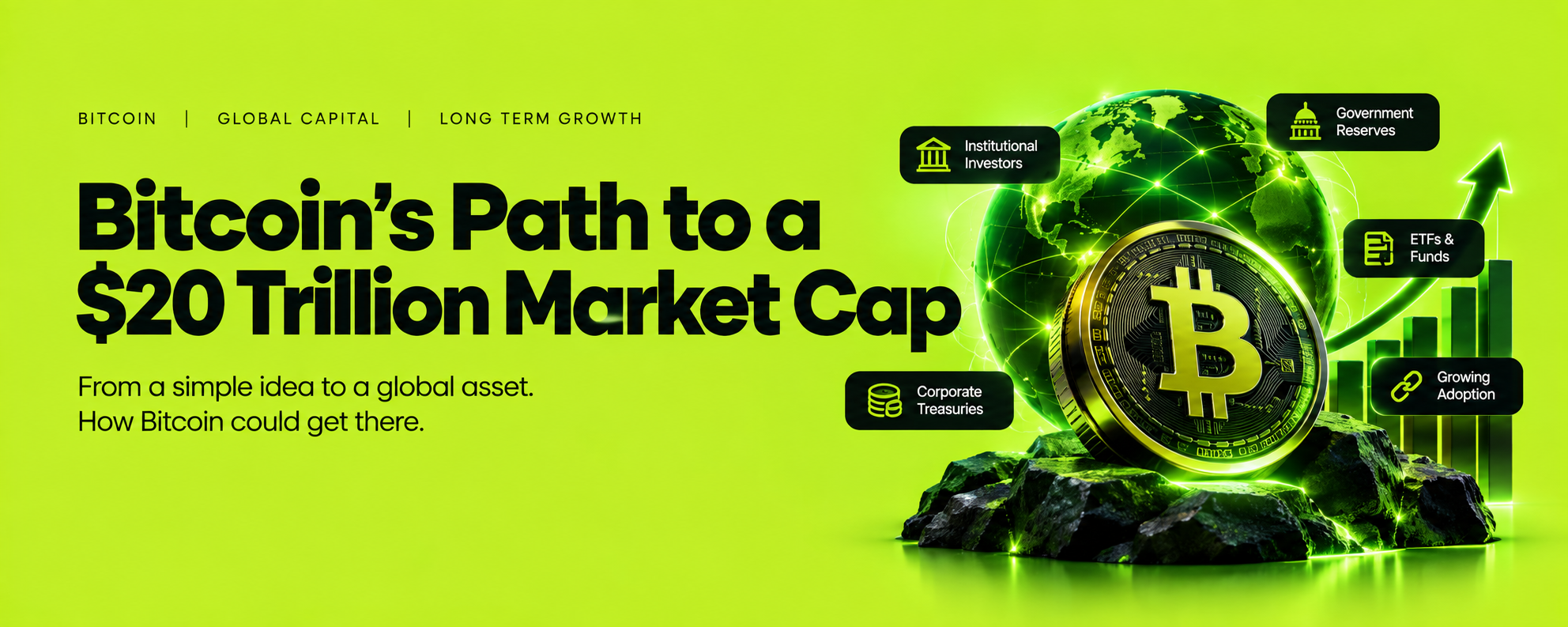
The United States holds Bitcoin in a Strategic Bitcoin Reserve, public companies such as Tesla, Marathon are putting Bitcoin on their balance sheets, ETFs have made it possible for ordinary investors and large institutions to gain exposure through traditional financial markets. Stablecoins are bringing the dollar onto blockchains, while their reserves are increasingly tied to U.S Treasury securities. Bitcoin is no longer sitting outside the financial system looking in, it is being absorbed into it.
There is an interesting connection between the growth of stablecoins and the future of Bitcoin. Stablecoins such as USDC and USDT allow people to hold and transfer dollar denominated value through blockchain networks. A person in South Korea, Argentina or Turkey does not need to live in the United States to use a digital dollar. The more those stablecoins grow, the more important their reserves become.
Under the GENIUS Act, which became U.S. law in 2025, qualifying payment stablecoins must be backed by permitted reserve assets. Short term U.S government securities are among those assets. The Federal Reserve is now working on further rules for stablecoin issuers, including reserve and capital requirements.
There is a simple connection here, more stablecoins can mean more demand for the assets that back them, including U.S. Treasuries. More people around the world can therefore end up using a financial system built around the dollar without ever holding a traditional U.S. bank account.
Some people have taken this idea much further, in 2025, Anton Kobyakov, an adviser to Vladimir Putin, argued that the United States could eventually move part of its enormous debt burden into the crypto economy and allow its value to be reduced through monetary debasement. It is an interesting theory, but there is no evidence that this is an actual U.S. government plan. The more obvious development is happening in front of us, the United States is bringing digital assets into its financial system while keeping the dollar at the centre of it, bitcoin is entering that system from a different direction, bitcoin Becomes a Reserve Asset
In March 2025, the White House created the U.S. Strategic Bitcoin Reserve. The reserve was not created by the government suddenly spending hundreds of billions of dollars buying Bitcoin on the open market. It was initially funded mainly with Bitcoin already held by the government, much of it obtained through criminal and civil asset forfeitures. The order directed that the Bitcoin in the reserve be held rather than sold. Since then, the idea has moved further into U.S. politics. In September 2026, the House Financial Services Committee advanced legislation that would establish a permanent Bitcoin reserve, although the bill has not yet become law. That is a long way from the world in which Bitcoin was treated simply as an internet experiment, the government is now holding it as a strategic asset. And while there is still plenty of disagreement over how large that reserve should become, the precedent has already been set. At the same time, companies have been doing something similar, the most obvious example is Strategy, formerly MicroStrategy.
Strategy has built an entire corporate financing strategy around Bitcoin. As of September 7, 2026, the company held 845,050 BTC, acquired for about $63.73 billion. Strategy has shown that a public company can raise money through the capital markets and use that money to acquire Bitcoin. Other companies have started experimenting with similar treasury strategies. The significance is not that every company will become Strategy. It is that Bitcoin now has another route through which capital can reach it. An investor does not always have to buy Bitcoin directly. They can buy an ETF, own shares in a company holding Bitcoin, invest through a fund, etc. The number of doors through which money can enter Bitcoin has grown.
So How Does Bitcoin Get to $20 Trillion? Bitcoin is currently worth roughly $1.7 trillion. For it to reach a $20 trillion market capitalization, its value would have to increase by roughly twelve times, at a maximum supply of 21 million coins, $20 trillion would put the theoretical value of one Bitcoin at about $950,000. Gold is already worth many trillions of dollars. Global stocks and bonds are worth hundreds of trillions. Governments, companies and individuals hold enormous amounts of wealth in assets whose main purpose is to preserve and grow capital, bitcoin does not need to replace all of them, it would only need to take a meaningful share. That is the argument behind the much higher Bitcoin forecasts.
Some analysts have projected Bitcoin reaching hundreds of thousands of dollars by 2030. Others, including Cathie Wood and Brian Armstrong, have publicly discussed the possibility of Bitcoin reaching $1 million or more. These are forecasts, not established outcomes. The interesting part is not whether one particular forecast is correct, it is the size of the market that would have to exist for those prices to make sense.
A $1 million Bitcoin would put the network at roughly $21 trillion if every one of the 21 million coins existed, In other words, the famous $1 million Bitcoin prediction is really a prediction about Bitcoin becoming one of the largest stores of wealth in the world, that is a much bigger claim than simply saying the price will go up.
There are now several forces pushing in the same direction, governments are beginning to hold Bitcoin, companies are adding it to their balance sheets, ETFs have opened the market to traditional investors, stablecoins are bringing more dollar liquidity onto blockchains, financial institutions are building products around digital assets, none of these guarantees a $20 trillion Bitcoin, the opposite could happen. Institutional demand could slow, corporate Bitcoin strategies could fail, regulation could become less friendly, investors could decide that Bitcoin is too volatile for large long term allocations, stablecoins could become the dominant form of crypto adoption while Bitcoin remains primarily a store of wealth, there is also nothing stopping Bitcoin from spending years moving sideways or falling sharply.
But the story has changed, Bitcoin began as a challenge to the financial system, it is now being given a place inside it, that may eventually prove more important than the original idea of Bitcoin replacing the dollar, perhaps Bitcoin does not need to replace the dollar at all, perhaps the dollar continues to dominate global finance, stablecoins carry that dollar across blockchains, treasuries continue to sit behind much of the digital dollar system, and Bitcoin becomes the scarce asset people hold alongside them.
If that happens, the path to a $20 trillion Bitcoin becomes easier to understand, it would not be a story about everyone suddenly buying Bitcoin, it would be a story about Bitcoin gradually becoming one of the places where the world's wealth is stored. And if that happens on a large enough scale, $950,000 per Bitcoin would no longer be the strange part of the story, the strange part would be how long it took us to see where the money was going.