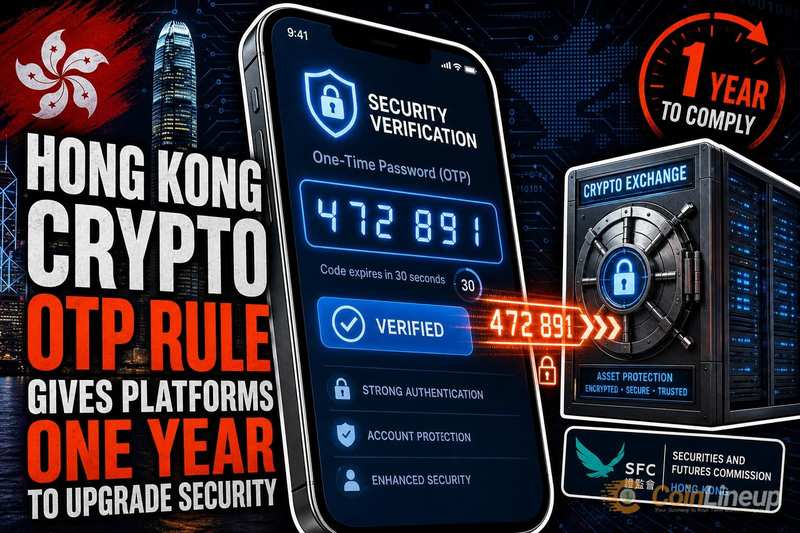
Hong Kong is requiring licensed crypto platforms to phase out one-time passwords as a primary authentication method within one year or accept liability for user losses tied to account comprom
Hong Kong is requiring licensed crypto platforms to phase out one-time passwords as a primary authentication method within one year or accept liability for user losses tied to account compromises. The policy marks a direct link between platform security design and financial responsibility for customer funds.
The Hong Kong Securities and Futures Commission issued guidance directing virtual asset trading platforms to move beyond SMS-based and email-based one-time passwords as standalone authentication. Platforms operating under Hong Kong's licensing regime have one year to comply with the upgraded security requirements. For related coverage, see Reuters: UAE Crypto Companies Show Resilience Amid US-Israel and Iran Conflicts.
The core consequence is straightforward: platforms that fail to replace OTPs with stronger authentication methods face responsibility for covering user losses resulting from unauthorized account access. This shifts the burden from users, who may fall victim to SIM-swap attacks or phishing, onto the platforms themselves. For related coverage, see Top Crypto News for April 10: Bitcoin Network Activity Slows.
The SFC's accompanying circular to licensed platform operators details the expected security standards. The move follows a pattern of Hong Kong regulators tightening operational requirements for crypto exchanges as the city builds out its digital asset licensing framework. For related coverage, see 6 Top Crypto Presales to Watch in 2025: BlockDAG, JetBolt, Solaxy, Bitcoin Hyper, Snorter Bot, TOKEN6900.
This is not the first time Hong Kong's SFC has targeted SMS-based authentication at crypto platforms, but the explicit liability mechanism for non-compliance raises the stakes considerably.
Why One-Time Passwords Are the Weak Link
OTPs delivered via SMS or email have long been considered a baseline security measure, but they are vulnerable to interception. SIM-swap fraud, where an attacker convinces a carrier to transfer a victim's phone number, renders SMS-based OTPs useless. Email-based codes carry similar risks if an inbox is compromised.
For custodial crypto platforms holding user funds, these vulnerabilities create direct financial exposure. Unlike a compromised social media account, a breached exchange account can result in immediate, irreversible loss of assets.
Stronger alternatives include hardware security keys, passkeys tied to device biometrics, and app-based authenticators that do not rely on interceptable communication channels. The policy signals that Hong Kong regulators now view authentication strength as a consumer-protection requirement, not merely a technical best practice.
Other jurisdictions in the region are also tightening crypto oversight. Taiwan recently passed its Virtual Asset Service Act, reflecting a broader push across Asia-Pacific markets to formalize exchange regulation.
A one-year window suggests the SFC expects a phased migration rather than an abrupt cutoff. Platforms will need to integrate new authentication infrastructure, update client-facing apps, and guide users through enrollment in stronger methods.
User onboarding friction is the likely pain point. Hardware keys require physical devices, and passkey adoption depends on device and browser support. Platforms that already support multiple authentication factors will have an easier path than those relying solely on OTPs today.
The liability trigger creates a competitive dynamic. Platforms that upgrade early reduce their risk exposure and can market stronger security as a differentiator. Those that delay face both regulatory consequences and potential financial liability if a breach occurs before the deadline.
For users on Hong Kong-licensed platforms, the practical change will likely appear as prompts to register new authentication methods over the coming months, with OTP-only login eventually disabled as the deadline approaches.
Disclaimer: This article is for informational purposes only and does not constitute financial or investment advice. Cryptocurrency and digital asset markets carry significant risk. Always do your own research before making decisions.
Read original article on coinlineup.com