Legislative Council Passes the CARF Law on November 4 Hong Kong regulation reached a milestone on 4 November 2026. The Legislative Council passed the Inland Revenue (Amendment) (Crypto-Asset
Legislative Council Passes the CARF Law on November 4
Hong Kong regulation reached a milestone on 4 November 2026. The Legislative Council passed the Inland Revenue (Amendment) (Crypto-Asset Reporting Framework and Amended Common Reporting Standard) Bill 2026.
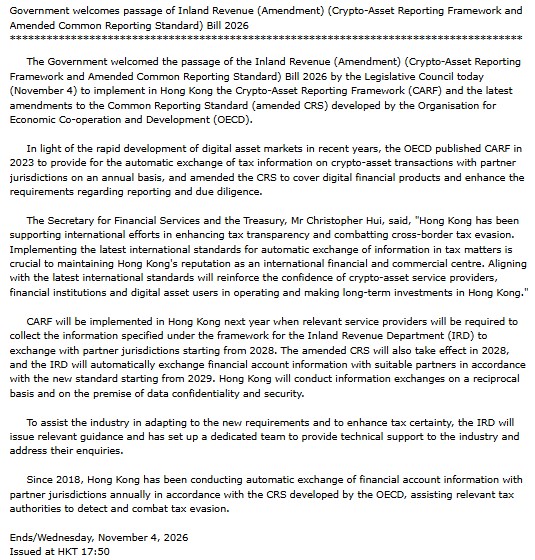
The government welcomed the passage of the bill in an official press release. It brings the OECD framework, known as CARF, into local law, together with the latest Common Reporting Standard (CRS) changes. This update shapes the Hong Kong crypto tax debate, yet it adds no new levy.
Wu Blockchain also covered the news and flagged 2027 as the start of data collection.
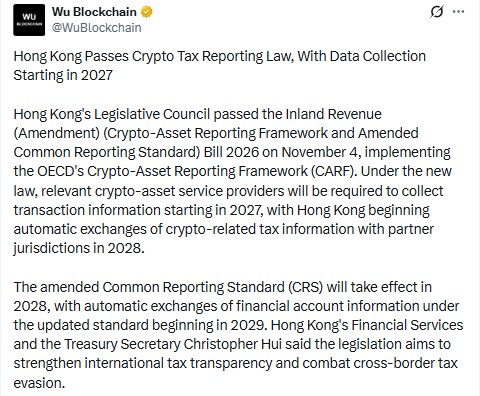
Source:Wu Blockchain Official X Post
Not a New Levy: What the Bill Really Changes for Traders
The bill sets up an information-sharing regime. The Inland Revenue Department (IRD) will receive standard information on digital asset activity, so existing rules become easier to apply. The IRD hosts the bill text and amended CRS details on its Amendment Bill page.
Crypto exchange users face reporting on three activity types:
Trades between digital assets and fiat currency
Trades between two digital assets
Certain transfers, including transfers to external wallets
Relevant assets include fungible tokens and NFTs. Central bank digital currencies, specified electronic money products, and assets with no payment or investment use are excluded.
Hong Kong Crypto Tax Duties for Service Providers
Reporting crypto-asset service providers (RCASPs) are businesses that carry out digital asset trades for customers. Exchanges, brokers, dealers, and ATM operators all fit. A firm comes under the rules once it has a local link, such as a residence, management, or a regular place of business. The IRD CARF page sets out the details.
Providers can build the due diligence step on existing KYC checks. They must:
Collect residence self-certifications from users
Register with the IRD
File annual totals for each reportable user
Keep records, generally for six years
Reports cover names, addresses, residences, tax identification numbers, and transaction totals by asset type.
Timeline: Rules Start in 2027, Data Sharing in 2028
The city follows the OECD framework timetable. Collection starts in 2027, and cross-border sharing begins a year later.
Milestone
Date
Bill passed by the Legislative Council
4 November 2026
CARF starts; providers collect information.
1 January 2027
First CARF sharing with partner jurisdictions
2028
Amended CRS takes effect.
2028
First sharing under amended CRS
2029
Sharing is reciprocal and subject to confidentiality and security standards. The city has shared CRS account details every year since 2018.
What the Law Means for Service Providers and Users
For Hong Kong crypto tax compliance, firms have about two months between passage and the 2027 start. Systems for self-certification and annual filing must be ready by then.
The IRD will issue guidance, develop a CARF Portal, and run a dedicated support team.
Reciprocity also means local authorities can receive details on residents who use digital asset services abroad. The bill amends the Inland Revenue Ordinance (Cap. 112).
Financial Services and the Treasury Secretary Christopher Hui said the law supports Hong Kong’s reputation as an international financial and commercial center. He added that it builds confidence among providers, financial institutions, and digital asset users.
Regional rules are tightening elsewhere too, as the Taiwan Coinbase and Kalshi block showed.
In short, the Hong Kong crypto tax reporting change is about disclosure, not a new levy. This latest crypto news update sets 2027 as the date firms must be ready.
Disclaimer: This article is for educational and informational purposes only and should not be considered financial or investment advice. Always conduct your own research before making investment decisions.