Hong Kong is accelerating its push to become a regulated digital asset hub, expanding across tokenization, crypto investment products, and blockchain infrastructure in a coordinated effort to
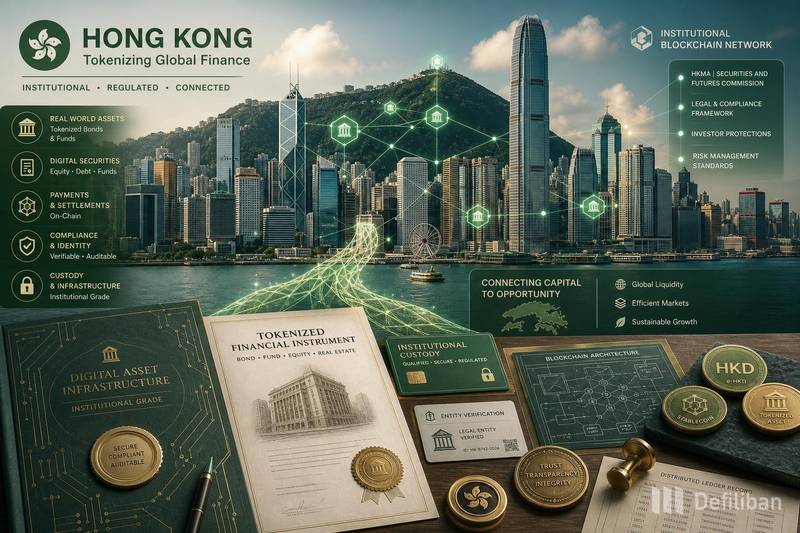
Hong Kong is accelerating its push to become a regulated digital asset hub, expanding across tokenization, crypto investment products, and blockchain infrastructure in a coordinated effort to attract institutional capital and Web3 firms to the city.
The expansion spans multiple fronts. Hong Kong authorities have signaled support for tokenizing real-world assets, broadened the range of investable crypto products available to retail and institutional participants, and invested in the blockchain rails needed to support regulated market activity.
The scale of growth is visible in custody figures. Digital assets under custody in Hong Kong jumped 180% to reach $14 billion, underscoring rising institutional confidence in the city's regulatory framework.
Tokenization as the Foundation of Hong Kong's Digital Asset Strategy
Tokenization sits at the center of Hong Kong's approach. By converting traditional financial instruments and real-world assets into blockchain-based tokens, the city is building a bridge between conventional finance and on-chain markets.
For a regulated financial hub, tokenized assets offer clear advantages: programmable compliance, faster settlement, and broader access to previously illiquid asset classes. These features align with what institutional players need before committing capital to blockchain-based markets.
The Hong Kong government has outlined its support for this direction through official policy statements on digital asset development, framing tokenization not as an experiment but as a core component of the city's financial infrastructure roadmap.
This structural approach distinguishes Hong Kong from jurisdictions that have focused narrowly on trading. By anchoring its strategy in tokenization, the city is positioning itself to capture value across issuance, distribution, and secondary markets rather than just exchange volume.
Crypto Products and Infrastructure Reinforcing Each Other
Product availability and backend infrastructure are expanding in tandem. Hong Kong has licensed crypto exchanges, approved spot crypto ETFs, and created regulatory pathways for stablecoin issuers, giving both retail and institutional investors more ways to participate.
These user-facing products depend on robust infrastructure: custody solutions, compliance tooling, settlement systems, and interoperable blockchain networks. The $14 billion custody figure reflects how quickly that infrastructure layer is scaling to meet demand.
The Hong Kong Monetary Authority has played a direct role in shaping this environment, issuing guidance on digital asset custody, stablecoin frameworks, and tokenized deposit initiatives. The HKMA's involvement signals that Hong Kong views digital assets as a permanent feature of its financial system, not a passing trend.
The regulatory clarity Hong Kong offers stands in contrast to the uncertainty facing digital asset firms in other markets. As jurisdictions like the United States continue to debate stablecoin legislation, with figures like Jamie Dimon warning that stablecoins could destabilize under proposed frameworks, Hong Kong's approach of building clear rules first has attracted firms looking for operational predictability.
Competitive Positioning in the Global Digital Asset Race
Hong Kong's coordinated push across tokenization, products, and infrastructure is designed to create a self-reinforcing ecosystem. More infrastructure attracts more product issuers, which attracts more capital, which justifies further infrastructure investment.
The city's strategy also reflects a broader trend of institutional players increasing their exposure to digital assets. Major corporate buyers continue to accumulate Bitcoin, and institutional custody demand is growing globally, giving Hong Kong's regulated framework a natural tailwind.
Whether Hong Kong can sustain this momentum depends on execution. The regulatory scaffolding is in place, the custody numbers are climbing, and the product pipeline is expanding. The next phase will test whether the city's ecosystem can compete for the largest institutional allocations in digital assets.
Disclaimer: This article is for informational purposes only and does not constitute financial or investment advice. Cryptocurrency and digital asset markets carry significant risk. Always do your own research before making decisions.
Read original article on defiliban.io