Hong Kong authorities are reported to be planning two linked digital-finance initiatives: the use of stablecoin settlement for tokenized investment funds, and a bill-tokenization test anchore
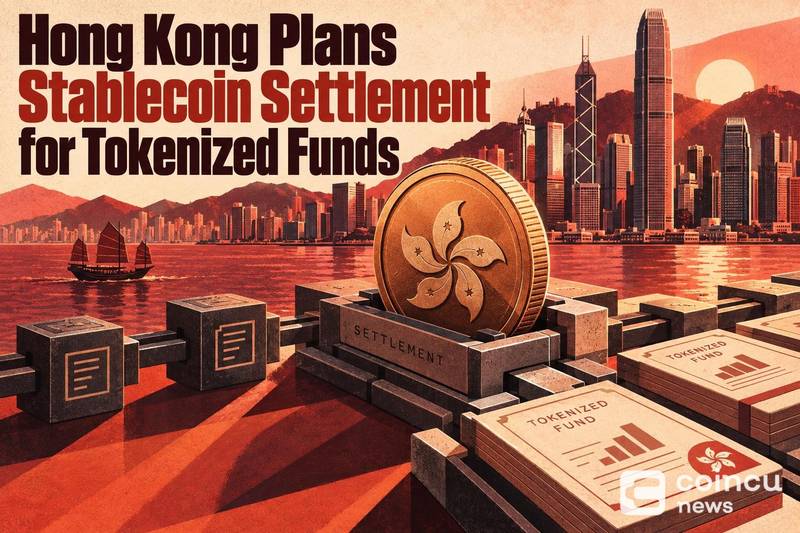
Hong Kong authorities are reported to be planning two linked digital-finance initiatives: the use of stablecoin settlement for tokenized investment funds, and a bill-tokenization test anchored to a HK$1.3 trillion figure. Both measures are at the planning or testing stage; no live rollout has been confirmed.
Hong Kong's Plan for Stablecoin Settlement in Tokenized Funds
The reported plan would connect stablecoin-denominated payment rails to the settlement layer of tokenized fund products, meaning that when investors buy or redeem units of a tokenized fund, the cash leg of that trade would be discharged using a regulated stablecoin rather than a conventional bank transfer. The significance is structural: stablecoin settlement can operate around the clock and finalize in seconds, removing the one-to-two-day lag that characterizes traditional fund processing. For related coverage, see Hong Kong Plans Crypto-Asset Legislation for 2028 Tax Reporting.
What stablecoin settlement means here
In conventional fund settlement, a custodian bank credits or debits fiat after a clearing window closes. Stablecoin settlement replaces that fiat wire with an on-chain token transfer that executes atomically alongside the delivery of the fund token, eliminating the gap between payment and asset delivery that creates counterparty exposure. Hong Kong has been advancing a stablecoin regulatory framework that would license issuers operating in the city, a prerequisite for deploying regulated stablecoins in institutional settlement. For related coverage, see Hong Kong Licenses and Stablecoins: Who Is Reshaping Finance?.
What tokenized funds are
A tokenized fund represents ownership units of a pooled investment vehicle as blockchain tokens. Investors hold tokens rather than paper certificates or ledger entries at a transfer agent, and those tokens can be transferred, collateralized, or redeemed on-chain. The settlement plan reported for Hong Kong would make stablecoin the native currency of that on-chain lifecycle, creating a fully digital round-trip from subscription through redemption. For related coverage, see Thai SEC Plans Stablecoin Rules, Roughly $150K Daily Cap.
The HK$1.3 Trillion Bill-Tokenization Test
Separately, Hong Kong is reported to be pursuing a bill-tokenization test associated with a HK$1.3 trillion figure. The figure has not been attributed to a specific issuance size, transaction volume, or outstanding stock in the available reporting, so it should be read as the scale marker cited in connection with the test rather than a confirmed transaction amount.
What bill tokenization involves
Bill tokenization converts short-term debt instruments, such as treasury bills or exchange fund bills, into on-chain tokens. Each token represents a claim on the underlying instrument and can be transferred, pledged as collateral, or settled without routing through a central securities depository. A tokenized bill market would allow institutional participants to move liquidity intraday using programmable collateral rather than waiting for end-of-day settlement cycles.
Why a test differs from full-scale implementation
A tokenization test typically involves a defined cohort of institutions operating under a sandbox or pilot framework, with transaction volumes and participants capped to contain operational risk. Findings from the test inform regulatory design, custody standards, and legal treatment of tokenized instruments before any broader rollout. The HK$1.3 trillion figure tied to this test suggests the exercise is calibrated against the scale of Hong Kong's existing short-term debt market rather than a notional proof-of-concept.
Why the Two Initiatives Matter Together
Settlement as the connective tissue for tokenized assets
Tokenized funds and tokenized bills address opposite ends of the same problem: fund tokens need a payment leg, and bill tokens need a collateral and liquidity ecosystem. Stablecoin settlement links these two layers. A fund manager holding tokenized bills as portfolio assets could use those bills as collateral for intraday liquidity, with stablecoins providing the settlement currency for the resulting cash flows, all within a single programmable environment. Hong Kong's stablecoin licensing landscape is developing in parallel with these product-level experiments, which is consistent with building the monetary infrastructure before enabling the use cases that depend on it.
The combination also positions Hong Kong to compete with other jurisdictions advancing tokenized capital markets. The city's crypto-asset policy trajectory, including forthcoming crypto-asset tax reporting rules targeted for 2028, reflects a layered regulatory buildout rather than ad-hoc approvals.
What Remains to Be Clarified
The available reporting does not specify which fund managers, custodians, or stablecoin issuers are involved in the settlement plan, nor does it confirm a launch date. The bill-tokenization test's participant list, operating timeline, and success criteria have not been disclosed in the current brief. Until those details are published, the initiatives remain plans subject to design change.
Regulatory, risk, and settlement-design considerations
Key open questions include which stablecoin issuers will be permitted to provide settlement currency, how intraday liquidity risk will be managed if a stablecoin depegs during a settlement window, and whether tokenized bills will receive the same legal treatment as their paper equivalents under Hong Kong's existing securities and banking laws. Regulators in comparable jurisdictions, including the UK Financial Conduct Authority, are working through similar design questions in parallel stablecoin consultation processes.
FAQ: Hong Kong Stablecoin Settlement and Bill Tokenization
What is Hong Kong planning for tokenized funds? Authorities are reported to be planning a settlement mechanism that would use regulated stablecoins to discharge the cash leg of tokenized fund subscriptions and redemptions, replacing conventional bank transfers.
What is the HK$1.3 trillion bill-tokenization test? It is a reported pilot program to tokenize short-term debt instruments, with HK$1.3 trillion cited as the scale reference for the test. The figure has not been confirmed as a specific transaction or issuance amount in the available reporting.
Does the reporting confirm a live stablecoin settlement launch? No. Both initiatives are described as plans or tests. No live deployment date or confirmed operational status has been established in the current evidence.
Why could stablecoin settlement matter for tokenized assets? Atomic on-chain settlement removes the counterparty exposure created by the gap between conventional payment processing and asset delivery, and enables continuous operation outside banking hours, both of which reduce friction and risk in tokenized fund markets.
Additional source references: source document 1, source document 2.
Disclaimer: This article is for informational purposes only and does not constitute financial or investment advice. Cryptocurrency and digital asset markets carry significant risk. Always do your own research before making decisions.
The post Hong Kong Plans Stablecoin Settlement for Tokenized Funds was initially published on Coincu.