The Hong Kong Monetary Authority (HKMA) has moved to harden the city’s financial system against the long-term risks posed by quantum computing. In a newly released white paper, the regulator
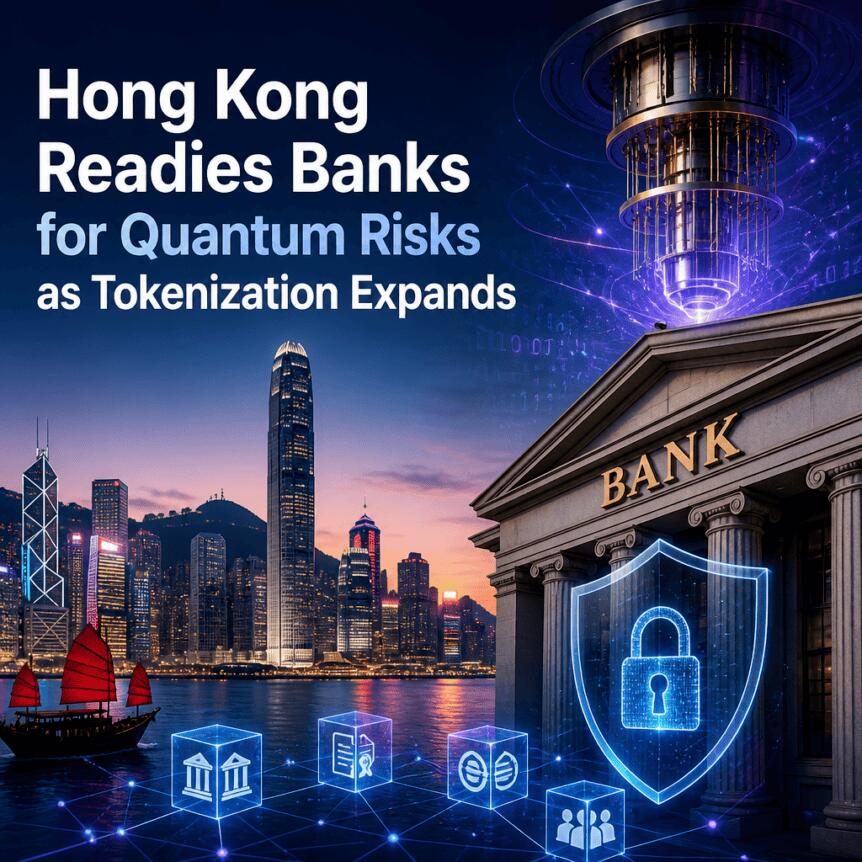
The Hong Kong Monetary Authority (HKMA) has moved to harden the city’s financial system against the long-term risks posed by quantum computing. In a newly released white paper, the regulator unveiled a first-of-its-kind Quantum Preparedness Index (QPI) designed to measure how ready banks are for potential threats to the cryptography that underpins digital payments, tokenized deposits and blockchain-based settlement.
According to the HKMA, the sector’s overall QPI score stands at 2.3 out of 10. The white paper also found that around half of surveyed institutions have not put formal post-quantum planning in place. HKMA said it is targeting full sector readiness—defined as a QPI score of 10—by 2030.
Key takeaways
- The HKMA’s inaugural Quantum Preparedness Index scored the banking sector at 2.3/10, signalling limited maturity in post-quantum planning.
- About half of surveyed institutions reportedly lack formal post-quantum cryptography migration plans.
- The regulator links quantum risk directly to the cryptography used in distributed ledgers and payment networks, warning of potentially severe disruption if protections fail.
- HKMA aims for banks to reach “full readiness” by 2030, with early actions such as inventories and migration planning flagged as urgent.
Why Hong Kong’s tokenization agenda raises quantum stakes
HKMA’s quantum initiative arrives as Hong Kong deepens the integration of traditional finance with distributed ledger technology. The regulator’s broader push includes work to tokenize assets and expand digital settlement rails—areas that rely heavily on cryptographic security for confidentiality, authentication and transaction integrity.
Government figures highlighted in related reporting show that Hong Kong has issued three batches of tokenized green bonds totaling about HK$16.8 billion (roughly $2.1 billion) since 2023. At the same time, HKMA continues to advance tokenized deposits and digital-asset settlement efforts through Project Ensemble, a programme designed to explore how tokenized forms of money and assets can move and settle on distributed ledgers.
In practice, the more value that is represented, transferred, and authorized on cryptographically protected networks, the more consequential it becomes if the underlying encryption or signature schemes are eventually weakened by quantum capabilities.
The HKMA’s quantum preparedness framework
In Monday’s announcement, the HKMA introduced both a white paper on quantum preparedness and the sector’s first QPI. The regulator’s central point is that modern distributed ledger applications and payment networks depend on cryptography for core functions, meaning a compromise could translate into operational and trust failures across financial services.
The HKMA’s white paper states that quantum computers capable of running Shor’s algorithm at scale could break widely used public-key cryptography such as RSA and elliptic-curve cryptography. The regulator warns that this could enable attackers to decrypt protected data or forge the digital signatures used to authorize transactions, verify identities and underpin trust in financial systems.
Because cryptographic systems can be embedded deeply in hardware, software and operational processes—and replacement can take years—the HKMA is effectively pushing banks to treat post-quantum migration as a multi-year programme rather than a last-minute upgrade. The regulator urged institutions to begin inventories, conduct risk assessments and develop migration planning well before quantum capabilities become a practical threat.
What the QPI score suggests—and what banks must address next
The gap between the intended endpoint and the current readiness level is stark. With an overall score of 2.3 out of 10, the QPI results imply that many institutions may not yet have translated quantum risk into concrete governance, technical roadmaps, and replacement strategies for cryptography used across their systems.
HKMA’s findings also highlight a planning shortfall: around half of the surveyed institutions reportedly had no formal post-quantum planning. That matters because preparedness is not only about choosing replacement cryptographic algorithms. Banks also need to map where current cryptographic methods are used across their infrastructure, assess dependency chains in distributed-ledger connectivity and settlement workflows, and ensure that upgrades do not disrupt operational continuity.
While the overall picture is cautious, HKMA noted that at least one surveyed institution completed a proof of concept applying post-quantum cryptography to distributed-ledger connectivity. The white paper also referenced HSBC’s 2024 use of quantum-safe technology to move tokenized gold across distributed ledgers—an example that illustrates how quantum-resilience work can show up in real settlement experiments rather than remaining purely theoretical.
Still, the HKMA’s score indicates that these efforts are not yet broad-based enough to lift the sector average. For investors and market participants, the practical takeaway is that compliance, systems readiness and operational risk management around cryptography are likely to become increasingly important as Hong Kong scales tokenized products and distributed settlement services.
HKMA framed the quantum preparedness push within its broader strategy to expand fintech and tokenized finance. The regulator had previously outlined a Fintech 2030 strategy in 2025, where tokenization was identified as a strategic pillar in a plan covering more than 40 initiatives. The approach includes accelerating real-world asset (RWA) tokenization, regularizing tokenized government bond issuance, and exploring tokenized Exchange Fund papers, alongside blockchain settlement supported by mechanisms such as e-HKD, tokenized deposits and regulated stablecoins.
Supporting context also came from a speech by Hong Kong Financial Secretary Paul Chan, who said banks held more than HK$14 billion in digital assets under custody at the end of 2025—up about 180% year over year—while tokenized deposits had reached HK$29 billion. Those figures underscore the speed at which tokenization-linked activity is growing, even as cryptographic migration planning remains at an early stage.
That combination—rapid adoption of tokenized rails alongside an acknowledged lack of post-quantum preparation—helps explain why HKMA’s framework is structured as a measurable readiness programme with a target by 2030.
For readers watching this space, the key question is how HKMA will turn the QPI into action: whether institutions will formalize post-quantum migration plans at scale, and how quickly banks move from proof-of-concept work to system-wide inventories and upgrade roadmaps as tokenized settlement continues to expand.
This article was originally published as Hong Kong Readies Banks for Quantum Risks as Tokenization Expands on Crypto Breaking News – your trusted source for crypto news, Bitcoin news, and blockchain updates.