In May this year, a small line item buried deep inside First Bank’s annual report caught our attention. “Electronic purse” deposits, basically digital wallet balances sitting on the bank’s bo
In May this year, a small line item buried deep inside First Bank’s annual report caught our attention. “Electronic purse” deposits, basically digital wallet balances sitting on the bank’s books, had surged from ₦5.4 billion to ₦65.4 billion. A twelve-fold jump. ₦60 billion in new digital money, appearing from nowhere.
We called it the most anomalous number in Nigerian banking. Not because ₦60 billion is the largest figure in First Bank’s ₦30 trillion balance sheet, but because of what it suggested: someone, or something, had parked a fortune in digital float inside Nigeria’s oldest bank, and nobody was saying who.
Now, six months later, the entire amount has vanished.
First Bank’s half-year report for June 2026 shows electronic purse deposits at ₦4.9 billion – back to where they started. The ₦60 billion exited between January and March 2026, collapsing in a single quarter. Then it flatlined. The bank has offered no explanation. Not in the annual report. Not in the quarterly filing. Not in the half-year statements.
This is not normal.

FirstHoldCo Chairman, Femi Otedola What “Electronic Purse” means (and why you should care)
To understand why this matters, you need to understand what an electronic purse is in Nigerian banking terms.
When you transfer money from your bank app to your OPay wallet, when your employer pays your salary into a digital payroll system, or when a fintech collects payments on behalf of merchants, that money sits somewhere. Often, it sits in a bank account classified as “electronic purse.” It’s not a traditional savings account. It’s not a current account. It’s a holding pen for digital money in transit.
For most of 2024, First Bank held about ₦5 billion in these balances. Then suddenly, in 2025, someone parked ₦60 billion more.
To put that in perspective: ₦60 billion is roughly what the federal government spends on the entire education sector in a quarter. It’s more than the market capitalisation of some Nigerian banks. And it appeared as a single line item with no name attached.
The Q1 collapse
The Q1 2026 filing, unaudited and filed in May, reveals the precise timeline.
DateElectronic Purse (₦’bn)Dec 20245.4Dec 202565.4
Mar 20264.5Jun 20264.9
The entire collapse happened in three months. Not gradually. Not seasonally. One quarter, the money was there. The next, it was gone.
This matters because of what it suggests about the nature of the arrangement. Slow drains indicate customer behaviour, that is, people withdrawing, spending, moving money.
Single-quarter collapses suggest contracts ending. Partnerships terminating. Regulatory interventions. Or relationships that were always temporary, now concluded. First Bank has not said which it was.
There is one other number that moved in the same direction: what First Bank pays to other banks and payment platforms when their customers use First Bank cards or services.
In 2025, these “switching” and platform charges jumped from ₦29.9 billion to ₦36.1 billion, a 21% increase. In Q1 2026 alone, the bank paid ₦17.2 billion, up 26% from the same period in 2025.
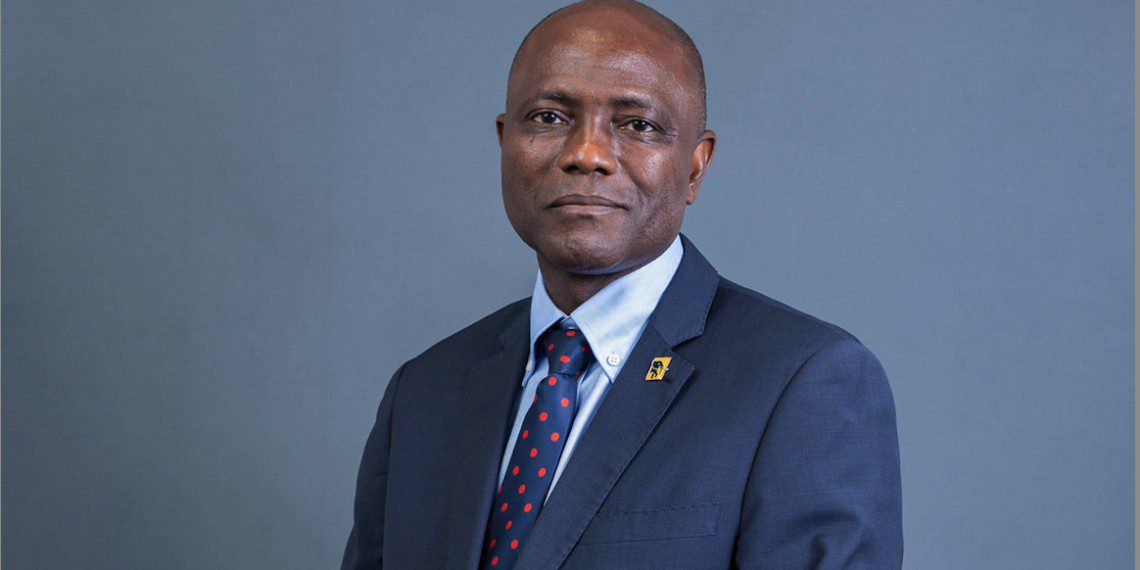
Managing Director and Chief Executive Officer of First Bank of Nigeria Limited, Olusegun Alebiosu
Think of it like this: every time you use your First Bank card on a GTBank ATM or pay for something through a fintech app that routes through multiple banks, First Bank pays a small fee to the intermediary. When those fees rise sharply, it usually means transaction volumes have surged, or the bank has plugged into new payment rails.
The coincidence is uncomfortable. First Bank starts paying significantly more into the payments ecosystem at the same time ₦60 billion in digital float appears on its books. Then, as the float disappears, the switching costs keep rising.
One interpretation is that a partnership formed, then ended, or changed structure. Another is that the ₦60 billion was never really “deposits” in the traditional sense but a temporary facility, perhaps a fintech’s customer funds parked at First Bank while a regulatory or technical arrangement was being finalised. When the arrangement concluded, the money moved.
But again, this is speculation. The bank has provided no narrative.
Why the silence is the story
Under Nigerian Stock Exchange rules and international accounting standards, material movements in financial statements require explanation. A ₦60 billion swing in a single deposit category, roughly 0.2% of the bank’s total deposits, is not immaterial. It is the kind of thing auditors ask about. The kind of thing risk committees discuss. The kind of thing that, in a properly governed institution, produces at minimum a footnote.
First Bank’s filings contain nothing. This silence has three possible explanations, none of them reassuring:
1. The arrangement was with a related party, and detailed disclosure would reveal uncomfortable relationships. First Bank’s parent company, First HoldCo, is controlled by Femi Otedola, who also has interests in energy, insurance, and increasingly, digital infrastructure. The overlap is not proof of anything. But it is why disclosure exists.
2. The ₦60 billion was connected to a regulatory experiment, perhaps CBN’s eNaira or a new digital currency framework – and the bank is constrained from discussing it. This is plausible but unsatisfying. Central bank pilots are typically announced, not hidden in balance sheet line items.
3. The bank simply does not consider ₦60 billion in mysterious digital float to be worth explaining to shareholders. If this is true, it says something profound about corporate governance in Nigerian banking and about what regulators consider worthy of investigation.
What this means for your money
Here is why an ordinary Nigerian should care about a number they will never see on their bank statement.
Every time you use a fintech app, every time your salary hits a digital wallet, every time you pay for Uber or Jumia or betting or airtime through a third-party platform, your money passes through arrangements like the one First Bank has refused to explain. The “electronic purse” is the plumbing. It is where your digital money lives before you spend it.
When ₦60 billion can appear and disappear with no accountability, it raises questions about who actually controls that plumbing. Is it the banks? The fintechs? The regulators? Or is it whoever can move ₦60 billion in a single quarter without leaving a footprint?
The Nigerian financial system is becoming more digital faster than it is becoming more transparent. This is the tension at the heart of the story. We are being asked to trust infrastructure we cannot see, governed by disclosures that do not come.
Less than three months after we first flagged the ₦60 billion anomaly, the mystery has deepened rather than resolved. Here is what we still do not know:

A First Bank branch
- Who deposited the ₦60 billion? A single entity? Multiple entities? A government body? A fintech? A related party?
- Why did it leave in Q1 2026? Was this a planned exit? A regulatory directive? A contractual dispute?
- Where did it go? To another bank? Out of the country? Into a different asset class entirely?
- Why has First Bank not explained? Is this a disclosure failure? A strategic silence? Or a judgement that the amount is not material enough to discuss?
- What does the CBN know? The central bank sees the same filings we do. Has it asked? Has it been answered?
These go to the heart of whether Nigeria’s financial system is governed by rules that apply equally or by arrangements that operate in the spaces between disclosures.
The ₦60 billion is gone. The electronic purse line item reads ₦4.9 billion, essentially where it was before the surge. First Bank has reported record half-year profits, improved loan quality, and a stronger capital position. The vanishing float is not mentioned.
But First Bank’s underlying business is undeniably stronger. Profit before tax surged to ₦653.5 billion in the first half, up 83% from N356.1 billion in the same period last year. Impairment charges fell by ₦69 billion. Net interest income held above ₦879.1 billion. The balance sheet grew to ₦30.6 trillion. By any conventional metric, this is a bank firing on most cylinders.
Read also: Is OPay the 3rd-largest bank in Nigeria, ahead of First Bank? Facts vs fiction
Which makes the silence on the ₦60 billion even stranger. A bank this profitable, this well-capitalised, this institutionally secure has nothing to fear from a footnote. The mystery did not need to become a ghost story. Yet six months after the anomaly appeared and three months after it vanished, First Bank has chosen opacity over explanation and in doing so, has turned a balance sheet curiosity into a question of trust.
Both the Q1 and H1 2026 filings are unaudited. First HoldCo Plc only published its half-year results on July 20, 2026, the same day this report was written. This means the ₦60 billion collapse currently exists only in management-prepared statements that have not been subject to independent audit. The bank may yet explain the movement in its audited 2026 annual report, due early next year. Or it may not. For now, the only official record is silence.