In the previous article, we explored how AI Influencer Agents extend traditional AI influencers by combining digital identity, conversational AI, memory, and workflow capabilities. They repre
In the previous article, we explored how AI Influencer Agents extend traditional AI influencers by combining digital identity, conversational AI, memory, and workflow capabilities. They represent a shift from static content generation to interactive engagement.
For many organizations, however, understanding the concept is only the beginning.
The next challenge is operational.
How should AI Influencer Agents fit into existing marketing workflows? What role should they play alongside campaign teams, customer support, ecommerce platforms, and online communities? More importantly, how can brands create AI experiences that continue delivering value after a campaign has launched?
These questions reflect a broader change taking place across digital marketing.
Campaigns are no longer evaluated only by their ability to generate attention. Increasingly, they are measured by how effectively they educate customers, support product discovery, encourage meaningful interactions, and build long-term relationships.
This is where AI Influencer Agents introduce a different operating model.
Rather than treating every campaign as a temporary event, organizations can deploy AI systems that remain available throughout the customer journey, creating an interactive layer between published content and customer actions.
Marketing Is Evolving Beyond Content Distribution
Traditional marketing workflows were designed around publishing.
A campaign begins with planning, creative production, content distribution, and performance reporting. Success is typically measured through reach, impressions, click-through rates, or conversions.
This model remains effective for building awareness.
However, awareness alone rarely completes the customer journey.
After discovering a product or service, customers often continue searching for information. They compare alternatives, ask questions, evaluate pricing, explore documentation, or seek recommendations from communities before making a decision.
These interactions usually happen outside the original campaign.
As a result, organizations frequently lose visibility into the conversations that influence purchasing decisions.
This creates a gap between attracting attention and supporting customer intent.
Instead of asking "How many people viewed our campaign?", marketing teams increasingly ask:
- Which questions prevented customers from converting?
- Which products generated the strongest interest?
- What information did customers struggle to find?
- Which audience segments required different messaging?
- Where did customers leave the buying journey?
Answering these questions requires more than publishing content.
It requires continuous interaction.
From Campaigns to Continuous Engagement
One of the most significant changes in modern marketing is the shift from campaign thinking to engagement thinking.
Campaigns are designed around fixed timelines.
They launch, run for a defined period, and eventually conclude.
Customer relationships, however, rarely follow the same pattern.
People return to products, communities, and creators over weeks or months. Their questions evolve as they move from discovery to evaluation, purchase, onboarding, and long-term usage.
AI Influencer Agents support this longer engagement cycle.
Rather than ending when a campaign concludes, they continue interacting with audiences by providing product information, answering questions, guiding customers toward relevant resources, and maintaining conversations across multiple touchpoints.
This changes the role of marketing from delivering messages to supporting ongoing customer experiences.
Instead of measuring only what happens during a campaign, organizations can better understand how customers learn, evaluate, and make decisions over time.
AI Influencer Agents as an Engagement Layer
AI Influencer Agents do not replace existing marketing systems.
Instead, they connect them.
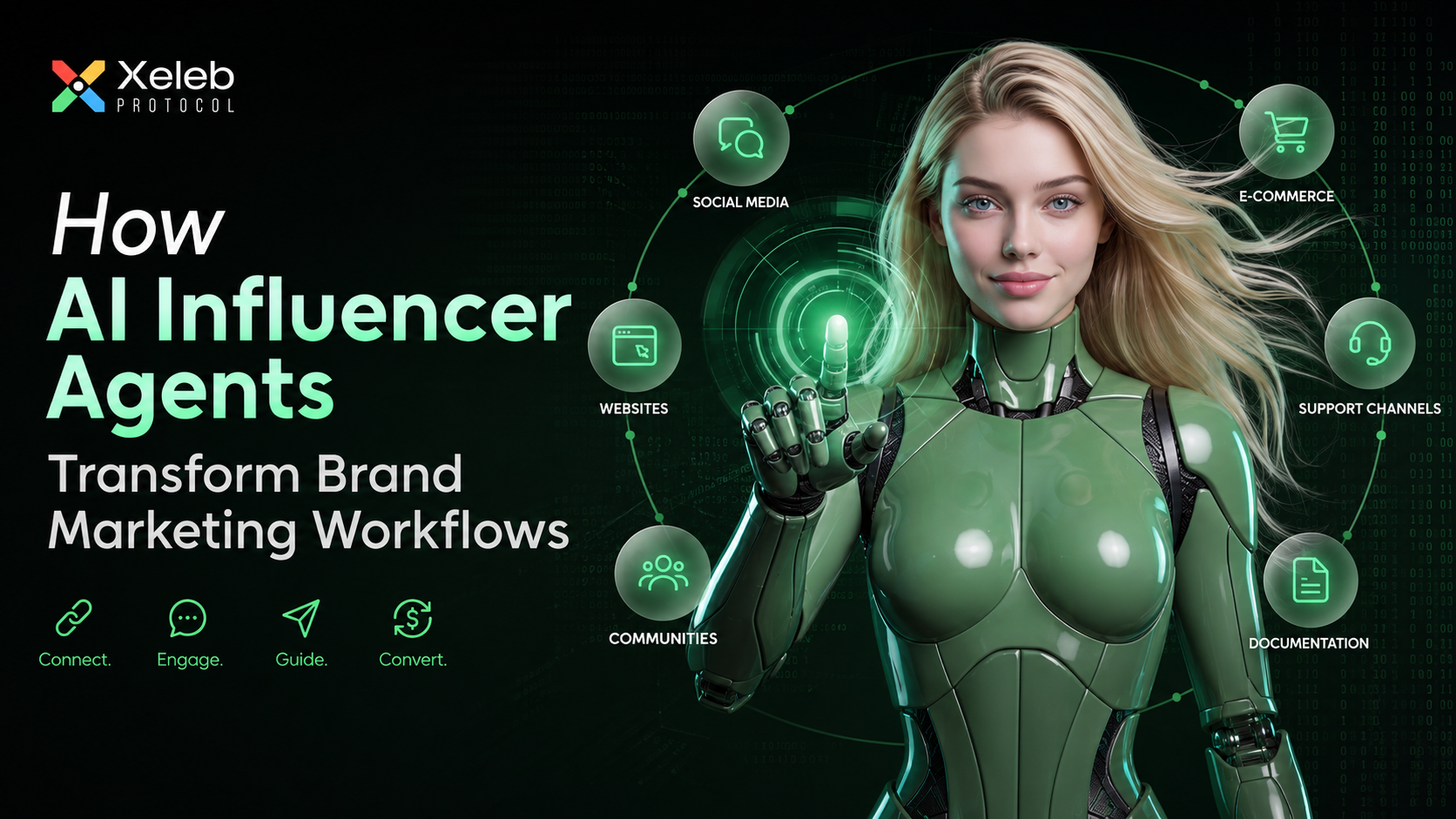
A typical customer journey may include social media, websites, ecommerce platforms, documentation, customer communities, and support channels.
Each system serves a different purpose, yet customers experience them as a single journey.
AI Influencer Agents help create continuity across these interactions.
Rather than directing every visitor toward the same landing page or knowledge base, they provide an interface through which customers can ask questions, receive contextual guidance, and continue exploring information at their own pace.
A simplified workflow looks like this:

This interaction layer benefits both customers and organizations.
Customers receive relevant information without navigating multiple systems.
Organizations gain a clearer understanding of customer intent, recurring questions, and engagement patterns that can inform future campaigns.
Beyond Digital Personalities
Early AI influencers demonstrated that digital personalities could attract attention and generate content at scale.
The next stage of development is less about visual realism and more about practical utility.
Organizations increasingly evaluate AI systems based on the experiences they enable rather than the content they produce.
An AI Influencer Agent becomes valuable when it helps audiences accomplish something meaningful.
That might include learning about a product, finding the right service, joining a community, discovering educational resources, or understanding the next step in a customer journey.
In this model, the AI Influencer is no longer only a communication channel.
It becomes part of the customer experience itself.
This distinction is important because engagement depends on interaction rather than exposure alone.
Content may capture attention.
Conversations help sustain it.
Why This Matters for Brand Marketing Teams
Brand marketing teams already manage a growing ecosystem of channels, platforms, and customer touchpoints.
Adding another content format does not necessarily improve customer engagement.
Adding an interactive layer can.
AI Influencer Agents allow organizations to extend campaigns beyond publication by making knowledge, recommendations, and customer guidance continuously available.
Instead of relying exclusively on static landing pages or frequently asked questions, brands can provide interactive experiences that adapt to customer needs while remaining aligned with approved messaging.
This does not replace human marketers, creators, or community managers.
Instead, it enables them to focus on strategy, creativity, and relationship building while repetitive interactions are handled more consistently through AI.
As AI adoption continues across marketing organizations, the competitive advantage will depend less on generating more content and more on creating experiences that remain useful after content has been published.
The next step is understanding what makes these systems reliable in production.
That begins with the architecture, governance, and operational components behind every AI Influencer Agent.
Building AI Influencer Agents for Production
As organizations move from experimentation to deployment, the focus shifts from creating an AI personality to operating a reliable AI system.
An AI Influencer Agent that performs well in a demonstration may not be suitable for production if it cannot provide consistent information, follow brand policies, or adapt as products and campaigns evolve.
For this reason, successful deployments depend not only on model capability but also on the surrounding operational architecture.
Rather than viewing an AI Influencer Agent as a standalone application, organizations should treat it as part of a broader customer engagement ecosystem.
While implementations vary across platforms, production deployments generally require several foundational capabilities.

Each capability supports a different aspect of the customer experience.
Together, they enable AI Influencer Agents to deliver interactions that are more consistent and useful than static content alone.
A Reference Architecture
Although technical implementations differ, many organizations follow a similar operational model.

This architecture separates knowledge management from customer interaction.
As information changes, organizations can update the underlying knowledge without redesigning the entire customer experience.
It also allows marketing, product, and community teams to contribute knowledge through existing workflows instead of maintaining separate AI systems.
Governance Builds Trust
As AI Influencer Agents become public-facing representatives of creators and brands, governance becomes an operational requirement rather than a technical feature.
Organizations should establish clear policies for:
- Approved knowledge sources
- Brand voice and communication guidelines
- Product claims and recommendations
- Escalation paths for complex or sensitive requests
- Privacy and data handling practices
- Ongoing review and knowledge updates
These controls help ensure that interactions remain aligned with organizational standards while reducing the risk of inconsistent or outdated responses.
The objective is not to restrict conversations, but to make them dependable as products, campaigns, and customer expectations evolve.
Measuring Operational Success
Traditional marketing metrics remain important, but they do not fully reflect the value of conversational engagement.
Organizations should also evaluate how AI Influencer Agents contribute to the overall customer experience.
Examples include:
- Conversation completion rate
- Frequently discussed topics
- Customer information needs
- Repeat interactions
- Knowledge gaps identified through conversations
- Customer satisfaction signals
- Conversion-assisted engagements
These measurements help teams understand not only whether customers interacted with the AI Influencer Agent, but also whether those interactions improved decision making and reduced friction throughout the customer journey.
The AI Influencer category is evolving beyond content generation.
Across the industry, platforms are exploring how conversational AI, structured knowledge, and workflow integration can create more interactive experiences for creators, brands, and communities.
Xeleb Protocol reflects this broader direction.
Rather than positioning AI influencers solely as digital personalities, the platform is exploring how they can evolve into AI-powered engagement experiences that strengthen relationships between creators, brands, and their audiences.
As the category matures, this shift from content creation toward continuous interaction is likely to become one of its defining characteristics.
Looking Ahead
The first generation of AI influencers demonstrated how digital personalities could attract attention.
The next generation is defined by what those personalities can do after attention has been captured.
Organizations are increasingly looking for AI systems that can educate customers, support communities, answer questions, and create meaningful interactions across multiple digital channels.
AI Influencer Agents represent one approach to achieving that goal.
Rather than replacing creators or marketing teams, they extend existing workflows by making trusted knowledge and interactive engagement available whenever customers need them.
For organizations evaluating this category, the opportunity is no longer limited to creating AI-generated content.
It is about building AI systems that remain useful throughout the customer journey and continue creating value long after a campaign has been published.