TLDR The US Navy awarded Boeing its F/A-XX fighter jet contract last week, valued at over $20 billion during development. Boeing previously secured the Air Force’s F-47 contract in March 2025
TLDR
- The US Navy awarded Boeing its F/A-XX fighter jet contract last week, valued at over $20 billion during development.
- Boeing previously secured the Air Force’s F-47 contract in March 2025, making it the sole provider of sixth-generation fighters for both services.
- Lockheed Martin and Northrop Grumman lost the Navy competition to Boeing.
- BA stock trades around $192.72, positioned between its 52-week low of $176.77 and high of $254.35.
- Fixed-price contracts have cost Boeing’s defense division $20.5 billion across five programs, raising questions about whether these new deals will generate profits.
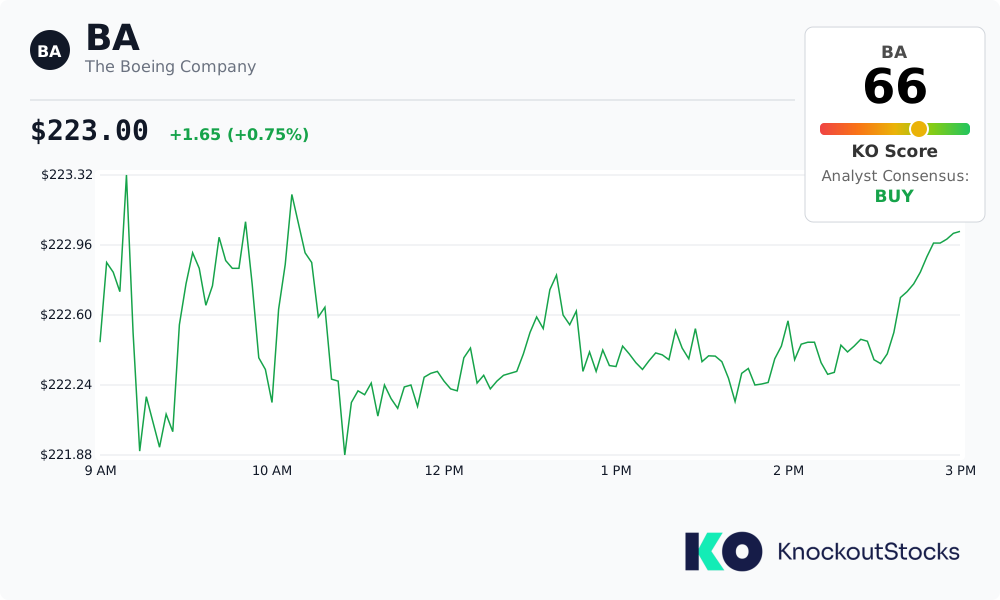
Boeing (BA) stock hovered near $192.72 during Monday trading, experiencing modest declines. The pricing follows the company’s announcement of securing its second consecutive major fighter aircraft contract in less than 24 months.
 The Boeing Company, BA
The US Navy selected Boeing for the F/A-XX program last week. Initial development funding exceeds $20 billion, making it one of the largest defense contracts awarded recently.
Boeing had already captured the Air Force’s F-47 fighter contract three months earlier in March 2025. The combination puts Boeing in position as the exclusive manufacturer for the next generation of advanced fighters across both military branches.
The Navy selection saw Boeing prevail over competing proposals from Lockheed Martin and Northrop Grumman. Northrop has formally asked the Navy for a debriefing on its decision, which represents the standard procedural step before filing any protest.
Boeing’s Competitive Advantages
Industry sources attribute the victory to Boeing’s substantial capital investments and extensive heritage in carrier-capable aircraft manufacturing. The company deployed advanced digital engineering platforms that enabled real-time collaboration between Boeing engineers and military stakeholders throughout the design process.
“Boeing’s approach proved highly effective,” noted a former Pentagon official, describing the company’s commitment to the Department of Defense’s vision for adaptable, upgradeable combat aircraft.
Steve Parker, Boeing’s defense division leader under CEO Kelly Ortberg, indicated the dual-program strategy was intentional. “Our roadmap always included concurrent development of two advanced fighters, and we allocated resources accordingly,” Parker explained.
Initial F-47 flight testing is scheduled for 2028, with operational deployment planned for 2029. The Air Force intends to procure a minimum of 185 units to phase out the F-22 Raptor fleet.
The F/A-XX program operates on a longer timeline, targeting operational capability during the 2030s. This platform will succeed the F/A-18 Super Hornet and integrate organic electronic attack capabilities without requiring separate jamming aircraft.
Financial Risks Remain
Contract awards don’t automatically translate into financial success for Boeing. Profitability hinges entirely on pricing structures and risk-sharing arrangements that remain undisclosed by both Boeing and Pentagon officials.
Boeing has accumulated $20.5 billion in losses from five fixed-price development contracts, including the KC-46 aerial refueler and Starliner crew capsule programs. “Fixed-price terms would be deeply concerning,” cautioned Richard Aboulafia, an analyst at AeroDynamic Advisory.
CEO Ortberg has publicly stated Boeing will reject similar fixed-price development agreements in the future. The strategy aims to prevent repeating the financial bleeding from previous programs.
However, the strategic outlook differs substantially from earlier efforts. Military planners expect combined procurement to exceed 370 sixth-generation fighters across both services over the program lifecycle.
That production scale, combined with Boeing’s monopoly position as the single supplier for both variants, eliminates competitive pricing pressure from rival manufacturers for this generation. Lockheed Martin, which dominated with the F-22 and F-35 programs, finds itself shut out of sixth-generation fighter production.
Northrop Grumman did secure the B-21 Raider stealth bomber program, maintaining its position in sixth-generation strike aircraft. Yet in the fighter category specifically, Boeing has established clear market dominance.
Boeing’s defense, space and security business unit recently achieved positive operating margins after four consecutive years of losses, based on S&P Global Market Intelligence reporting. Financial analysts have targeted 2027 as the inflection point when Boeing achieves sustained profitability across all business segments.
BA stock fluctuates within a 52-week band spanning $176.77 to $254.35, supporting a market capitalization approaching $152 billion. Neither Pentagon officials nor Lockheed Martin representatives provided comments regarding specific contract pricing mechanisms.
The post How Boeing (BA) Won Both Major Sixth-Generation Fighter Programs from US Military appeared first on Blockonomi.