How ContraCop Protocol Works: Security Features and Key Functions Crypto moves quickly, and so do scams. A token can look healthy on a chart while its contract hides a trap. Most buyers canno
How ContraCop Protocol Works: Security Features and Key Functions
Crypto moves quickly, and so do scams. A token can look healthy on a chart while its contract hides a trap. Most buyers cannot read contract code, so many rely on hype, or a friend's tip. Web3 security tools exist to close that gap. ContraCop Protocol is one such project, built to check wallets, tokens, and contracts in one place.
This guide covers what the platform does, how its parts fit together, and where its limits sit.
Key Takeaways
ContraCop Protocol is an AI-powered security platform that checks wallets, tokens, and smart contracts before users interact with them.
It looks at warning signs such as holder concentration, liquidity, contract permissions, and deployer behavior.
It offers data-driven insights, not financial guarantees, so personal research still matters.
What Is ContraCop Protocol?
ContraCop is an AI-powered Web3 security platform. It analyzes wallets, tokens, and smart contracts, then returns security insights, risk assessments, and wallet scores. The idea is simple: a user checks an address first and decides afterward. The project describes its vision as building a trusted security layer for Web3.
The platform also describes autonomous on-chain agents. These agents monitor wallets, track tokens, and send alerts when something changes. Together, these tools make up what can be called ContraCop AI security: blockchain data turned into results that both experienced traders and newcomers can read.
Source: official website.
Why On-Chain Risk Is Hard to Spot
Most losses in new tokens follow a few repeating patterns. In a rug pull, developers drain liquidity and leave holders with worthless tokens. In a honeypot, buyers can purchase but cannot sell. Other contracts keep strong permissions, such as the power to mint new supply or change fees after launch.
Honeypot token detection matters because these traps look normal until someone tries to sell. Good on-chain habits start before the purchase, and the same is true for crypto scam protection in general. Both depend on reviewing data first and trusting promises last.
The ContraCop Protocol architecture is built around that check-before-you-act idea.
ContraCop Protocol Architecture Explained for Beginners
The platform can be understood as four layers working in order. This is a simplified view based on the functions the project describes publicly.
Layer
What it does
Data layer
Collects blockchain data on wallets, tokens, and contracts
Analysis layer
Reviews holders, liquidity, contract permissions, and deployer activity
AI intelligence layer
Interprets the findings and produces risk assessments and scores
Monitoring layer
Uses on-chain agents to watch addresses and send alerts
Each layer depends on the one before it. Weak data produces weak analysis, so the data layer sets the quality of everything that follows.
How ContraCop Protocol Works: Step by Step?
Enter an address. A user submits a wallet, token, or contract address.
Data is gathered. The platform pulls the on-chain information tied to that address.
Checks run. Holder spread, liquidity, contract permissions, and deployer history are reviewed.
AI interprets the results. The findings become a readable risk summary or wallet score.
Monitoring continues. Agents can keep watching and alert the user when activity changes.
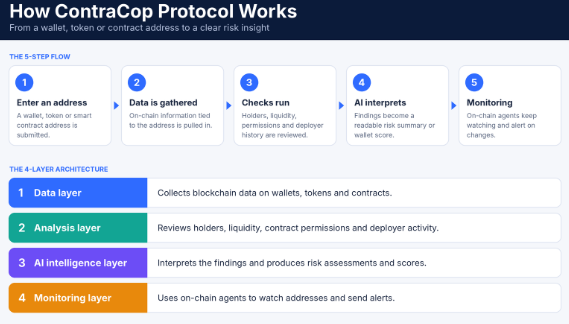
In practice, the flow works like an AI-powered token scanner that also covers wallets and contracts. The user sees a result in plain language instead of raw blockchain data.
What Are the Core Features of ContraCop Protocol?
Feature
Purpose
AI wallet analysis
Explains wallet activity and holdings
Wallet risk scoring
Gives a security score for a wallet
Token risk analysis
Flags warning signs in a token
Contract analysis
Reviews contract code and permissions
Rug-pull and scam detection
Highlights patterns linked to common scams
Holder and liquidity analysis
Shows who holds supply and how easily it can be sold
Deployer activity analysis
Looks at the creator's on-chain behavior
Real-time token intelligence
Tracks token and market activity
Blockchain security monitoring
Watches addresses and raises alerts
These ContraCop Protocol features share one aim: to make a risky address easier to recognize before money moves.
How ContraCop Detects Rug Pulls and Weak Smart Contracts
Rug pull detection works best when several signals are read together. Thin or unlocked liquidity can be pulled quickly. Heavy holder concentration means a few wallets can crash the price by selling. Deployer history shows whether the same creator has launched failed tokens before. No single signal proves a scam, but a cluster of them deserves attention.
Weak contracts need a different lens. Smart contract vulnerability analysis focuses on permissions and code-level risks, such as owner controls that allow unexpected changes. The platform lists smart contract security checks among its core features, and its FAQ also mentions premium AI-based source code audits.
How the $CCP Token Fits In
The ContraCop CCP token is the utility token of the ecosystem. According to the project's FAQ, it gives access to premium AI-based source code audits, real-time live security monitoring, and token activity reports. The website also states that audits, monitoring sessions, and premium tools require the token.
Limits and Safe Use
ContraCop is designed to give data-driven insights, not financial guarantees. A token risk assessment shows warning signs at one point in time. It cannot predict a team's future choices or catch every new trick.
A safer routine looks like this:
Run the scan, then read the whitepaper and roadmap.
Check the team and community, not just the score.
Start with a small test amount if buying.
Conclusion
The platform's approach is easy to summarize: gather the data, analyze the risk signals, explain them clearly, and keep watching. Understanding how ContraCop Protocol works helps readers judge its security approach and evaluate similar Web3 security tools.Anyone interested can start with the official website and the official whitepaper, then verify claims independently.
Disclaimer: This article is for educational purposes only and is not financial or investment advice. Crypto assets carry high risk, and no security tool can guarantee an outcome. Readers should do their own research before making any decision.