
Markets6 min read
Everyone Is Watching Bitcoin. Smart Money Is Watching Bonds.
Bitcoin may dominate headlines, but recent movements in Treasury yields could tell investors far more about where risk assets are headed next.
You make money through Hyperliquid's Builder Program by routing user trades through your own app into Hyperliquid's perpetuals exchange and charging a small fee on top of the protocol's base
You make money through Hyperliquid's Builder Program by routing user trades through your own app into Hyperliquid's perpetuals exchange and charging a small fee on top of the protocol's base fee. You keep 100% of that fee, with no cut to the protocol. The model is open to anyone, and it has quietly turned a handful of crypto wallets into eight-figure businesses.
A CoinGecko report from late May put hard numbers behind that, and it lit up timelines for days. The headline: one Solana wallet has earned more than $20 million doing nothing more exotic than passing its users' trades to someone else's order book.
Hyperliquid (@HyperliquidX) runs one shared order book called HyperCore. Builders do not launch their own exchange or fight over liquidity. They route orders into that same book and attach an extra fee, called a builder code, to each trade.
The rules are simple:
A user approves your builder address once and sets the maximum fee they are willing to pay. They can revoke it at any time, and each user can hold up to 10 active approvals. After that, every order your app sends can carry your builder code, and Hyperliquid deducts the fee on-chain as part of the fill. You claim what you earn through the same process as referral rewards.
That is the whole system. No tokenomics, no vesting, no gatekeeping. It is a straight contest over product, user experience, and distribution.
Phantom, the Solana-native wallet, sits at the top with $20,630,022 in cumulative builder revenue. That is 31.8% of the revenue earned by the top 10 builders. Phantom has 137,496 users, processed $39.4 billion in volume, and charges a 0.05% fee.
Based ranks second with $15,056,894. It processed more volume than Phantom at $44 billion, but its lower 0.025% fee left it with less revenue. Together, Phantom and Based account for about 55% of all top-10 builder revenue.
MetaMask sits fourth with $6,510,547, even though it charges the highest fee in the group at 0.1%. Its 43,761 users traded $7.46 billion. The top 10 together clear $64 million, and total builder revenue across the ecosystem now runs close to $80 million.
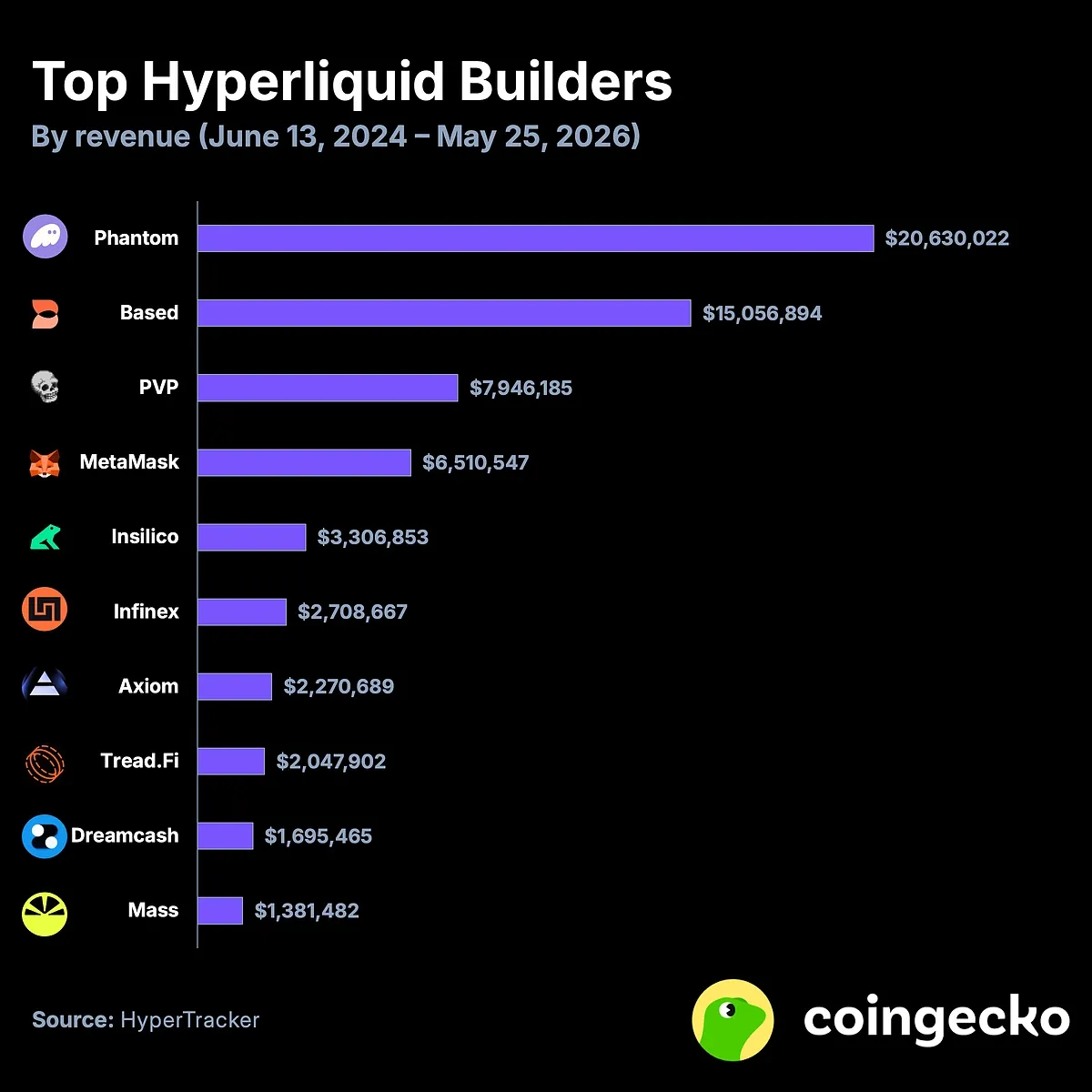 Top HyperLiquid Builders (Coingecko)
The pattern is hard to miss. The biggest earners are wallets, and the reason is distribution. Phantom and MetaMask already own the relationship with millions of users. Routing those users into Hyperliquid takes a single integration, not a new chain or a new exchange.
Fee strategy matters less than reach. Based charges half of Phantom's rate and still earns less, because Phantom has more than three times the users. Based pulls in about $354 per user against Phantom's $150, but volume at scale wins out. MetaMask makes the same point from the other direction: the highest fee in the group, carried by brand and reach rather than the lowest fee.
The barrier is low.
Everything settles on-chain with one-block finality, and every builder's fill data is published daily, so earnings are auditable.
The takeaway is not that the fees are high. It is the front end that now captures the value. Hyperliquid runs the liquidity and the matching engine and hands the economics to whoever brings the users. That reframes what a wallet is: not just a place to hold keys, but a perps brokerage that happens to look like a wallet, with the revenue to match.
Sources: