Some prediction markets charge taker fees, while others are fee-free; there is no single universal take rate. Gross fees, rebates, builder income and company profit are different measures. Pu
- Some prediction markets charge taker fees, while others are fee-free; there is no single universal take rate.
- Gross fees, rebates, builder income and company profit are different measures. Public product documents do not establish consolidated earnings.
- The international protocol settles trades on Polygon using pUSD; a supported deposit network is not necessarily the settlement network.
Polymarket has documented trading-fee mechanisms, but fees collected are not the same as company revenue or profit. Some prediction markets charge taker fees; others do not. Rebates, third-party charges and the specific product all matter. Public product documentation explains these mechanisms, not a complete corporate income statement.
This article covers Polymarket’s international prediction-market protocol. Its documentation links separately to Polymarket US; the rules discussed here should not be assumed to apply to that product or to other Polymarket product lines.
WHAT IS POLYMARKET? HOW DOES POLYMARKET MAKE MONEY
Polymarket lets participants trade positions tied to event outcomes. Its central limit order book (CLOB) matches participants’ orders offchain, while matched trades settle onchain. That is a marketplace mechanism, not evidence that the operator earns every dollar a trader loses. Official order-book documentation explains how bids, asks and matching work.
✅Funding networks are not settlement networks
The current collateral is pUSD, an ERC-20 token on Polygon backed by USDC. According to Polymarket’s trading overview, matched trades transfer pUSD and outcome tokens on Polygon. The collateral documentation describes the token and its backing.
Deposits can originate on supported networks including Solana, but the bridge converts supported assets to pUSD on Polygon. Supporting a Solana funding route therefore does not mean these prediction-market trades settle on Solana. Supported tokens, minimums and routes can change; consult the bridge guide and current supported-assets information.
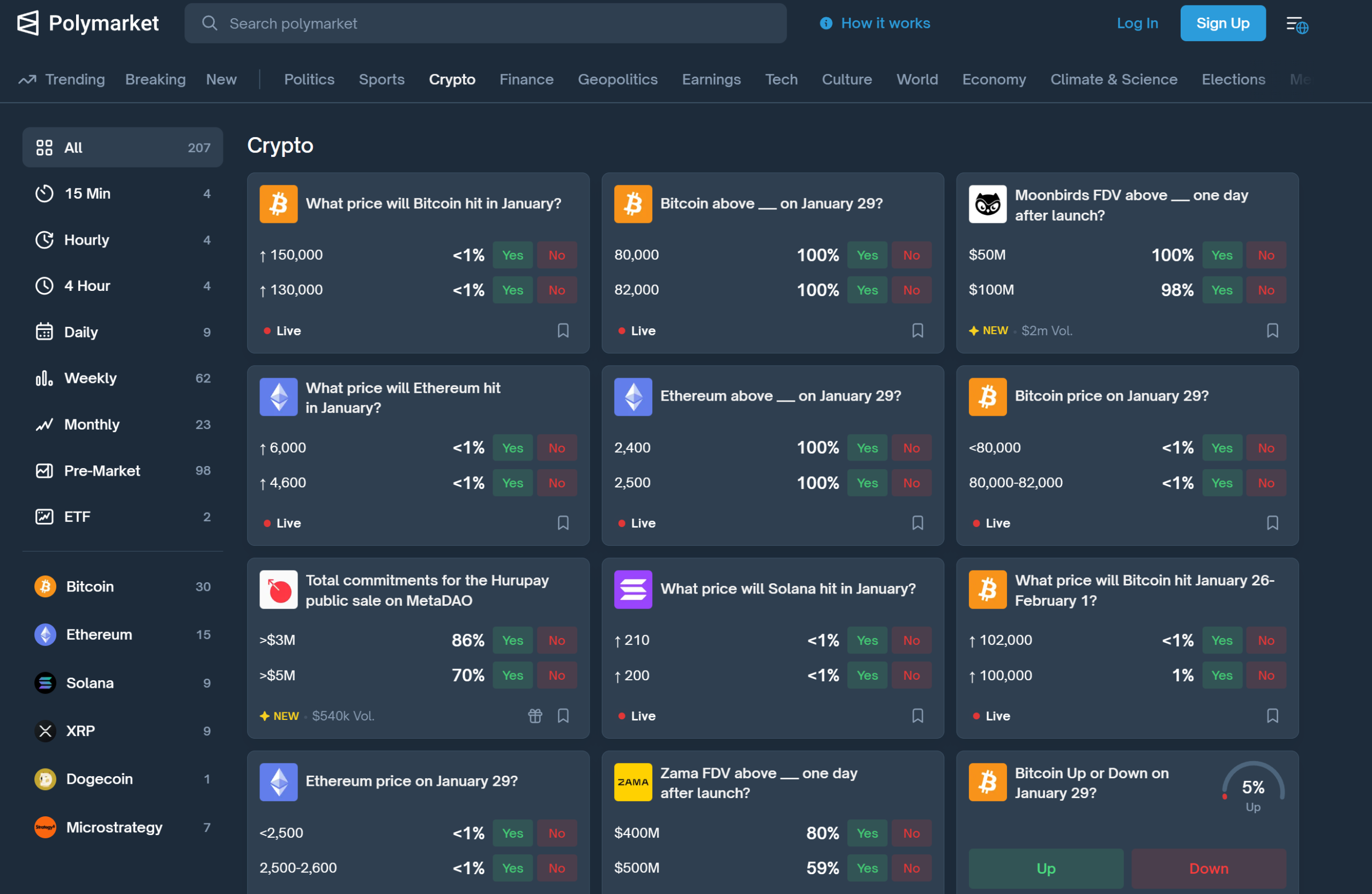
Historical interface screenshot retained from the original article; it is not a current fee schedule.
Related: What is Polymarket? Web3 Prediction Market.
HOW DOES POLYMARKET MAKE MONEY
1. Start with the specific market’s fee rules
The official fee schedule describes taker fees on certain markets and no platform maker fees. Geopolitical and world-event markets are described as fee-free. Fee calculations depend on the applicable category and share price; a published fee parameter should not be mistaken for a flat percentage of every trade’s value.
This means total platform trading volume cannot simply be multiplied by one assumed take rate. A defensible estimate would need the relevant markets, executions, fee parameters and period—not just a headline volume figure.
2. Separate gross fees from rebates and net economics
Polymarket’s Maker Rebates Program redistributes fees to eligible liquidity providers, while its Taker Rebate Program returns a portion to qualifying takers. These programs help explain why gross fees are not automatically money retained by the company.
Analytical distinction: gross fees, fees remaining after rebates, recognized corporate revenue and profit are different measures. Establishing profit would also require reliable information about costs and accounting treatment. The cited product documents do not establish consolidated revenue, margins or profitability, so this article does not estimate them.
3. Identify who receives other charges
An app built on Polymarket may charge a builder fee in addition to the platform fee. The builder-fee documentation describes this as a separate fee earned by the builder on routed orders. It should not automatically be counted as Polymarket company revenue.
The fee guide also distinguishes Polymarket’s own deposit and withdrawal charges from charges imposed by intermediaries. A payment, conversion or funding cost paid by a user is not necessarily income for Polymarket.
Trading gains and losses belong to a different calculation. A position’s result depends on its purchase price, execution costs and eventual sale or settlement. Outcome-token documentation explains redemption, including that a binary market can have a split payout rather than an ordinary full winning or losing payout.
A displayed probability is also not a guaranteed executable price. Available bids, asks and order-book depth matter. Claims of easy arbitrage, assured profits or a universally sustainable business model require evidence beyond the existence of trading activity.
What readers should check next
- Which product and market does a fee or volume figure cover?
- Is the figure trading volume, gross fees, retained fees or company revenue?
- Are rebates and third-party charges identified separately?
- What is the measurement period, and is the underlying source available?
The useful answer is therefore qualified: Polymarket documents fee-generating prediction-market activity, but that alone does not reveal how much the company ultimately earns. Keep that distinction when comparing platforms or interpreting revenue claims.
Related: What is a Crypto Prediction Market? A Beginner’s Guide.
〈How Does Polymarket Make Money in Prediction Markets〉這篇文章最早發佈於《CoinRank》。