Introduction Crypto research has traditionally been a fragmented process. Investors often spend hours switching between block explorers, price aggregators, exchange dashboards, GitHub reposit
Introduction
Crypto research has traditionally been a fragmented process. Investors often spend hours switching between block explorers, price aggregators, exchange dashboards, GitHub repositories, social media, and analytics platforms to assemble a complete picture of a single cryptocurrency.
As the digital asset industry continues to grow, so does the amount of information researchers need to process. This creates an opportunity for AI-powered tools that can automate data gathering while leaving the final analysis to the user.
To explore this concept, I tested CoinMarketCap's Agent Hub together with Cursor AI by generating a complete token profile for Terra Classic (LUNC) using a single prompt.
The results demonstrated how AI agents can dramatically streamline crypto research.
The Experiment
Rather than manually searching multiple websites, I entered a single prompt into Cursor:

@cmc-agent-hub skill: altcoin token profileInput:{ "symbol": "LUNC"}
The Agent Hub immediately identified the requested skill, queried CoinMarketCap's structured datasets, and generated a comprehensive token profile.
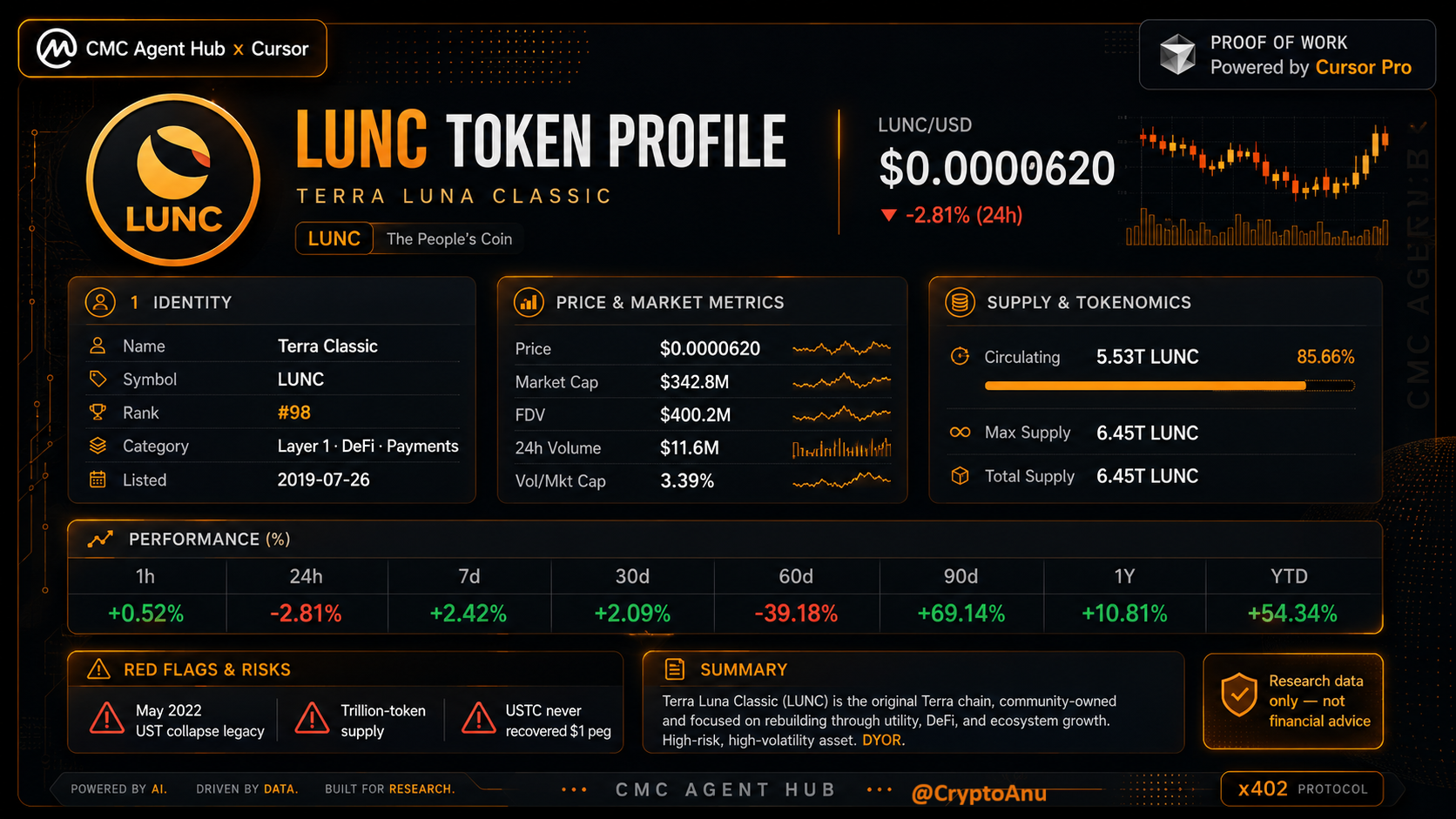
Instead of spending time collecting information manually, I was presented with an organized overview containing identity information, market statistics, tokenomics, and performance metrics.
This illustrates how AI-assisted workflows can reduce repetitive tasks while allowing researchers to focus on interpretation and decision-making.
A Structured Token Profile

The generated profile included core project information such as the asset's name, ticker, CoinMarketCap identifier, ecosystem category, launch date, and founding team.
Beyond basic identity, the report also summarized important market metrics, including price, market capitalization, trading volume, fully diluted valuation, and liquidity indicators.
Having this information consolidated into a single structured output removes much of the friction associated with traditional crypto research.
Understanding LUNC's Tokenomics
One of the most valuable sections of the report focused on tokenomics.
The profile highlighted the current circulating supply, total supply, and maximum supply, making it immediately clear why supply dynamics remain central to discussions surrounding Terra Classic.
The report also provided useful context regarding the ecosystem's ongoing burn mechanisms and the broader narrative around supply reduction.
For many investors, tokenomics remain one of the first areas examined when evaluating long-term potential, and presenting this information in a structured format improves both readability and analysis.
Performance in Context

The generated report also summarized LUNC's historical performance across multiple time horizons.
While recent gains have attracted renewed market attention, the report simultaneously illustrates the asset's significant drawdown from its historical all-time high.
Viewing these two realities together provides a balanced perspective.
On one hand, the recent recovery demonstrates renewed market participation.
On the other, the long-term chart reminds investors of the structural challenges that remain.
This balanced presentation is one of the strengths of structured AI-generated research.
Why AI Matters for Crypto Research
The most important takeaway from this experiment was not the individual market statistics.
It was the workflow itself.
AI agents reduce the time spent gathering data and allow analysts to dedicate more attention to interpretation, risk assessment, and investment thesis development.
Rather than replacing human judgment, tools such as CoinMarketCap's Agent Hub augment it by automating repetitive research tasks.
Conclusion
As cryptocurrency markets continue to expand, the ability to process information efficiently becomes increasingly valuable.
My experiment with Cursor AI and CoinMarketCap's Agent Hub demonstrated how a simple prompt can generate a structured, data-rich token profile within seconds.
The future of crypto research is unlikely to eliminate human analysis.
Instead, AI will increasingly serve as a research assistant—handling data collection, organization, and presentation—while investors continue to provide context, critical thinking, and decision-making.
For anyone interested in streamlining their research workflow, this experiment offers a compelling glimpse into what AI-assisted crypto analysis can look like today.