How Injective Is Bringing Trade Finance Onchain: Explained Introduction The future of finance is not only about creating new digital assets. It is also about transforming the massive financia
How Injective Is Bringing Trade Finance Onchain: Explained
Introduction
The future of finance is not only about creating new digital assets. It is also about transforming the massive financial systems that already power global commerce.
One of the biggest opportunities lies in trade finance, an industry that still relies heavily on traditional processes, intermediaries, and manual operations.
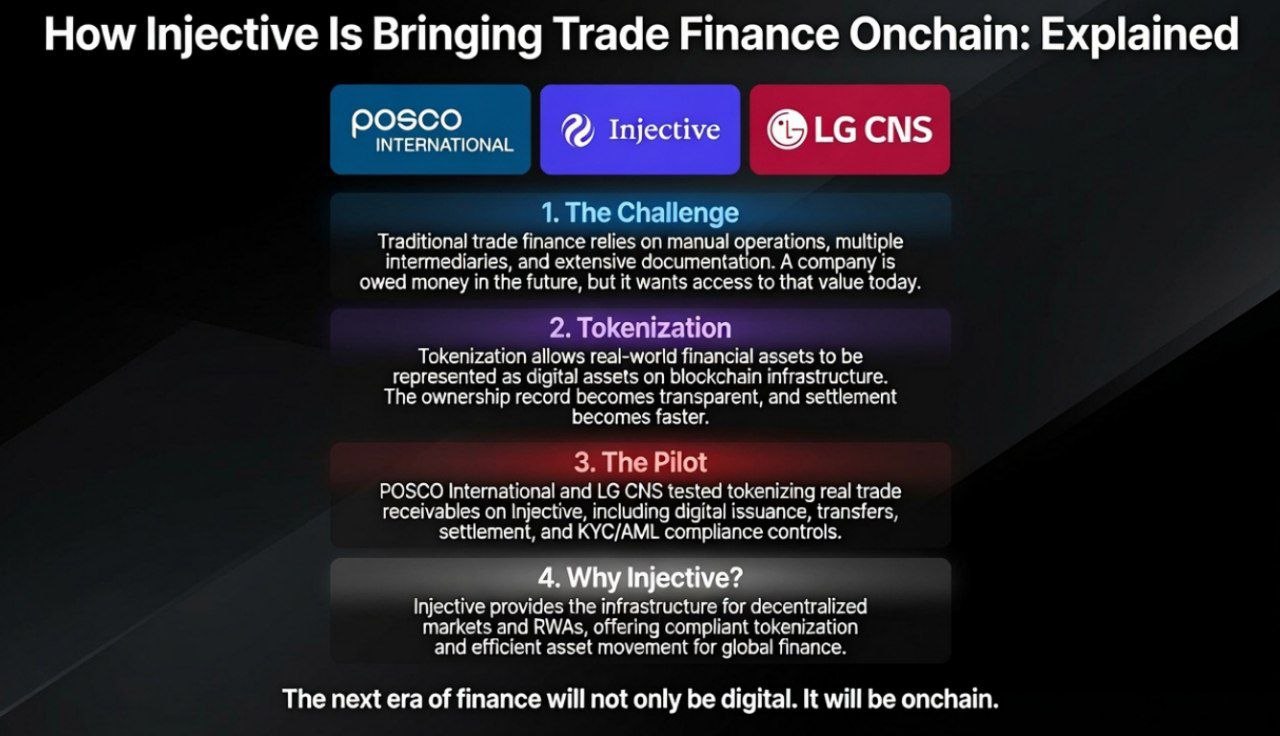
Recently, POSCO International and LG CNS completed a pilot program exploring how real-world trade receivables can be tokenized and managed on Injective.
This marks another step toward bringing institutional finance and real-world assets (RWAs) onchain.
What Are Trade Receivables?
To understand why this matters, we first need to understand trade receivables.
Imagine a global company sells products worth $5 million to an international buyer.
The buyer agrees to pay after 90 days.
The seller has already delivered the goods, but the payment has not arrived yet.
That future payment obligation is called a trade receivable.
In simple terms:
A company is owed money in the future, but it wants access to that value today.
The Challenge With Traditional Trade Finance
Businesses often need liquidity before their customers complete payments.
Traditionally, companies can sell their trade receivables to financial institutions at a discount to receive cash earlier.
While this process provides liquidity, it can also be slow and complex.
It often involves:
- Multiple intermediaries
- Manual verification processes
- Extensive documentation
- Cross-border coordination between different financial systems
For global businesses, improving this process can create significant efficiency gains.
How Tokenization Changes The Process
Tokenization allows real-world financial assets to be represented as digital assets on blockchain infrastructure.
Instead of relying only on traditional systems, a trade receivable can become a compliant digital token that can be issued, transferred, and settled onchain.
For example:
A company has a future payment of $5 million.
Through tokenization, that financial claim can be represented digitally, allowing approved participants to interact with the asset more efficiently.
The ownership record becomes transparent, and settlement can become faster.
What Did POSCO International and LG CNS Test?
The pilot explored how real trade receivables from POSCO International’s overseas businesses could be brought onchain using Injective.
The testing included:
- Tokenizing real trade receivables
- Issuing digital representations of these assets
- Testing transfers and settlement
- Applying compliance requirements such as KYC and AML controls
The goal was to explore how blockchain technology can support real-world institutional workflows.
Why Injective Matters
Injective was designed with financial applications in mind, providing infrastructure for decentralized markets, real-world assets, and institutional use cases.
By enabling compliant tokenization and efficient asset movement, Injective aims to provide the rails needed for the next generation of financial applications.
The combination of blockchain transparency and institutional-grade requirements creates new possibilities for global finance.
The Bigger Picture: Trade Finance Moving Onchain
Trade finance represents a massive global market, but many processes still operate through outdated infrastructure.
Tokenization introduces a new model where financial assets can become:
- More transparent
- Easier to transfer
- Faster to settle
- Programmable with compliance rules
The POSCO International and LG CNS pilot represents an important exploration of how traditional commerce can connect with blockchain technology.
Conclusion
The adoption of blockchain by institutions is moving beyond speculation and into real-world applications.
By bringing trade receivables onchain, Injective is helping explore a future where global commerce and financial infrastructure can operate more efficiently.
The next era of finance will not only be digital.
It will be onchain.