⏳ How Lock Duration Shapes ARKENSTON Voting Power in STON.fi Governance Governance mechanics, time-weighted voting power, and the trade-off between liquidity and influence. In most token-gove
⏳ How Lock Duration Shapes ARKENSTON Voting Power in STON.fi Governance
Governance mechanics, time-weighted voting power, and the trade-off between liquidity and influence.
In most token-governance systems, influence is simple to describe and simpler still to game: one token equals one vote. Buy more tokens, get more say. Sell them tomorrow, and your say disappears with them — which means governance weight can be rented for exactly as long as it takes to pass a proposal, then discarded before any of its consequences land.
STON.fi takes a different path. Holding STON, on its own, grants no governance power at all. To participate in the STON.fi DAO, a user stakes STON for a fixed period and receives a non-transferable ARKENSTON NFT representing the voting power tied to that specific position.

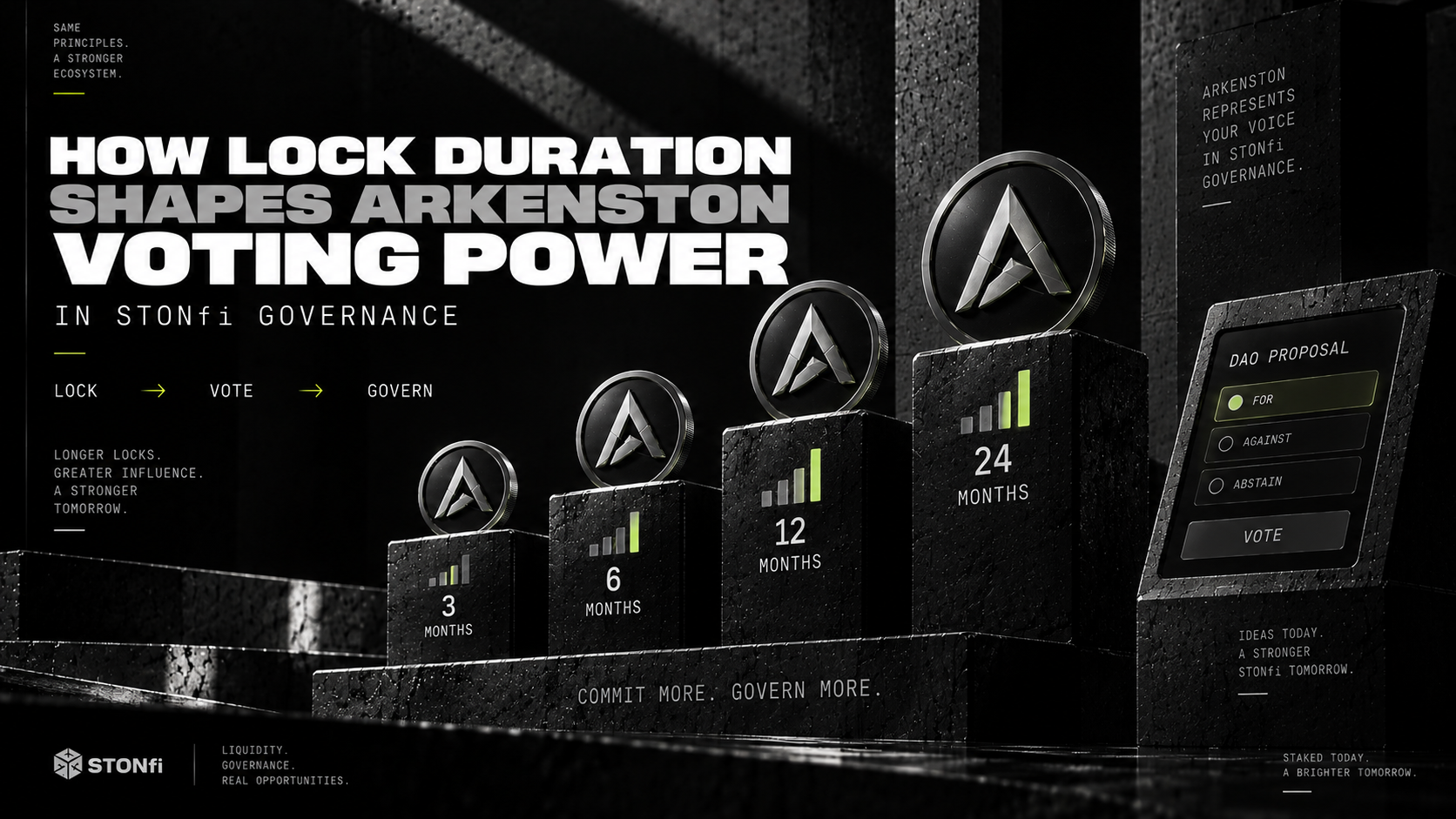
That single design choice turns time into a governance variable — arguably the governance variable. Two users staking the exact same amount of STON can end up with dramatically different influence depending on how long they're willing to lock it. STON.fi currently allows staking periods from 3 to 24 months, and the DAO states plainly that longer locks produce greater voting power.
But the system is considerably more interesting than "lock twice as long, get twice the votes." ARKENSTON voting power is dynamic rather than fixed, the published formula contains an exponential component rather than a linear one, and lock duration also determines something more fundamental than weight: whether your position can participate in a given vote at all.
"Capital tells you who showed up. Time tells you who intends to stay."
🗝️ ARKENSTON Turns Commitment Into Governance Weight
ARKENSTON is a soulbound NFT, minted at the moment STON is staked. Soulbound means non-transferable — it cannot be sold, lent, or moved to another wallet. That property is doing real structural work, and it's worth sitting with rather than skimming past.
In a transferable-governance-token system, voting power is a commodity. It can be borrowed for a weekend, used to swing a vote, and returned before the outcome takes effect. Entire markets have grown up around exactly this — flash-loaned governance attacks are a documented failure mode across DeFi, not a hypothetical one. By binding voting power to a non-transferable NFT that only exists alongside a locked staking position, STON.fi removes the separation between "who holds the influence" and "who holds the exposure." You cannot acquire the vote without also acquiring the commitment underneath it.
According to the current STON.fi DAO Governance Rules, voting weight depends on two inputs working together:
- 🪙 More STON staked → more voting power.
- ⏱️ Longer commitment → more voting power per STON.
This creates a genuine distinction between owning STON and governing with STON. A liquid holder retains complete flexibility — they can sell into strength, exit during a drawdown, redeploy capital elsewhere the moment a better opportunity appears. A DAO participant deliberately trades away some of that flexibility in exchange for a voice.
And the trade is real, not symbolic. STON.fi's staking guide is explicit that there is no ordinary early exit — staked STON becomes available for unstaking only after the selected lock period has fully ended. There's no penalty-based early withdrawal, no partial unlock, no emergency hatch. When a user selects 24 months, they are making a two-year statement about their relationship with the protocol, and the protocol treats that statement as binding.
That's worth naming clearly because it changes how the rest of this system should be read. Every multiplier described below is purchased with genuinely illiquid capital.
Here's where the mechanism becomes genuinely distinctive rather than merely conventional.
The STON.fi whitepaper expresses ARKENSTON voting power as:
Voting Power = X × b^(Tc − T0 + t)
Where X is the amount of STON staked, t is the lock duration, the timestamps describe when the stake exists relative to the system's origin point, and b is the exponential base. The published value of that base is approximately b ≈ 1.000000043929018416.

The number itself looks almost comically close to 1 — which is exactly why it's easy to misread its significance. The critical structural detail isn't the base's size; it's where t sits in the equation. Lock duration appears inside the exponent, not as a coefficient multiplying the STON balance. The whitepaper defines the exponential scale such that a one-year difference in commitment corresponds to roughly a fourfold factor in resulting voting power.
Run that forward and the practical consequences are steep. Holding both the STON amount and the stake-creation moment constant, the lock-duration component alone produces approximately:
- ⏱️ 3 months — the baseline, 1.00×
- ⏱️ 6 months — roughly 1.41× the baseline
- ⏱️ 12 months — roughly 2.83× the baseline
- ⏱️ 24 months — roughly 11.31× the baseline
(Derived mathematically from the published ARKENSTON formula, with STON amount and stake-creation time held equal. These are relative formula comparisons, not guaranteed fixed interface multipliers — actual displayed voting power also depends on the timing and state of the governance system as a whole.)
Sit with that last figure for a moment. The gap between the shortest available commitment and the longest is not 8× — which is what a simple linear "24 months is 8 times 3 months" model would produce. It's north of 11×. The exponential structure means each additional month of commitment is worth progressively more than the month before it, rather than adding a flat, predictable increment.
This has a real behavioral implication that the documentation doesn't spell out but the math makes unavoidable: the incentive structure is deliberately back-loaded. A user upgrading from 3 to 6 months gains relatively little. A user going from 12 to 24 months roughly quadruples their weight. The system isn't gently nudging toward longer commitment — it's making the longest tier disproportionately attractive to anyone who actually intends to govern rather than merely participate.
"A linear system rewards showing up. An exponential one rewards staying."
🌀 The Same Lock Duration Doesn't Guarantee the Same Position
This is the part most likely to surprise someone who reads only the multiplier list above and stops there.
Lock duration is one input among several. The current DAO documentation notes that voting power also depends on when the stake was created, on the staking contract's decay mechanism, and on shifts in total protocol voting power as other participants stake, restake, or unstake around you.
The whitepaper illustrates this with an example that initially reads like an error:
One user stakes 100 STON for 24 months at the beginning of the example period. Another user stakes the same 100 STON twelve months later, for only twelve months. Both receive the same stated voting power — because their differing timing places both positions at the same point in the formula. The whitepaper goes further still: a later five-month stake in the same example can receive higher nominal voting power, purely because the stake begins so much later in the timeline.

That result is counterintuitive until you look back at the formula and see why it's structurally necessary. The exponent isn't t alone — it's (Tc − T0 + t). Absolute position in time matters alongside duration. The system is measuring not just "how long are you committing" but "when, within the protocol's life, does that commitment sit."
The practical takeaway matters more than the mechanism:
- ❌ It would be misleading to describe ARKENSTON as having a permanent lookup table — "12 months always equals X votes" simply isn't how this works.
- ✅ Voting power is a position within a moving system, not a fixed badge stamped at mint time.
- ⚠️ The percentage of total DAO influence one ARKENSTON represents can change even when the underlying STON balance hasn't moved at all — because everyone else's staking activity shifts the denominator.
For anyone treating governance weight as a durable, quantified asset, that's the most important caveat in the entire system. The number displayed today is a snapshot of a relationship between your position and every other position, not a permanent entitlement.
🚪 Duration Also Decides Whether Your Vote Counts at All
Beyond changing the numerical weight attached to ARKENSTON, lock duration governs eligibility — a second layer that operates as a hard gate rather than a sliding scale.
STON.fi's Governance Rules state that an NFT must remain locked beyond the end of the relevant proposal's voting period to be eligible. A position expiring before the proposal concludes cannot be used for that vote, full stop.
Picture two ARKENSTON holders, both with substantial voting power on paper. One has months of lock remaining. The other's position expires in four days. A new proposal opens with a voting window that runs past that expiry. The second holder's power — regardless of how large the displayed number is — cannot be applied to that proposal, because the underlying STON will not remain committed for the full duration of the decision being made.
The logic here is clean once you see it: the protocol refuses to let anyone vote on an outcome they'll have exited before experiencing.

That principle applies with even more force to proposal creation. The standard proposal threshold is defined in the Governance Rules as voting power equivalent to 1,000 STON locked for the maximum 24-month period — and the NFT used to satisfy that requirement must itself remain locked beyond the end of voting. Proposing isn't just a higher weight requirement; it's a higher commitment requirement, benchmarked explicitly against the maximum possible lock.
So duration influences not only how strongly you can vote, but which governance actions are available to you in the first place:
- 🗳️ Voting requires a lock extending past the proposal's close.
- 📜 Proposing requires weight benchmarked to a full 24-month commitment, plus that same lock-past-close condition.
- ⛔ An expiring position can hold real voting power and still be structurally excluded from an active decision.
This is a subtlety worth planning around rather than discovering mid-proposal. A holder who wants continuous governance participation needs to be thinking about lock renewal well before expiry — not at the moment a vote they care about appears.
🔄 Extending a Lock Is Itself a Governance Action
The lock decision isn't frozen permanently, and the rules around changing it reveal something about the DAO's design philosophy.
The STON.fi whitepaper states that already-staked STON can be restaked to prolong the staking period, with ARKENSTON voting power updated to reflect the new lock. That alone would be unremarkable — most staking systems allow extension.
What's more interesting is what the current Governance Rules specify about extending during an active vote. If a user increases a position's voting power — by adding stake, or by extending the lock — the additional voting-power delta can be cast on the same proposal. But it can only reinforce the direction that NFT has already selected. It cannot be used to reverse the original vote.
That constraint is doing careful work. It permits genuine, good-faith strengthening of a position mid-vote while closing an obvious manipulation vector: a large holder voting one way early to shape sentiment or discourage opposition, then reversing with amplified weight once the tally is visible. Reinforcement is allowed; reversal isn't.

The result is that extending a lock becomes an active governance action rather than a routine staking operation. A participant renewing a long-term commitment sees that commitment immediately reflected in their governance standing — a design that rewards deepening conviction in real time rather than only at the moment of initial staking.
There's a second, quieter effect here too. Because extension is available and immediately reflected, a holder isn't forced to choose their maximum commitment on day one. Someone can begin cautiously at a shorter lock, develop confidence in the protocol over months, and escalate toward longer commitment as that confidence grows — with governance weight compounding accordingly. The system accommodates conviction that builds gradually, not just conviction that arrives fully formed.
🛡️ Dynamic Power, Protected Votes
A dynamic voting-power system raises an obvious concern: what happens to a vote after it's cast, if the weight behind it keeps moving?
STON.fi addresses this by cleanly separating account-level voting power from votes already recorded on a proposal. The DAO documentation states that governance thresholds and quorum values are determined for a proposal at its relevant creation or voting stage, while the weight of votes already cast remains recorded rather than continuously recalculating afterward.

This distinction matters more than it might first appear. Without it, a proposal's tally would be unstable right up to the moment of closure — every stake, unstake, and decay tick across the entire protocol silently rewriting the result of votes people cast days earlier. Governance would become something closer to a live market feed than a decision process, and participants would have no way to know what they'd actually contributed.
Instead:
- 📌 Your broader ARKENSTON voting power evolves as time passes and staking positions change across the protocol.
- 🔒 A vote already registered on a specific proposal doesn't continuously rewrite itself as the surrounding staking environment shifts.
- ➕ Newly acquired voting power may still be added under the reinforcement-only rules described in the previous section.
It's a reasonable balance: the system stays responsive to genuine commitment changes, without letting ambient protocol activity retroactively rewrite decisions people have already made.
⚖️ Short Locks and Long Locks Are Different Instruments
A three-month lock and a twenty-four-month lock shouldn't be understood as two settings on the same dial. They're closer to two distinct instruments serving different purposes.
- 🟢 Shorter lock → more flexibility, faster access to underlying STON, lower governance commitment. Still grants DAO access when eligibility conditions are satisfied. Suits someone who wants a voice without surrendering capital mobility.
- 🔵 Longer lock → substantially less flexibility, meaningfully greater governance weight, and eligibility maintained across a far longer future window. Suits someone whose interest in the protocol's direction outweighs their need for capital agility.
Neither is evaluable from voting power alone, because the cost of that influence is precisely the period during which STON remains illiquid — and that cost is entirely dependent on individual circumstances the formula knows nothing about.
Worth stating plainly, since discussions of governance mechanics often skip it: none of this makes longer locks automatically the "right" choice. An 11.31× weight multiplier is genuinely substantial, but it's purchased with two years of forfeited optionality in an asset class where two years is an extremely long time. A participant who locks for the maximum and then needs that capital during a downturn has no recourse. The multiplier is a real benefit; the illiquidity is an equally real cost, and the formula doesn't price it for you.
🏁 ARKENSTON Makes Time Part of Governance Capital
The central insight is that ARKENSTON isn't simply a receipt wrapped around staked STON.
STON supplies the capital behind governance. ARKENSTON converts that stake into voting power. Lock duration determines how forcefully that capital is represented — and for how long it remains usable inside governance at all.
The result is a system where two holders with identical STON balances can occupy genuinely different positions within the DAO. A longer lock can amplify voting weight by more than an order of magnitude, preserve proposal eligibility across a much wider window, and signal deeper exposure to decisions whose consequences may take years to materialize.
At the same time — and this is the caveat most worth carrying forward — ARKENSTON voting power is dynamic. Stake creation time, lock extensions, other participants' activity, and the protocol's decay mechanics all feed into it continuously. The number displayed today should not be read as a permanent share of governance influence.
What STON.fi has built here is a system that prices conviction rather than merely counting capital. Whether that produces better decisions than one-token-one-vote is genuinely an open question — time-weighted governance can entrench early, long-term participants just as effectively as balance-weighted governance entrenches wealthy ones, and the design doesn't eliminate concentration risk so much as add a second dimension to it. A very large holder can still accumulate substantial influence; they simply have to commit to staying.
But it does mean the people voting on STON.fi's future have, by construction, agreed to live with the results.
In STON.fi governance, how much STON you commit matters — but how long you're willing to commit it matters just as much.
🔗 Sources & Further Reading
- STON.fi DAO — About & Voting Power
- STON.fi DAO Governance Rules (PDF)
- STON.fi Whitepaper v0.6 — ARKENSTON formula and staking mechanics
- STON.fi Ultimate Guide — Staking on STONFI
- STON.fi Blog — "From users to governors: STON.fi launches TON's first full DAO"