Every mapping app operating in Nigeria today was built somewhere else first. Google Maps was designed for markets with clean postal codes and stable street grids, and was later patched for Ni
Every mapping app operating in Nigeria today was built somewhere else first. Google Maps was designed for markets with clean postal codes and stable street grids, and was later patched for Nigeria. What3words solved a slice of the addressing problem without touching the underlying mapping layer. None of them was built assuming Nigeria’s informal settlements, unnamed streets and landmark-based directions as the default case.
Maiaddy‘s answer is Maimaps, a navigation platform that lets anyone search, share and navigate to locations across Nigeria using Loccodes, a proprietary, patented addressing system the company built to give every place in the country a digital identity. It has rolled out the full stack on day one: consumer app, developer API and SDKs, all at once, arguing that the gap isn’t a corner someone forgot to fix but a market nobody has fully claimed yet.
Explaining the vision behind the project, Obinna Onyejeli, founder and CEO of Maiaddy, says, “We built Loccodes to give every place in Nigeria a digital identity. Maimaps is what makes that identity useful every day. Our goal is simple: make it easier for people, businesses, and digital services to identify and reach any location in Nigeria.”
A bitter rejection by NIPOST that birthed Maimaps
The solution did not necessarily begin as a business plan; it started as a rejection. When Maiaddy built the Loccode system in late 2024, the obvious first move was to bring Nigeria’s postal service on board. NIPOST is, on paper, exactly the kind of institution a national location-identity system should run through. So Maiaddy offered it a free API, unlimited use, in perpetuity, with no catch attached.
Nothing came back. “We tried various ways,” Onyejeli recounts his various attempts to reach out, “emailed the postmaster-general, tagged them, NIPOST and the ministry aggressively on social media posts, and even used third parties. None worked.” The calculation behind the offer was that if NIPOST adopted Loccodes, every mapping platform operating in Nigeria would eventually have to integrate with Maiaddy’s system rather than the other way round.

Obinna Onyejeli, founder and CEO of Maiaddy
“The idea was that if they adopted it, mapping platforms would have to integrate with us,” the CEO says. “So we decided to build a mapping platform ourselves, and it’s been quite the journey.”
That silence is worth sitting with, because it complicates any reading of this launch as a company generously choosing to build public infrastructure out of goodwill. Maiaddy wanted a government partner to distribute Loccodes at a national scale and didn’t get one. So it built the distribution layer itself, and, in doing so, ended up owning the entire stack: identity system, mapping app, API and SDKs.
Had NIPOST responded in 2024, Maimaps as a standalone product might never have needed to exist; every mapping platform would simply have integrated with the postal service’s version of Loccodes instead. Now, Maiaddy is the gatekeeper of a system a government agency had a right of first refusal on and passed up; whether by inertia or by choice is not something anyone outside NIPOST can confirm.
A year spent building infrastructure, not featuresMaimaps has been in development for close to a year, and the company is unusually upfront about why it took that long. “Building mapping technology is far more complex than most people realise,” Onyejeli says. “Unlike many software products, you’re not just building an application; you are building infrastructure.”
Over the past twelve months, that meant designing the core architecture, developing GIS capabilities from scratch, and building mapping services that could hold up at scale before anyone outside the company ever touched them. Working with location data at that volume brought its own headaches around accuracy, performance and consistency, the kind of problems that don’t announce themselves until real usage hits them. “We also spent significant time validating assumptions and refining the product rather than rushing something incomplete to market,” he adds.
The team has worked together across at least eight products and location projects before this one, and Onyejeli frames that history as the company’s real qualification for the problem: “We’ve experienced first-hand the frustration of inaccurate addresses, difficult navigation, and unreliable location data, particularly across Nigeria. We’re combining modern technologies with mapping infrastructure to create a platform that understands locations the way people actually describe them.”
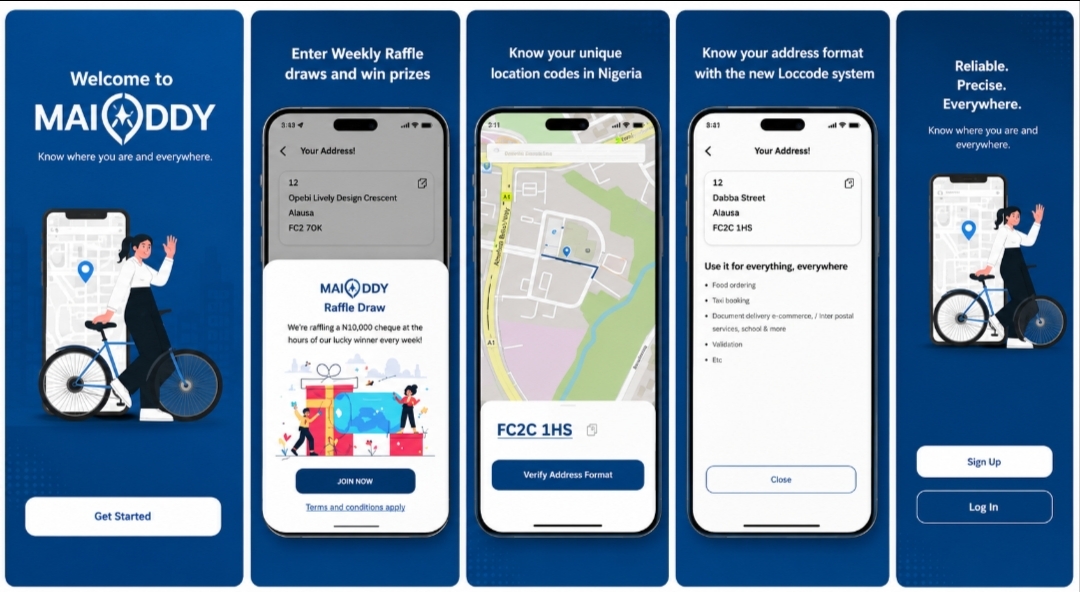
Maiaddy
Where Maiaddy expects to actually make money says a lot about how it sees this market. Not consumer downloads. The company expects businesses integrating its APIs and enterprise services into logistics, delivery, transportation, e-commerce, emergency services, real estate, field operations, utilities, financial services and government workflows to become the primary revenue driver over time, alongside premium tiers for organisations that need heavier analytics and routing tools.
“For now, our focus is on growing the ecosystem, working closely with early adopters, and ensuring we’re solving meaningful problems before aggressively monetising,” Onyejeli says. Pricing for those enterprise tiers hasn’t been finalised or disclosed.
That is a deliberate strategic choice. Maiaddy is treating Africa’s mapping gap as underpriced infrastructure, and it says it’s already in early conversations with logistics, financial services and public sector prospects.
What launch day actually covers, and what it doesn’t yetCoverage is national in ambition from day one, though Maiaddy is candid that this doesn’t mean uniform quality everywhere. “Beginning from today, users across Nigeria will be able to access the platform, although we expect some regions to have richer data and more features as we continue expanding and improving our coverage,” he says. “Mapping is never truly finished; it’s a living system that continuously evolves as new locations are added and data quality improves.”
Has any of this been pilot-tested before today? Onyejeli says yes. “During development we’ve worked closely with prospective users and businesses to validate ideas, gather feedback, and refine the product experience,” the CEO explains, and the biggest lesson to come out of that process was that “organisations don’t just need maps, they need reliable location intelligence that integrates into their existing workflows.” Businesses cared as much about accuracy, speed and ease of integration as they did about navigation itself, feedback that has since shaped the product roadmap.
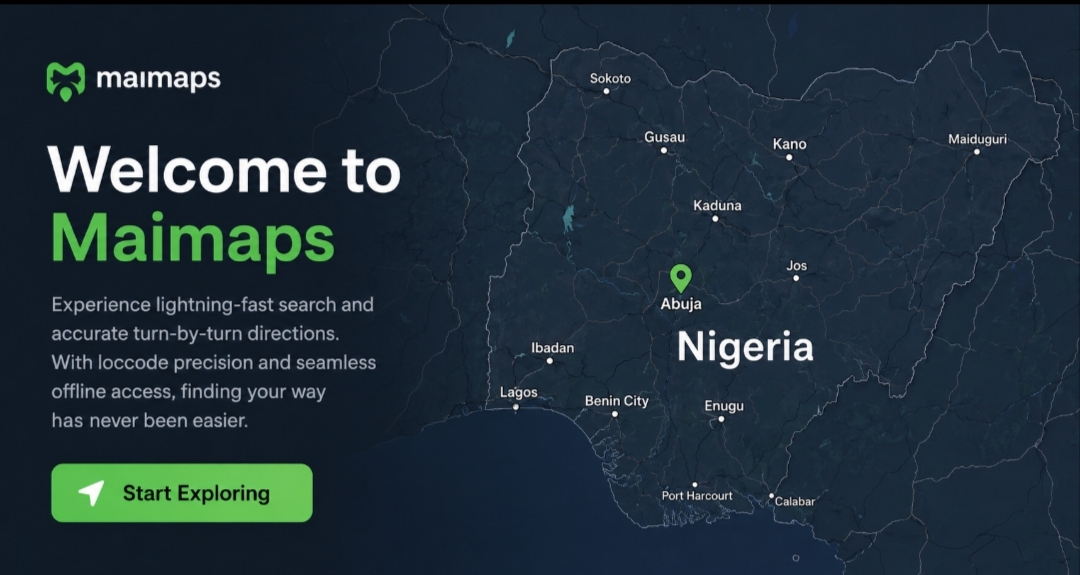
Maimaps
While Maimaps is designed as a horizontal platform, Onyejeli is candid that early traction will likely concentrate in sectors where a wrong pin drop has real operational cost: logistics and delivery, transportation, e-commerce, emergency services, real estate, field operations, utilities, financial services and government. Individual consumers remain part of the plan too, largely through easier navigation and more accurate location sharing, but the long-term ambition is bigger than any single use case. “Our long-term vision is to become foundational location infrastructure that developers, businesses, governments, and everyday users can all build upon,” Onyejeli says.
Ask the team what a year of building taught them, and the answer isn’t really about GIS or API architecture. It’s about how Nigerians actually talk about where they are. “People don’t naturally communicate locations using perfect addresses,” the CEO observes. “They use landmarks, neighbourhoods, familiar buildings, and local context. Building a map platform with people who understand those patterns is incredibly important.” The company also points to patience as an underrated startup discipline: “It’s tempting for startups to launch quickly, but investing time in getting the fundamentals right has resulted in a much stronger platform than if we had rushed to market.”
Onyejeli’s framing of the underlying problem, that Nigeria has been trying to build a digital economy on top of a broken map, is the correct diagnosis. It’s also not a new one. Several African startups have already taken runs at pieces of this puzzle, from digital addressing to last-mile logistics data. What’s genuinely uncommon here is attempting the consumer app, the developer API and the SDK ecosystem all at once, at launch, rather than sequencing them across separate funding rounds.