TON liquidity is not concentrated in a single place. Different DEXs have their own pools, market makers hold their own inventories, and the available price for the same asset pair can vary de
TON liquidity is not concentrated in a single place.
Different DEXs have their own pools, market makers hold their own inventories, and the available price for the same asset pair can vary depending on where a trader looks.
That creates a familiar problem across DeFi: liquidity exists, but finding the most useful liquidity for a particular trade can be difficult.
Omniston approaches this by putting multiple liquidity sources into the same execution process. Instead of making a trader compare different platforms manually, it can evaluate public liquidity and resolver quotes for the same swap and determine how the order should be executed.
From the user's perspective, this can look like a straightforward swap.
Underneath it, however, there can be several liquidity sources competing to provide the final result.
Liquidity fragmentation is a natural consequence of an open blockchain ecosystem.
Multiple DEXs can support the same assets while maintaining completely separate liquidity pools. Each pool has its own reserves, trading activity and resulting price.
STONFI has its own liquidity. Other TON protocols have theirs. Independent market makers can also provide liquidity using their own capital.
As a result, there is not necessarily one universal price for a swap at any given moment.
For a trader, this creates an unnecessary comparison problem.
A quote that looks attractive on one platform might not remain attractive once trade size, price impact and fees are considered. Another source could have deeper liquidity or a better executable price for that particular order.
The challenge is therefore not simply finding liquidity.
It is finding and combining the liquidity that makes the most sense for the trade.
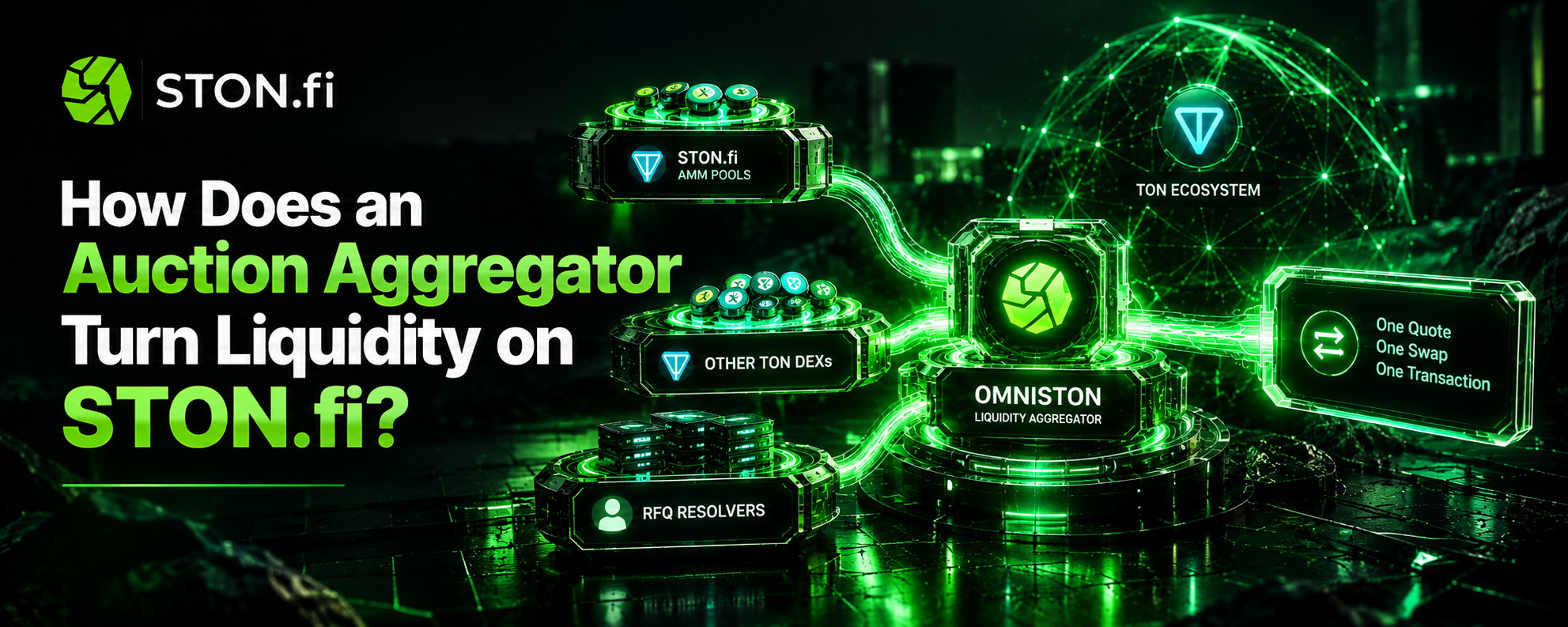
Omniston brings several types of liquidity into the same routing process.
The first is STONFI's own AMM liquidity. These pools determine prices through their underlying pool mechanics and available reserves.
The second is liquidity from other TON DEXs. Instead of treating external pools as completely separate destinations, Omniston can evaluate them alongside STON FI's own available liquidity.
The third comes from RFQ resolvers.
Resolvers operate differently from AMM pools. Rather than relying entirely on a public pool's mathematical pricing curve, they can respond to a specific request using their own inventory, pricing models and risk parameters.
The important part is that these sources can be considered together.
A resolver isn't simply waiting in the background for every pool to fail. Its quote can compete with public liquidity during the same request.
That creates a broader marketplace for execution.
Finding the best individual pool is not always enough.
Consider a larger trade entering a relatively shallow pool. Because the order represents a larger percentage of that pool's reserves, the execution price can deteriorate as more of the trade moves through it.
This is normal AMM price impact.
Omniston's routing architecture allows an order to be represented through routes, steps and chunks. That means the system can divide an order rather than assuming that one liquidity source has to handle everything.
A portion of the trade might use one pool.
Another portion could use a different liquidity source.
A resolver might provide another part if its quote produces a better result.
The trader does not need to manually construct those pieces. The routing layer handles the underlying distribution while presenting the user with a single swap experience.
This becomes particularly useful when liquidity is unevenly distributed across the ecosystem.

RFQ resolvers introduce a different kind of liquidity into the comparison.
An AMM pool exposes liquidity through its reserves and pricing curve. A resolver, on the other hand, can respond directly to a request with a quote backed by its own capital.
That difference can become important for certain trades.
A public pool may have limited depth for a particular asset pair. A resolver with inventory on hand could potentially provide a more competitive quote for that request.
The opposite can also happen.
There is no requirement for the resolver to win every comparison. Its quote is simply another option that can be evaluated against the available pool liquidity.
This competition is one of the more interesting parts of the aggregation model.
Instead of assuming that one type of liquidity is always superior, Omniston can compare different execution mechanisms according to the conditions of the specific trade.

A liquidity aggregator cannot rely on a price that was calculated several minutes ago and assume it is still executable.
AMM reserves change whenever trades occur.
A resolver's inventory changes as it completes orders. Its willingness to provide liquidity can also change depending on its current exposure and view of the market.
This means the best route for a swap is not a permanent piece of information.
It is a snapshot of current market conditions.
Omniston's quote architecture is designed around this reality. Pricing can be delivered as a live stream, allowing the system to work with current quotes rather than relying on a permanently cached price.
Quotes also have a validity period.
That is important because an executable quote is fundamentally different from a historical price displayed on a chart. The former represents a time-sensitive opportunity to execute under particular conditions.
All of this infrastructure exists to hide unnecessary complexity from the person making the swap.
The trader does not need to know which TON DEX has the deepest pool.
They do not need to manually ask several resolvers for prices.
They do not need to decide how a large order should be divided between different sources.
Instead, they request a swap and receive an execution result produced by the routing system.
Behind that simple interaction, Omniston can be evaluating different pools, resolver quotes, trade sizes, routes and potential price impact.
The complexity is pushed into the infrastructure rather than placed on the trader.
That is arguably the main purpose of an aggregation layer.
Imagine someone wants to swap USDT for GRAM.
Suppose STONFI has one pool for the pair, while another TON DEX has a different reserve balance. At the same time, a resolver has $GRAM inventory and is willing to provide a quote.
There is no reason to assume the first pool checked will produce the best execution.
Omniston can evaluate the available options for the request and compare their expected outcomes.
If one source can handle the entire trade efficiently, the order can use that route.
If another source offers better conditions for part of the order, the trade can potentially be divided.
The final experience remains one swap even though multiple sources may have contributed to its execution.
This is the difference between simply displaying multiple prices and actually building an execution layer around them.
TON's liquidity fragmentation does not disappear because Omniston exists.
The pools remain separate.
Resolvers still maintain their own capital.
Different protocols still have different reserves and pricing conditions.
What changes is where the burden of dealing with that fragmentation sits.
Without aggregation, the trader has to perform the comparison.
With an aggregation layer, the infrastructure can perform much of that work before execution.
That makes liquidity fragmentation less visible without pretending that the underlying liquidity has been unified into one pool.
Omniston's role becomes more interesting when viewed as infrastructure rather than simply another swap interface.
The value comes from connecting different forms of liquidity to the same execution process.
AMM pools contribute public liquidity.
Other TON DEXs add additional sources of depth.
Resolvers introduce independently managed capital and direct quotes.
Routing then determines how those sources can be used for a particular request.
The result is an execution model where the best available path does not have to come from a single location.
For traders, that can mean less manual comparison.
For liquidity providers and resolvers, it creates another route through which their liquidity can compete for order flow.
And for the broader TON ecosystem, it provides a way to make fragmented liquidity more accessible without requiring every protocol to merge its liquidity into one shared pool.
The interesting part of Omniston is not simply that it can find different prices.
It is that it treats TON liquidity as a collection of independent sources that can compete, combine and change in real time.
STONFI pools, other TON DEX liquidity and RFQ resolvers can all become part of the same execution decision.
Large trades can be divided into smaller chunks when that produces a more efficient route, while live quoting allows the system to respond to constantly changing liquidity conditions.
The trader ultimately sees one swap.
Behind that swap is an aggregation layer designed to answer a much harder question:
Given the liquidity available across TON right now, how should this particular trade actually be executed?
That is where Omniston's role becomes more than simple price discovery. It becomes an infrastructure layer connecting fragmented liquidity to a single execution experience.
Useful Links