Ripple institutional finance is shaping XRP’s market configuration as the asset becomes increasingly defined by a structural split between leveraged derivatives pressure and steady spot accum
Ripple institutional finance is shaping XRP’s market configuration as the asset becomes increasingly defined by a structural split between leveraged derivatives pressure and steady spot accumulation, even as Ripple expands deeper into institutional finance. This setup has created a tense market condition where price weakness persists despite underlying capital flows pointing in a different direction.
Data shows that XRP continues to trade under heavy short-side pressure in derivatives, while spot markets and ETF-linked demand provide a stabilizing counterforce. The contrast is becoming sharper as the institutional development tied to Ripple institutional finance continues to expand across brokerage, custody, and settlement infrastructure.
Why is the market split becoming more visible?
Ripple institutional finance is gaining attention because it sits at the center of XRP’s evolving disconnect between price action and institutional expansion. The current phase of Ripple institutional finance is unfolding while derivatives markets continue to build aggressive short exposure against XRP.

How Ripple Institutional Finance Growth Could Support Long-Term XRP Accumulation 5
At the same time, this expansion is being reinforced through trademark filings covering prime brokerage, securities lending, hedge fund financing, clearing systems, and institutional settlement functions. These filings define the operational perimeter of Ripple institutional finance, but the key shift is not just legal scope.
It is the alignment between existing institutional operations and traditional capital market infrastructure. This development signals that Ripple institutional finance is already embedded in execution layers rather than remaining a future-facing concept.
Why are XRP traders facing extreme drawdowns?
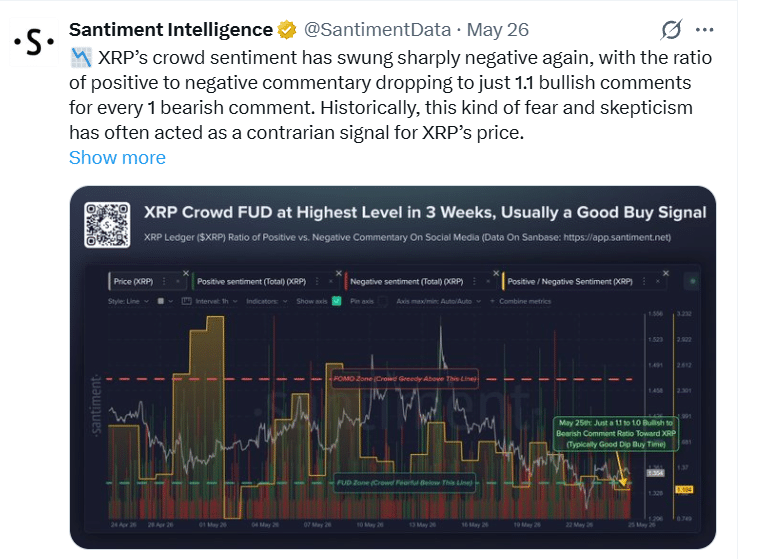
XRP traders are experiencing severe financial pressure as unrealized losses deepen across short-term market participants. Santiment data shows that the average XRP trader over the past 30 days is holding roughly 47% unrealized losses.
The market-value-to-realized-value ratio has fallen to its lowest level since December 2020, marking a statistically significant stress zone. This deterioration follows an earlier rally phase where expectations around regulatory clarity, ETF approvals, and Ripple expansion drove aggressive positioning.
The reversal left late entrants exposed, increasing forced selling and accelerating downside momentum. Sentiment data reinforces this condition, with bullish-to-bearish commentary compressed near 1.1.
This reflects exhaustion rather than strong conviction selling, although it does not signal an immediate recovery. Despite this pressure, Ripple institutional finance remains present in long-term positioning discussions, although its effect on short-term price action remains limited.
How Ripple Institutional Finance Growth Could Support Long-Term XRP Accumulation 6
What does the derivatives versus spot imbalance really show?
The most important signal in XRP’s current structure is the imbalance between leveraged short positioning and steady spot absorption. Exchange data shows repeated expansions in XRP open interest during recent declines.
Binance added approximately 25.6 million XRP in one wave, while Bybit added about 54 million XRP. A second phase added another 28.9 million XRP on Binance and 42.9 million XRP on Bybit, bringing total new leveraged positioning close to $107 million at $1.34–$1.35 levels.
However, the direction of this positioning is heavily one-sided. Binance perpetual futures cumulative volume delta has dropped to around -$641.9 million, reflecting sustained dominance of aggressive short sellers.
At the same time, spot markets show the opposite flow. Estimated spot cumulative volume delta has climbed to roughly +$397.3 million, indicating consistent accumulation that continues to absorb sell-side pressure.
This creates a two-speed market. Fast leverage is driving downside pressure while slower capital accumulation is absorbing supply. Ripple institutional finance is often referenced as part of the longer-duration demand backdrop, though it does not neutralize short-term liquidation risk.
Are ETF inflows strong enough to stabilize price action?
ETF inflows are acting as structural demand support, but they are not strong enough to override derivatives volatility. XRP-linked exchange-traded funds have recorded approximately $117 million in inflows, extending a 13-day consecutive inflow streak and pushing total cumulative inflows beyond $1.12 billion.
This reflects consistent allocation from regulated capital channels. However, these inflows function more like delayed or latency demand compared to the immediate impact of derivatives positioning. Futures markets react in real time to leverage shifts, while ETF flows accumulate more gradually.
This difference in speed creates an uneven balance of influence. Ripple institutional finance benefits indirectly from this structure, as regulated access points expand XRP exposure across traditional markets. Still, ETF demand alone cannot fully counteract extreme short positioning during volatility spikes.
Is Ripple’s institutional expansion changing its core identity?
Ripple’s expansion into institutional infrastructure continues to reshape how market participants interpret its long-term trajectory. Recent trademark filings span prime brokerage, securities lending, clearing systems, hedge fund financing, and broader financial market operations.

How Ripple Institutional Finance Growth Could Support Long-Term XRP Accumulation 7
These are core components of traditional capital architecture, not peripheral crypto services. This direction aligns with Ripple Prime, formed after the $1.25 billion acquisition of Hidden Road.
The platform clears over $3 trillion annually for more than 300 institutional clients, placing it in the category of large-scale financial intermediaries rather than crypto-native infrastructure providers. Alongside custody, treasury systems, and payment rails, XRP functions as a liquidity mechanism within this broader setup.
However, market observers emphasize a persistent separation between Ripple institutional finance expansion and XRP price performance, since revenue growth does not automatically transmit into token appreciation.
What do historical XRP cycles suggest about the current phase?
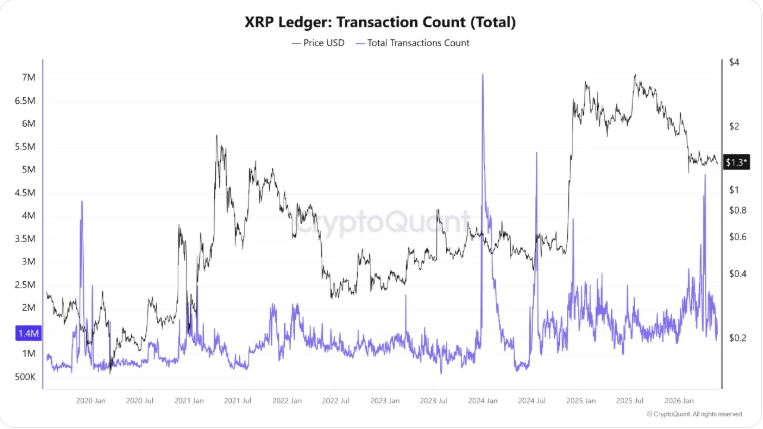
Historical XRP behavior shows that sharp increases in network activity have often preceded major cycle expansions, but only after prolonged consolidation phases. Previous surges were followed by extended sideways movement before eventual breakout phases developed.
Similar behavior is visible now, with XRP consolidating within a $1.30–$1.50 range after earlier activity spikes. However, the interpretation remains uncertain. Past cycles have also resulted in long stagnation periods before any directional breakout, meaning pattern repetition is not guaranteed.
How Ripple Institutional Finance Growth Could Support Long-Term XRP Accumulation 8
Conclusion
Ripple institutional finance sits at the center of XRP’s evolving structure, but it exists within a market defined by unresolved tension rather than clear direction. Spot accumulation and ETF inflows suggest persistent underlying demand, while derivatives markets continue to show extreme short exposure and structural fragility.
This creates a market where price is not purely driven by capital strength, but by the speed difference between liquidation pressure and absorption flows. Ripple institutional finance continues to expand into brokerage, custody, clearing, and settlement systems, reinforcing a long-term institutional thesis.
However, the near-term outcome remains uncertain, with both stabilization and continuation of the downtrend still valid possibilities depending on how these opposing forces resolve.
Glossary
Spot Market: Direct XRP trading showing real buying activity.
Open Interest: Total active futures positions reflecting leverage in play.
CVD: Net flow between buyers and sellers in the market.
Short Selling: Borrowed trading used to profit from price drops.
Market Divergence: Spot and derivatives moving in opposite directions.
Frequently Asked Questions About Ripple Institutional Finance
Why is XRP under pressure?
XRP is under pressure due to heavy short selling in derivatives markets.
What is causing the market split in XRP?
The split is caused by short selling in derivatives while spot markets continue buying.
Why are XRP traders losing money?
XRP traders are losing money because prices have fallen after many bought at higher levels.
What is happening in XRP spot markets?
XRP spot markets are showing steady accumulation.
Why is XRP not rising despite ETF inflows?
XRP is not rising because derivatives selling pressure is stronger than ETF inflows.
Sources:
Cryptoslate
Financeyahoo
Read More:How Ripple Institutional Finance Growth Could Support Long-Term XRP Accumulation">How Ripple Institutional Finance Growth Could Support Long-Term XRP Accumulation