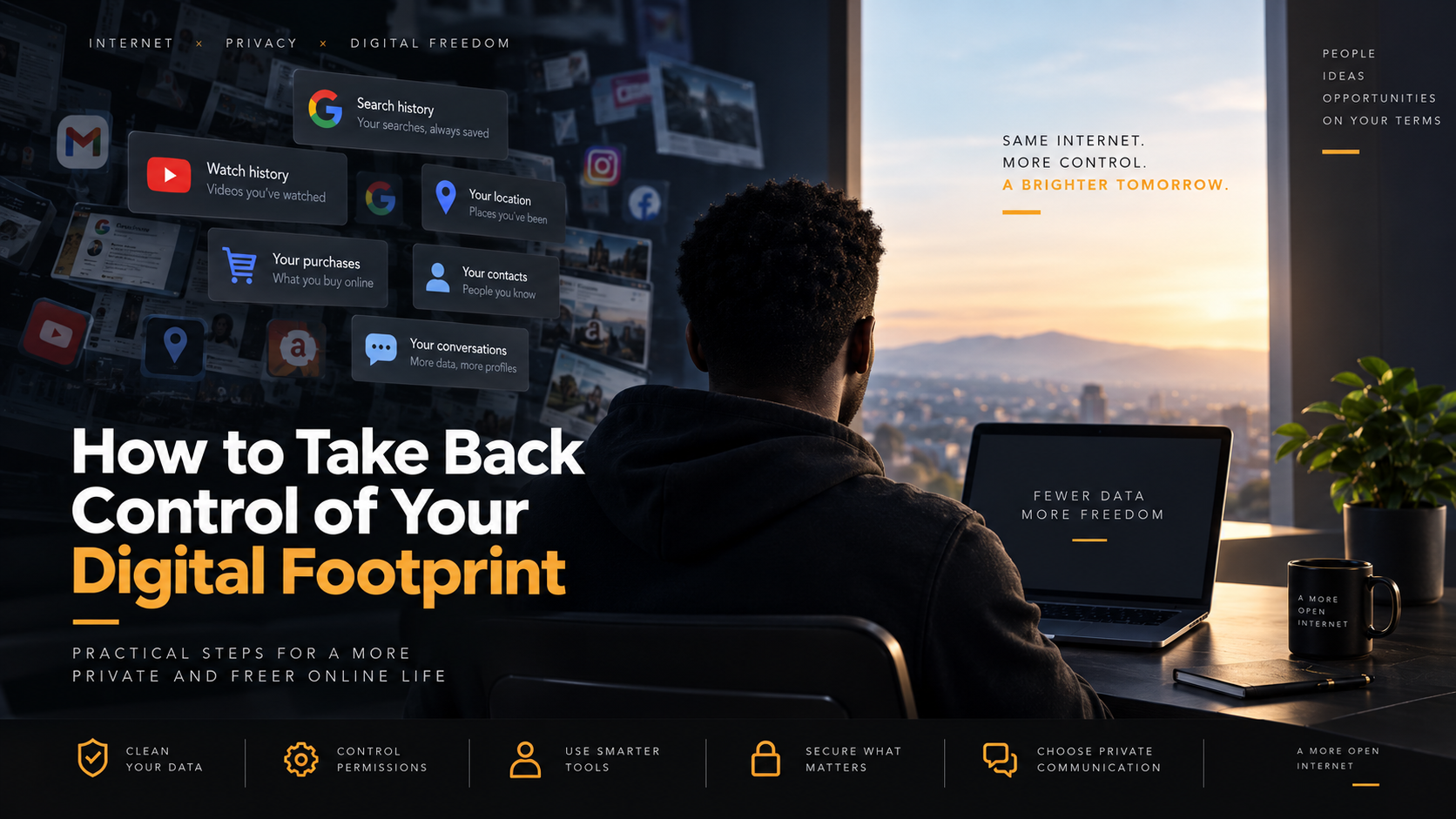
You probably have more data online than you realize. Your searches. Your location. Your watch history. Your purchases. Your contacts. Your conversations. And the interesting part is that you
You probably have more data online than you realize.
Your searches.Your location.Your watch history.Your purchases.Your contacts.Your conversations.
And the interesting part is that you don't necessarily need to do anything unusual for this to happen.
You simply use the internet.
The goal of privacy isn't to disappear from the internet. For most people, that's neither realistic nor necessary.
The goal is simpler:
Give away less data than you have to.
If you use Google, Apple, Microsoft or similar services, take a few minutes to review what your account has accumulated over the years.
Search activity, YouTube history, location-related information and other activity can become part of your digital footprint.
You don't have to keep everything forever.
Review your activity, delete what you no longer need and check whether automatic deletion options are available.
You might be surprised by how much information is sitting there simply because you never looked.
This one is surprisingly simple.
Your flashlight probably doesn't need your contacts.
A game probably doesn't need your microphone running in the background.
A shopping app doesn't necessarily need permanent access to your location.
Go through your permissions and ask one question:
Does this app actually need this information to do its job?
If the answer is no, remove the permission.
Privacy often starts with very boring settings.
Using the same email address everywhere makes it incredibly easy to connect different parts of your online life.
Consider separating important accounts from newsletters, shopping, social platforms and websites you don't completely trust.
You don't need ten complicated identities.
Even having a separate address for less important services can reduce the amount of information tied directly to your primary identity.
Websites don't necessarily need to know everything about you.
Using privacy-oriented browser settings and tracker-blocking tools can reduce some forms of tracking.
It won't make you invisible.
And that's important to understand.
Privacy isn't invisibility.
It's about reducing unnecessary data collection and making it harder to build an overly detailed profile of you.
Privacy without security is fragile.
Use unique passwords.
Use a password manager.
Enable two-factor authentication or passkeys where available.
Keep your recovery methods secure.
One reused password can turn a problem with one account into a problem across your entire digital life.
You can clean your search history.
You can restrict app permissions.
You can use a privacy-focused browser.
You can protect your files.
But then you may spend hours every day communicating through platforms where your account, identity and conversations depend on a centralized service.
This is where projects like Liberdus become interesting.
Not because they magically make someone anonymous.
And not because privacy means having nothing to hide.
The interesting question is architectural:
Can communication be built differently?
Liberdus explores a model where communication, identity and payments can exist within a decentralized ecosystem.
Even something as simple as its Toll mechanism challenges a familiar assumption: that anyone should be able to demand your attention for free.
If someone outside your connections wants to message you, a Toll can put an economic value on that unsolicited access.
That's a small feature, but it points toward a much bigger idea:
Your attention is part of your digital life too.
There is no single application, setting or technology that will suddenly make your digital life private.
It's a combination of decisions.
What you share.
What you allow.
What you keep.
Who gets access.
And which tools you choose to use.
You don't have to leave the internet.
You just have to stop giving the internet everything it asks for.
Privacy isn't about disappearing.It's about having more control over what remains visible.