How to Trade Tokenized Stocks on OKXICE: Steps, Rules, and Risks OKXICE tokenized stocks are now open to approved OKX customers in the US. The market opened on November 23, 2026, and runs all
How to Trade Tokenized Stocks on OKXICE: Steps, Rules, and Risks
OKXICE tokenized stocks are now open to approved OKX customers in the US. The market opened on November 23, 2026, and runs all day, every day. New readers can first learnhow stock tokens work.
OKXICE: The ICE and OKX Tokenized Venue
Intercontinental Exchange (ICE) and an OKX affiliate each own half of OKXICE. ICE owns the New York Stock Exchange, but the NYSE does not run this venue.
The market is called the Tokenized Securities Venue, or TSV. Itsofficial public notice listed six launch stocks: COIN, SECZ, MSTR, BTGO, HOOD, and CRCL.
Each launch stock traded against USDC, a token tied to the dollar. See thisstablecoin explainer for more.
OKX and ICE Plans for Digital Markets
According to the project, the firms aim to build systems for digital financial products. TheirJune 2026 announcement pairs OKX blockchain tools with ICE market systems.
Separate plans for ICE futures and NYSE stock tokens still need approvals.
Why OKXICE Offers Round-the-Clock Trading
News can break while stock markets are closed, so OKXICE tokenized stocks let approved users act.
The SEC'sSeptember 17 order frees qualified venues from exchange registration, with strict conditions. OKXICE says it is not registered with the SEC for this activity.
How OKXICE Tokenized Stocks Link to Real Shares
Each token is a legal claim to one share. Securitize creates the launch tokens, and a registered broker holds the matching shares.
The venue has no order book, so users trade with a liquidity pool. This shared pot of two assets sets the price.
According to the project, holders get normal rights, including dividends and votes. Some payouts may need an app claim.
Steps to Trade OKXICE Tokenized Stocks
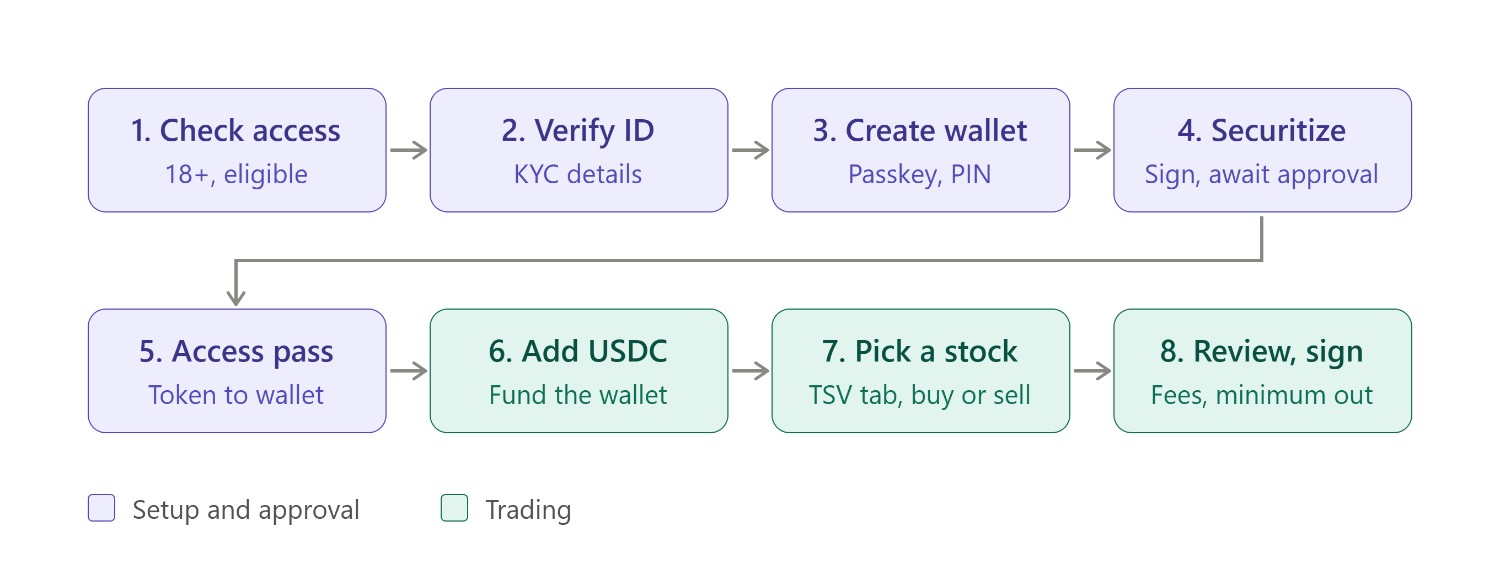
Theofficial venue page, notice, and terms show this path:
Check that you qualify. You need to be at least 18 and meet the eligibility rules. You also need an OKX Inc. account in good standing.
Verify your identity. Expect to share your name, birth date, address, nationality, and Social Security number. It works like a standard KYC check.
Set up a CeDeFi Wallet. You create a passkey for it. After that, you approve actions with your device PIN or biometrics.
Open a Securitize account.Sign the forms it asks for. Then wait for approval, which can take a little while.
Receive your access pass.Once every check clears, OKXICE sends a locked token to your wallet. That token is your way in.
Add USDC. Move enough funds from your OKX account into the wallet. Make sure the amount covers your trade and the fees.
Choose a stock. Open the TSV tab and pick buy or sell. Then type in the amount.
Review and sign. Look over the price, the fees, the wallet address, and the minimum amount you will receive. If it all looks right, sign to confirm.
Quotes refresh about every 15 seconds. A trade fails if the price moves past the slippage limit. Target-price orders are possible but might not fill.
The 0.30% Trading Fee and Network Costs
The listed fee on OKXICE tokenized stocks is 0.30%. Pool funders earn 0.20%, while OKXICE keeps 0.10% as a service fee.
The venue page calls trading gas-free, but the notice says users pay network fees, even on failed trades. The terms say users may pay unless the screen shows the fees as covered.
SEC Volume Caps, Trading Halts, and Issuer Objections
The SEC order sets these limits:
Stock group
Most symbols
Daily volume cap
Tier 1
75
0.25% of last month's daily average
Tier 2
250
2.5% of last month's daily average
The system blocks trades above a cap, and a second or later breach brings a three-month pause.
Trading stops when the real stock is halted on its main exchange. The venue also bans market abuse.
For outside-made tokens, venues must give companies at least 30 days' notice. A timely objection blocks that stock, and the November 20 notice named 67 objectors. They included Apple and Tesla.
X Layer Pools and Wallet Access Checks
The system runs on X Layer, a second-layer blockchain from OKX. It uses Uniswap v4 pools, with added code that checks each wallet.
The access pass is a soulbound token, so holders can't transfer it. Other contracts route trades and track caps.
24/7 Features of OKXICE Tokenized Stocks
Trading runs every day and night.
Both sides of each trade settle together.
Trades either fill in full or fail.
Users control their own wallets.
Trade data goes public within 10 minutes.
Users should read aself-custody safety guide first.
Pool prices follow the formula x*y=k. Buying a stock token raises its pool price, while selling lowers it.
The trading code doesn't read outside price feeds. An OKX team and Certified Kernel Tech audited the code, but audits can't remove all risk.
What Stock Tokens, USDC, and Access Passes Do
With OKXICE tokenized stocks, the token carries the share claim and linked rights. USDC pays for trades, while the access pass grants entry.
Approved users can also fund pools and earn part of the fee.
Tokenomics: One Share Backs Each Stock Token
The venue has no governance token or blockchain voting. Its notice and terms show no supply cap or unlock plan.
Item
Official status
Governance token
None
Allocation table
None found in the notice or terms.
Stock token backing
One share for each token
New stock tokens
Issued after the share is bought and held
Redeemed tokens
Burned under securitization terms
The notice also describes no separate OKXICE coin. Stock token supply changes as tokens are issued or redeemed.
OKXICE Milestones and Pending Broker Plans
It found no formal roadmap in the notice or terms. This table lists past steps and announced plans.
Date
Milestone
June 22, 2026
Joint venture announced
September 17, 2026
SEC order issued
November 11, 2026
Launch date announced
November 23, 2026
The venue opened.
Rolling
More confirmed assets due
No date
Broker and futures roles, pending approval
113 Confirmed Assets and Named Issuers
The launch update confirms 113 stocks and funds for a staged rollout, and the app shows live ones.
Named issuers and fund firms include Circle, Coinbase, Fidelity, Robinhood, and Strategy. The venue fits the wider rise ofreal-world asset tokens.
Benefits of Longer Hours and Shareholder Rights
You can trade outside regular market hours. You also see the fees before you sign anything. The tokens come with promised shareholder rights, which sets them apart from products that only track a price.
Price Gaps, Wallet Loss, and Legal Risks
Prices can slip,especially at night or in thin pools. Fewer traders means bigger gaps.
Your wallet is your responsibility. OKXICE cannot recover lost keys or reverse a trade once it is confirmed.
Legal protection has limits. The launch update says assets you hold yourself do not carry SIPC or FDIC cover. It also calls SIPC treatment uncertain, so the picture is not fully clear.
Other parties add risk too. Securitize or its broker could fail, and Securitize can freeze tokens in some cases. Code bugs or network outages could also disrupt trading.
OKXICE can change its contracts with no built-in delay. Anyone who funds a pool can lose value.
The SEC order runs until September 17, 2031, unless it changes sooner. Thevenue terms require private arbitration and limit OKXICE liability.
Expert Source: Pool Depth and Issuer Support
From a market design view, pool depth is the key test. Long hours help most when users can trade near a fair price.
Issuer support also matters, as company objections may keep the stock list narrow.
New Listings, Liquidity, and Approvals to Watch
Key signs for OKXICE tokenized stocks include new listings, pool size, price gaps, trading pauses, and rule changes.
The venture's broker and futures plans still need approval.
What to Check Before a First OKXICE Trade
OKXICE tokenized stocks bring real share claims into a blockchain market. However, setup takes more work than a normal broker order.
New users should read the latest terms and learn wallet safety first.
Disclaimer: This article is for educational and informational purposes only and should not be considered financial or investment advice. Always conduct your own research before making investment decisions.