TLDR Weekend military strikes between US and Iran have unsettled global markets Tech-heavy Nasdaq 100 futures tumbled 1%, while S&P 500 futures declined 0.3% Brent crude surged 3.8% approachi
TLDR
- Weekend military strikes between US and Iran have unsettled global markets
- Tech-heavy Nasdaq 100 futures tumbled 1%, while S&P 500 futures declined 0.3%
- Brent crude surged 3.8% approaching $79 amid fears of Hormuz Strait disruption
- Bitcoin dropped 1.6% to $62,943 as investors flee risky assets
- Critical inflation reports and major financial earnings reports scheduled this week
Market futures took a hit Monday following a weekend of military exchanges between the United States and Iran. The tech-focused Nasdaq 100 futures plummeted 1%, while S&P 500 futures retreated 0.3%. Dow Jones futures remained relatively unchanged.
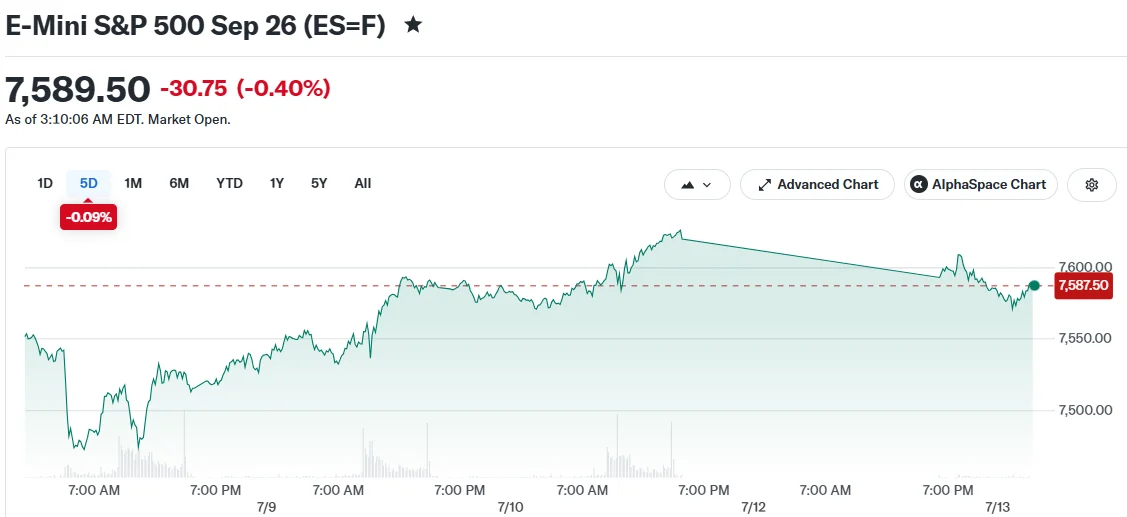 E-Mini S&P 500 Sep 26 (ES=F)
The renewed Middle Eastern hostilities unnerved market participants who were already monitoring the region with heightened concern. Despite both major indices posting modest weekly gains, those advances now face significant headwinds.
According to Iran’s Islamic Revolutionary Guard Corps, the Strait of Hormuz has been declared “closed until further notice.” American officials have challenged this assertion, maintaining the waterway remains operational. However, data from tracking service Kpler indicates zero LNG shipments have passed through since Saturday.
Oil prices experienced a sharp rally in response. Brent crude advanced 3.8% to reach $78.89 per barrel, while West Texas Intermediate gained 3.7% to $74.04. Deutsche Bank’s Jim Reid noted that energy markets had “reacted” to reports of vessel damage, intercepted drone strikes, and attacks targeting energy infrastructure throughout the Gulf region.
President Trump indicated ceasefire negotiations with Iran continue, though he simultaneously declared the existing ceasefire “over.” This conflicting messaging has amplified market volatility and investor confusion.
Inflation Data and Earnings in Focus
The timing of this geopolitical crisis couldn’t be more critical for financial markets. Two pivotal inflation measurements arrive this week. Tuesday brings the Consumer Price Index release, with the Producer Price Index following on Wednesday.
These economic indicators will be crucial for determining whether Middle Eastern developments are influencing domestic inflation trends. The data will also inform market expectations regarding Federal Reserve monetary policy decisions through year-end.
Corporate earnings season enters full swing simultaneously. Major financial institutions including JPMorgan Chase, Goldman Sachs, and Bank of America deliver quarterly reports Tuesday. Netflix and UnitedHealth also announce results this week.
Taiwan Semiconductor Manufacturing Company releases its quarterly performance data in coming days. Market analysts anticipate these figures will provide valuable insight into artificial intelligence chip demand, a subject commanding intense Wall Street attention.
The artificial intelligence investment narrative has weakened recently. Questions persist about whether technology giants can sustain their aggressive AI infrastructure spending indefinitely.
South Korean semiconductor manufacturer SK Hynix experienced a 15% share price collapse Monday following its Friday US listing debut. This decline pulled South Korea’s KOSPI index down 9%, underscoring growing doubts about the sustainability of AI-driven market momentum.
Bitcoin Drops as Risk Appetite Fades
Bitcoin declined 1.6% during the last 24 hours, settling at $62,943. The cryptocurrency’s weakness mirrors a widespread retreat from speculative investments amid escalating geopolitical uncertainty.
The 10-year US Treasury yield ticked up 1 basis point to 4.57%. Meanwhile, the US dollar weakened 0.1% relative to a basket of major global currencies.
With energy prices spiking, crucial inflation data approaching, and earnings season launching, the coming week promises to be among the most consequential of the year for market participants.
The post How US-Iran Tensions Are Shaking Global Markets and Driving Oil Higher appeared first on Blockonomi.