XRP whale accumulation is emerging as a key on-chain trend as data points to a growing divide between large investors and smaller holders. Santiment’s latest on-chain data shows that over the
XRP whale accumulation is emerging as a key on-chain trend as data points to a growing divide between large investors and smaller holders. Santiment’s latest on-chain data shows that over the five weeks since late June, wallets holding between 100,000 and 100 million XRP increased their balances by 2.8%, while the smallest wallets reduced their holdings by 5.2%.
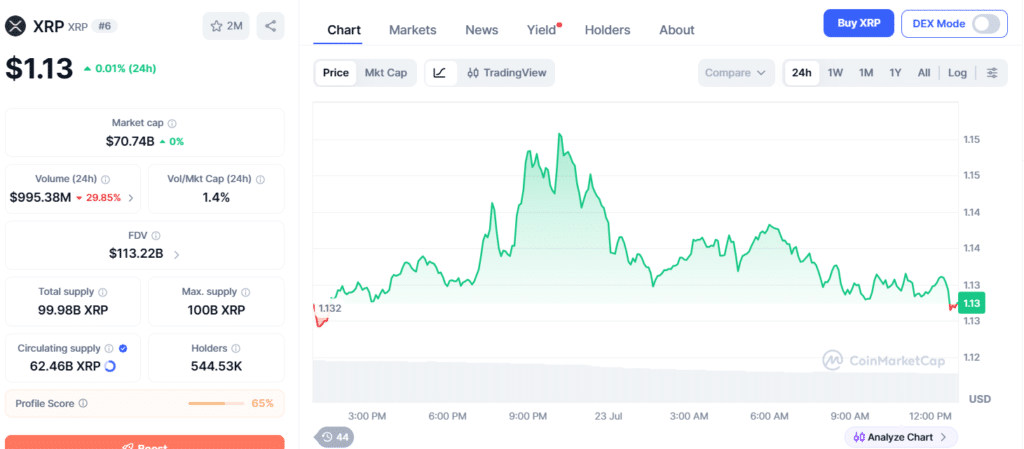
During the same period XRP rebounded from $1 to above $1.16 and is currently trading around $1.13. The changing ownership pattern has attracted attention because XRP has historically tended to follow the behavior of major stakeholders rather than the smallest retail participants.
What does XRP whale accumulation indicate about the latest market trend?
XRP whale accumulation reflects growing confidence among larger investors even as smaller holders continue to reduce exposure. On-chain data from Santiment shows that wallets holding between 100,000 and 100 million XRP, often referred to as whales and sharks, increased their combined holdings by 2.8% over the past five weeks.

How XRP Whale Accumulation Rises 2.8% as Small Holders Capitulate 4
This accumulation coincided with XRP rebounding to $1.16 from $1 at the end of June, suggesting larger market participants were steadily building positions during the recovery. Meanwhile, the smallest wallets reduced their holdings by 5.2% over the same period.
This shift represents a transfer of supply from smaller investors to larger holders, a trend that Santiment characterizes as bullish for XRP. The analytics firm stated on X, “Historically, XRP price has tended to move more with key stakeholders and against the smallest retail wallets, so this split supports the bullish case behind the bounce.”
Why are large investors increasing their XRP holdings?
The latest accumulation appears to be supported by both improving fundamentals and broader developments surrounding the XRP ecosystem. Santiment said the timing aligns with improving institutional access through potential XRP ETF products and the continued utility of the XRP Ledger across payments, tokenization, and the RLUSD stablecoin.
These developments have kept XRP in focus among sophisticated investors. While retail participation has weakened, larger holders appear to be positioning themselves based on longer-term developments rather than short-term price fluctuations.
Supporting data also indicates that selling pressure from major holders has eased. Whale deposits to Binance have fallen significantly, suggesting fewer large investors are moving XRP to exchanges for potential selling. Lower exchange inflows typically reduce immediate supply pressure, although they do not guarantee future price appreciation.
What do the latest market indicators show?
Current market data presents a balanced picture for XRP despite mixed trading activity. XRP is currently trading around $1.13 with a 24-hour gain of 0.39%. Its market capitalization stands at $70.96 billion, also up 0.39%, while 24-hour trading volume has declined 30.37% to $993.96 million. The volume-to-market-cap ratio currently stands at 1.4%.
How XRP Whale Accumulation Rises 2.8% as Small Holders Capitulate 5
Derivative markets also indicate that trader positioning continues to evolve. XRP futures trading volume reached $1.79 billion over the past 24 hours, while approximately $1.07 million worth of futures positions were liquidated. Of that total, around $510,850 came from long positions and $558,160 from short positions.
Open interest currently stands at $2.53 billion after rising 0.63%, suggesting market leverage is still adjusting gradually. Options volume declined 50.46% to $2.52 million, while options open interest increased 1.83% to $68.42 million.
Technical indicators also reflect a mixed outlook. The Relative Strength Index (RSI) stands at 55.21, indicating neutral momentum. The MACD continues to generate a buy signal, while the 200-day Simple Moving Average remains on a sell signal, indicating the price is still trading below this long-term trend line.
Could reduced retail participation strengthen the market structure?
The latest wallet activity suggests the ongoing shift could create a more resilient ownership structure. When larger holders accumulate while the smallest wallets continue to reduce positions, more supply moves into the hands of investors who have historically been less reactive to short-term market volatility.
Such ownership changes have previously coincided with stronger price support for XRP. However, Santiment’s data reflects a trend that developed over five weeks rather than a sudden surge in buying activity. Whether this structure remains supportive will depend on whether large holders continue adding to or maintain their positions.
At the same time, weaker spot trading activity suggests retail participation remains subdued. Although softer spot demand may limit immediate upside, it also indicates that widespread retail buying has yet to emerge, leaving room for additional demand if market sentiment strengthens.
What should investors monitor next?
The current on-chain signals provide constructive evidence, but future confirmation will depend on continued market participation. Market participants are likely to watch whether XRP whale accumulation continues over the coming weeks and whether sustained spot demand returns alongside institutional interest.

How XRP Whale Accumulation Rises 2.8% as Small Holders Capitulate 6
Continued development of the XRP Ledger through payments, tokenization and the RLUSD stablecoin may also remain important drivers of long-term confidence. Broader liquidity conditions and consistent network utility will remain key factors in determining whether the recent accumulation evolves into a more durable market trend.
Conclusion
XRP whale accumulation continues to stand out as one of the strongest on-chain signals supporting the asset’s recent recovery. Wallets holding between 100,000 and 100 million XRP increased their holdings by 2.8% over the past five weeks while the smallest wallets reduced exposure by 5.2%. That divergence coincided with XRP’s rebound from $1 to above $1.16 before the asset settled around its current trading level of $1.13.
Although derivatives data and technical indicators show that the market is still adjusting the latest on-chain figures indicate that larger investors remain confident despite weaker retail participation. Whether XRP whale accumulation develops into a longer-term bullish trend will depend on sustained demand, continued utility across the XRP Ledger ecosystem and broader market conditions.
Glossary
On-chain data- Blockchain records showing wallet and transaction activity.
XRP Ledger (XRPL)- Blockchain network that powers XRP transactions.
RLUSD- Ripple’s U.S. dollar-backed stablecoin.
Simple Moving Average (SMA)- Average price over a set period.
Open interest- Total number of active futures contracts.
Frequently Asked Questions About XRP Whale Accumulation
How much XRP did whales accumulate?
Santiment said large XRP wallets increased their holdings by 2.8% over the past five weeks.
What is the XRP Ledger used for?
The XRP Ledger is used for payments, tokenization and supporting RLUSD stablecoin.
What happened to small XRP holders?
Small XRP holders reduced their holdings by 5.2% during same five-week period.
What is XRP trading at now?
XRP is currently trading at around $1.13 based on latest market data
What should investors watch next?
Investors should watch whether whales keep buying and whether overall demand for XRP continues to grow.
Sources-
Coindesk
Blockchainreporter
Coinmarketcap
Coinglass
Tradingview
Cryptorank
Read More:How XRP Whale Accumulation Rises 2.8% as Small Holders Capitulate">How XRP Whale Accumulation Rises 2.8% as Small Holders Capitulate