How Zoi Network Works: From Bluetooth Transfers to On-Chain Settlement Most crypto payments fail the moment your signal drops. The app spins, the payment hangs and the person in front of you
How Zoi Network Works: From Bluetooth Transfers to On-Chain Settlement
Most crypto payments fail the moment your signal drops. The app spins, the payment hangs and the person in front of you is still waiting.
Zoi Network is built for that gap. It is a Zoi offline payment network, so phones pay each other directly over Bluetooth, and the blockchain records the payment later. The payment itself needs no signal, which makes it crypto without internet where it counts.
This guide shows how Zoi Network works, one step at a time. It is Zoi Network explained in plain words, using the official website and whitepaper v1.2.
Key Takeaways
Zoi payments travel phone-to-phone over Bluetooth, so no signal is needed to accept one.
The core idea is “accepted offline, settled on-chain.” Final settlement happens once any phone on the path goes online.
The Zoi app is free and live today. Offline payments are rolling out in phases.
Zoi Network Explained: What It Is
Zoi is built for the places the signal forgets. The whitepaper names night markets, metro tunnels, festival grounds, ferries, border towns, blackouts and disaster zones. Most crypto assumes you are online. Zoi assumes you are not, and designs from there.
The idea itself is not new. Cash, cheques and card terminals have always worked on trust first and settlement later: a shop takes your cheque today and the bank clears it days afterwards. Zoi brings that same model to crypto. Every payment is checked and risk-scored the second it is accepted, and finality arrives when the transfer reaches the chain. The network also pays the phones that make the system work, which is where the token comes in.
Source: official website.
What Is the ZOI Token?
The ZOI token is the network’s single token, so there is no second coin to track. It does two jobs. It is the unit that digital notes are denominated in, and it is the reward for verifiable work.
Inside the Zoi app, users earn ZOI by staying synced and inviting friends. Later, phones will also earn by carrying transfers for people around them. The site puts it simply: every phone makes the network stronger, and the network pays you back in ZOI. Rewards are meant for real people only, and the team says it closes fake accounts and takes back what they earned.
How Does Zoi Network Send Crypto Without Internet?
The answer starts with bearer notes. A bearer note is a signed digital banknote, and a phone can verify it with no connection at all. Think of a paper note: you look at it and decide, without calling the bank first.
Zoi gives a phone that same power. When someone pays you, your phone checks the signature on the spot, with no server involved. Every transfer is also digitally signed by the sender’s wallet, which is why nobody can fake a payment or change it on the way. Each note can be spent only once, and the chain enforces that rule later.
How Do Zoi Phones Pass Payments Over Bluetooth?
Your phone talks straight to the phones near it, the same way wireless earbuds connect. Many phones doing this together form a Bluetooth mesh. A payment hops from one phone to the next, and this phone-to-phone transfer goes on until one device on the path gets online.
Two helpers keep the trip honest. Witnesses are phones and certified payment points that stamp the transfers they see, and their weight comes from their credentials and history. The Trust Ladder tells the receiver how sure a payment is and how much to accept before accepting, because a small purchase and a large one do not need the same confidence. That is why offline crypto payments on Zoi are risk-scored at the moment of acceptance, not afterwards.
What Happens When a Zoi Payment Reaches the Internet?
The moment any phone on the path gets a connection, the payment moves on. It does not have to be the sender’s phone, and it does not have to be the receiver’s either. Any device on the path can push it forward, so the payment never waits for one particular phone.
Public relays then carry the transfer the rest of the way to the chain. For the people at the market, nothing changes: the vendor already has the payment and the customer has already left. The internet only matters for the final record.
How Zoi Offline Payments Get Settled On-Chain
On-chain settlement happens on Zoi’s settlement chain, which is built for this purpose. The official whitepaper gives it four jobs: finalising one spend per note, turning double-spends into proofs, keeping reputation records and paying contributors.
Finality arrives only when a transfer reaches this chain. Until then, trust rests on the signature, the witnesses and the Trust Ladder. Cheating is covered too, since the official FAQ says the network catches double-spending automatically and the cheater loses. That is the project’s own claim, so it is worth reading the whitepaper pages on fraud proofs before relying on it.
Zoi Step by Step at a Glance
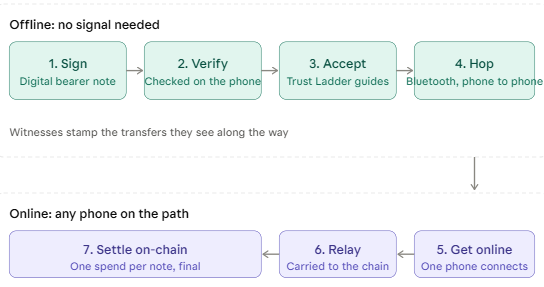
Here is how Zoi Network works in seven steps:
Step
What happens
Layer
1
Sender signs a digital note
Bearer notes
2
Receiver’s phone verifies it, no signal needed
Bearer notes
3
Trust Ladder shows how much to accept
Trust Ladder
4
Payment is accepted offline
Zoi app
5
It hops phone to phone, stamped by witnesses
Mesh and witnesses
6
One phone gets online, relays carry it on
Relays
7
The chain finalises it
Settlement chain
Quick flow: Sign → Verify offline → Accept → Hop over Bluetooth → Go online → Settle on-chain
What Is Live and What Comes Next
The Zoi app is live today. It is free on the App Store and Google Play, and people without Google Play can download an Android APK from the website. There is no hardware to buy and no fee to start.
Offline payments are arriving in phases. Zoi Lab comes first, where users can send offline with test tokens that have no value and never turn into ZOI. Real ZOI offline payments follow, with low limits first. Further out, the site lists a wallet, phone to phone sending, shop payments and a chain of its own. The site says its dates are targets, not promises, and any change is noted in the whitepaper changelog.
Final Thoughts
How Zoi Network works comes down to one idea: accept now, settle later. Bluetooth carries the payment, and the chain makes it final.
The app is live, but offline payments are still being built. That gap between plan and product is normal at this stage, which is why checking official updates matters. Would you pay offline with crypto if it worked in a metro tunnel? Share your answer in the comments.
Disclaimer: This article is for information only. It is not financial, investment or legal advice, and it does not recommend buying, selling or holding any token. Crypto is volatile, and features and timelines can change. The details come from Zoi’s official website and whitepaper v1.2 at the time of writing. Readers should do their own research before making any decision.