Key Takeaways Kraken restriction reports have not received public confirmation. HTX cited one claimed case near $4.2 million. A later update said several users regained access. Wallet records
Key Takeaways
- Kraken restriction reports have not received public confirmation.
- HTX cited one claimed case near $4.2 million.
- A later update said several users regained access.
- Wallet records are needed to resolve the dispute.
HTX’s denial is narrower than the wider allegation
In posts published on August 20, HTX Molly said an internal review found no official HTX accounts involved in the transfers cited in earlier address-poisoning reports. She also suggested that some users may have acted independently after their Kraken funds were restricted.
That is a denial of direct platform involvement. It does not identify the wallets examined, disclose the transaction history or explain how HTX separated exchange-controlled addresses from wallets belonging to its users. A wallet used by an HTX customer is not necessarily a wallet controlled by HTX itself.
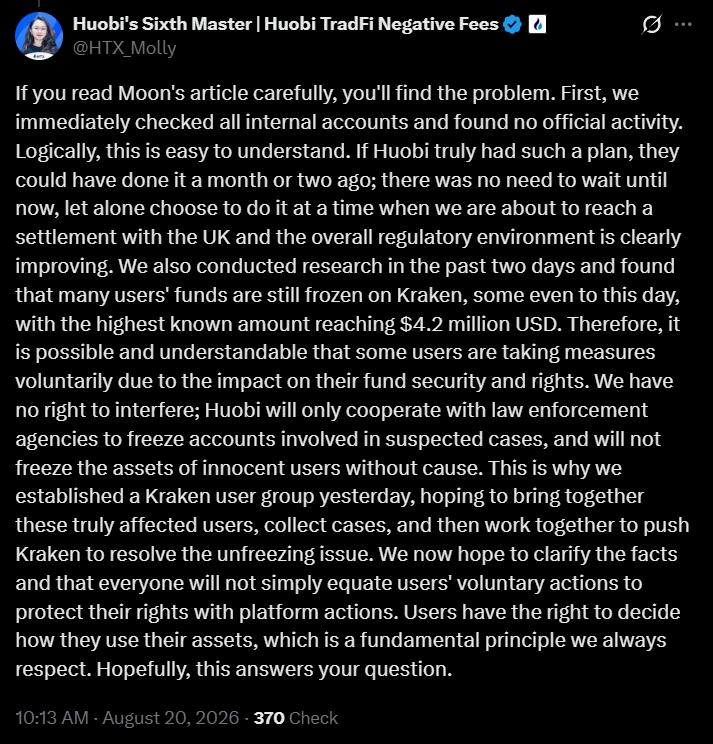
X post by HTX executive @HTX_Molly discussing fund security concerns and ongoing user asset situations across major exchanges.
The post also referred to reports of Kraken users whose assets remained restricted. An image included in a later update appeared to show a Kraken Support notice saying that a deposit had exposure to Huobi Global SA and warning that transactions involving sanctioned entities can lead to account restrictions.
The screenshot cannot independently authenticate the email or establish Kraken’s position. But it illustrates why the parties can be addressing different parts of the same case. HTX’s review asks whether one of its official wallets sent the funds. A receiving exchange may instead review whether a customer’s deposit can be linked to a particular entity, address cluster or transaction route.
Neither position proves the other wrong. An HTX internal review could find no official-wallet activity while a Kraken review still flags a customer deposit for compliance checks. Public transaction data and Kraken’s explanation would be needed to establish whether that happened here.
Molly said HTX had identified users with funds still restricted at Kraken and referred to a highest known amount of about $4.2 million. The post did not publish the number of affected users, supporting account records or a list of balances.
For that reason, the figure should be read as HTX’s description of a reported individual case. It is not evidence that Kraken froze $4.2 million in aggregate, nor that the amount was connected to the alleged address-poisoning transfers.
Later update says some users regained access
Hours later, Molly wrote that several affected Kraken users had already had their accounts unfrozen. The post included a private-chat screenshot in which a user appeared to confirm that access had been restored.
That is a meaningful change for the individual cases described by HTX, but it does not establish a platform-wide reversal. The post does not state how many accounts were released, how long they had been restricted, whether any assets remained unavailable or why Kraken allegedly lifted the restrictions.
One case involved roughly $4.2 millionHTX’s reported highest-known amount.The total value of all restricted funds.Several accounts were unfrozenHTX’s later post and a user-chat screenshot.A broader change to Kraken’s compliance approach.
Claim & Evidence Verification Analysis of available records vs. establishment Audit Review ClaimEvidence currently availableWhat it does not establishHTX official accounts were not involvedHTX Molly’s account of an internal review.A public audit of the alleged transaction path.Kraken restricted users connected to HTXHTX’s account of user cases and a screenshot presented as a support notice.Kraken’s reason, scope or policy for the restrictions.■ Responsive Card Design Optimized for mobile & desktop views
What would settle the dispute
Four pieces of evidence would clarify the case:
- Transaction hashes: The transfers described as address poisoning and the deposits later reviewed by Kraken.
- Wallet attribution: A documented method showing whether the relevant addresses belonged to HTX, individual users or unrelated parties.
- Kraken case records: Account notices or a direct statement explaining the restrictions and any subsequent releases.
- A timeline: When the deposits arrived, when accounts were restricted and when access was restored.
All we know for now is that the public record supports a limited conclusion: an HTX executive has denied official-account involvement and says some users have since regained access at Kraken. It does not yet show who controlled the disputed wallets, why each account was reviewed or whether the reported cases were connected.
This article is provided for informational purposes only and does not constitute financial, legal or compliance advice.
The post HTX Executive Denies Address-Poisoning Link in Kraken Dispute appeared first on Coindoo.