HYPE fell below $55 after Hyperliquid activated permissionless HIP-4 deployments on testnet, with whale transfers and broader crypto market weakness weighing on the token. Summary HIP-4 permi
HYPE fell below $55 after Hyperliquid activated permissionless HIP-4 deployments on testnet, with whale transfers and broader crypto market weakness weighing on the token.
Summary
- HIP-4 permissionless deployments are now live on testnet, allowing developers to create prediction markets.
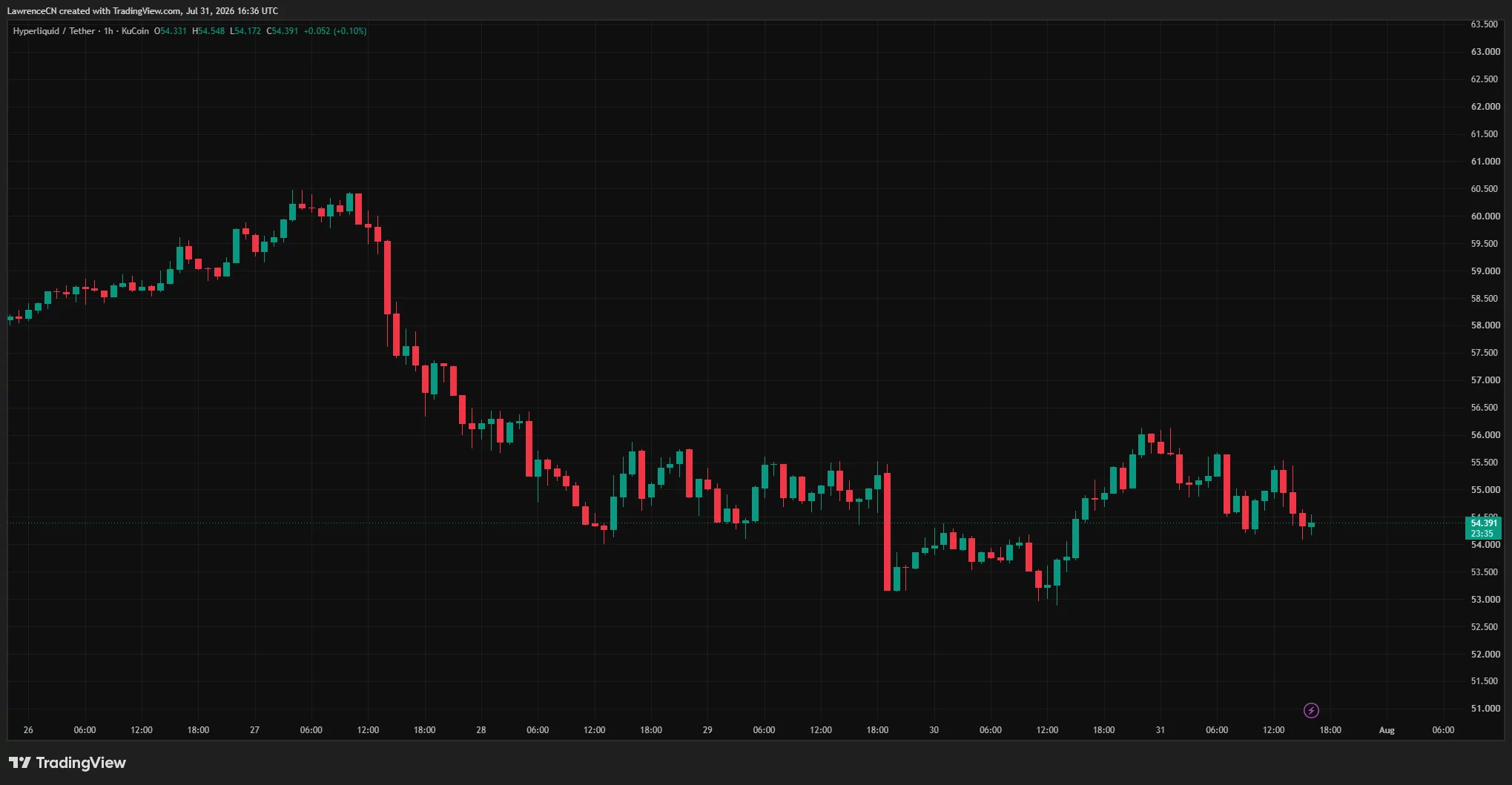
- HYPE declined almost 2% to around $54.70, losing the psychological $55 support level.
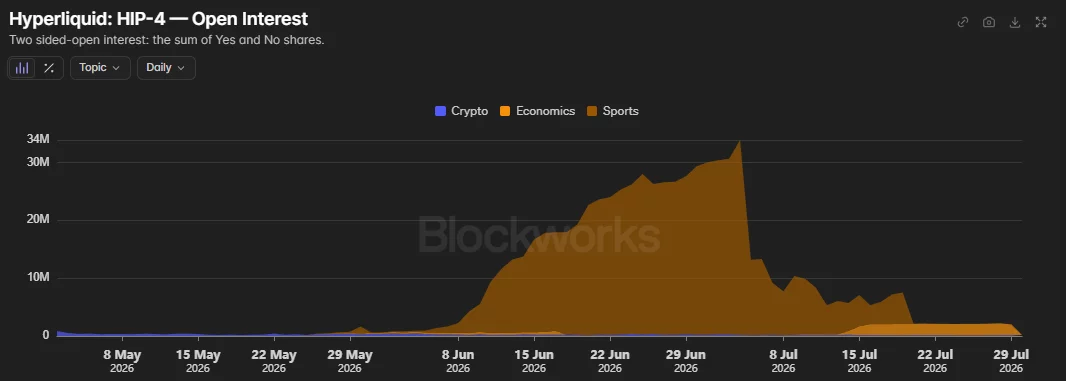
- HIP-4 markets hold roughly $182,000 in open interest and $881,000 in notional trading volume.
- A whale moved previously unstaked HYPE to FalconX and Coinbase Prime, according to Lookonchain.
Hyperliquid opens HIP-4 deployments on testnet
Hyperliquid has released the first implementation of permissionless deployments for its HIP-4 prediction-market framework on testnet.
The update allows developers to begin testing their own prediction and outcome markets on the decentralized exchange. Hyperliquid said it plans to introduce more features, including configurable fees and additional testnet templates.
HIP-4 extends the permissionless listing model used by HIP-3, which allows developers to deploy perpetual futures markets for different assets. The newer framework applies a similar approach to event contracts, placing Hyperliquid in closer competition with prediction-market platforms such as Polymarket and Kalshi.
A mainnet launch is expected to follow the testing phase, although Hyperliquid has not provided a confirmed date. Developers will likely use the testnet period to assess market settlement, liquidity, and contract configuration before deploying products involving real capital.
You might also like: Stablecoin remittances hit 9% in Bank of Italy test
HIP-4 activity declines after the World Cup
Current activity on HIP-4 remains limited compared with established prediction-market platforms. Blockworks data shows that HIP-4 markets have about $182,000 in open interest and $881,000 in notional trading volume.
Source:
BlockworksSports contracts have accounted for most of the open positions. However, open interest has declined since the end of the 2026 FIFA World Cup earlier in July, reducing activity across Hyperliquid’s early event markets.
Permissionless deployment could broaden the available contract range beyond sports. Developers may eventually create markets tied to economic releases, elections and other measurable events, subject to the platform’s rules and applicable regulations.
The rollout also carries operational risks. Crypto.news reported on July 28 that Hyperliquid’s SK Hynix perpetual contract briefly dropped about 17.9% after an unusually low pre-market trade in South Korea affected its oracle price.
The market, listed as xyz:SKHX and displayed as SKHYNIX-USDC, tracks the U.S. dollar value of SK Hynix shares and offers leverage of up to 10 times. A Hyperliquid representative said Trade.xyz deployed and operated the market under HIP-3. Trade.xyz is investigating the incident and plans to release an update after completing its review.
Although that incident involved HIP-3 rather than HIP-4, it shows the importance of reliable pricing and settlement systems as Hyperliquid opens market creation to more developers.
HYPE price loses the $55 level
HYPE traded near $54.70 at the time of reporting, down almost 2% over the previous 24 hours. The decline pushed the token below $55 despite the HIP-4 testnet announcement.
Hyperliquid price chart | Source: TradingView
The move followed weakness across the broader crypto market as Bitcoin fell below $64,000. Risk appetite declined amid reports that the United States and Israel were discussing a land blockade on Iran, raising concerns about a further escalation of the conflict.
On-chain transfers added to the pressure. Lookonchain identified a whale that acquired HYPE at an average price of about $18 several months ago before unstaking the tokens and depositing them with FalconX and Coinbase Prime.
Transfers to institutional trading platforms do not prove that a sale occurred. However, they can increase expectations of incoming supply, particularly when the holder sits on a large unrealized gain.
US prediction-market rules remain in focus
HIP-4’s expansion comes as U.S. regulators consider clearer federal standards for event contracts.
The Hyperliquid Policy Center and Multicoin Capital filed a joint comment supporting the Commodity Futures Trading Commission’s proposed prediction-market framework on July 27. They argued that written standards would help operators structure event contracts while limiting policy changes between presidential administrations.
The CFTC proposal addresses how the agency reviews contracts involving gaming, war, terrorism, assassination and conduct prohibited under federal or state law. These rules could affect how prediction markets are offered to U.S. traders, even as Hyperliquid advances its permissionless infrastructure.
HIP-4’s mainnet timing, developer participation, and recovery in open interest will determine whether the framework can develop beyond its initial concentration in sports markets. HYPE, meanwhile, must reclaim $55 to ease the immediate pressure created by market weakness and potential whale selling.
Read more: BNB price jumps 5% but stalls below $600