How Hyperliquid AI Tools Enable Automated Crypto Trading Search for Hyperliquid AI trading tools and you will find plenty of bold claims. Few say what is actually official. Here is the short
How Hyperliquid AI Tools Enable Automated Crypto Trading
Search for Hyperliquid AI trading tools and you will find plenty of bold claims. Few say what is actually official.
Here is the short version. Hyperliquid is a layer-one blockchain with a public API. Anyone can build a bot on it, and an AI model can sit on top. The docs don't describe a built-in AI product.
This guide separates confirmed facts from analyst reading. Details were checked against theofficial Hyperliquid website and its docs on 28 September 2026.
What Is Hyperliquid, and Why Do Traders Automate Here?
Hyperliquid-is a Layer 1 blockchain built for on-chain finance. The project says it wants a fully on-chain, open financial system.
The chain has two parts. HyperCore runs the order books for perpetual futures and spot markets. HyperEVM runs general smart contracts.
Perpetual futures, or perps, are contracts that track a price with no expiry date. New readers can start with this guide to perpetual futures trading.
The docs state that HyperCore currently supports 200,000 orders per second. That figure comes from the project itself.
Open data and fast execution suit bots. That is why Hyperliquid-AI trading tools keep showing up in searches.
The public API has three main pieces. The info endpoint reads market and account data. The exchange endpoint places and cancels orders. A websocket streams live updates.
Developers also get an official Python SDK and a testnet. Test first, because a bug in a live bot costs real money.
According to theofficial developer documentation, websockets give the lowest latency for real-time data. Every Hyperliquid-AI trading tool setup should start there.
API Wallets: Signing Without the Main Key
An API wallet, also called an agent wallet, signs orders for a master account. The master account must approve it first.
The docs say API wallets only sign. To read account data, you query the real account address.
In practice, this lets Hyperliquid-AI trading tools trade without holding the main wallet's key. That is an analyst reading, not a doc's promise.
One warning from the docs: don't reuse agent wallet addresses. Old nonce data can be pruned, and signed actions could then be replayed. Use a fresh API wallet per trading process.
Which Built-In Order Types Already Automate Trading?
Not every strategy needs code. The trading interface already offers order types that run on rules.
Order Type
What It Does
Detail From the Docs
TWAP
Splits a big order into smaller suborders
Runs 5 minutes to 7 days; $100 minimum
Scale
Places several limit orders across a range
One order sets the whole price range.
Chase
Re-prices a post-only order to track the best bid or ask
Runs in the browser tab; up to 5 active
Trailing Stop
Follows the mark price at a set distance
Available for perp markets
TP/SL
Closes a position at a target or stop price
Market orders by default
TWAP suborders go out as often as every 30 seconds. Each carries a 3% maximum slippage. If suborders don't fill, the order can fall behind.
Chase orders live in the browser tab where you create them. So they are not set-and-forget.
None of these are AI. They form the rule-based base under any Hyperliquid-AI trading tool.
How Could AI Fit Into Hyperliquid Automation?
AI doesn't place trades by itself. Something has to sign and send each order. That something is a script using the API.
A typical setup, in our reading, has three layers:
A model reads data and suggests a signal.
Code checks that signal against fixed risk rules.
An API wallet signs and sends the order.
Most Hyperliquid AI trading tools are custom builds like this. They pair a model with the official API.
No official page reviewed lists an AI trading product. Any such tool would be a third-party build. Check who made it and what permissions it asks for. Readers can also compare crypto trading bots on CoinGabbar.
What Do Vaults and Builder Codes Add?
Builders can create tokenized vaults on HyperEVM. The docs say these vaults can trade on-chain through CoreWriter. They can also delegate authorized agents. For wider context, see these DeFi protocols explained.
Builder codes let an app earn a fee on fills it sends for a user. The user approves a maximum fee first and can revoke it at any time.
The caps are 0.1% on perps and 1% on spot. Read the fee before approving any of the Hyperliquid AI trading tools that use builder codes.
The docs set clear limits per IP address and per account.
Limit
Value
REST weight per IP
1,200 per minute
Websocket connections
10 maximum
Websocket subscriptions
1,000 maximum
Starting request buffer per address
10,000 requests
Open orders per user
1,000 by default, capped at 5,000
Address limits allow one request for every 1 USDC traded. A bot that runs out gets one request every 10 seconds.
Now the risks:
Model risk: an AI signal can be wrong or overfit.
Margin risk: perp positions can be liquidated fast.
Funding risk: the docs say funding rates matter, especially for hyperps.
Key risk: an exposed agent key can sign orders.
Fake tools: unofficial apps can misuse permissions.
Good crypto risk management matters more with Hyperliquid AI trading tools than with manual trading. A bot repeats its mistakes at machine speed.
Hyperliquid offers real automation building blocks. Those include an open API, API wallets, TWAP and scale orders, vaults, and builder codes.
What stands out is how much runs on-chain in the open. What stays unclear is any official AI product. The docs simply don't describe one. More crypto market analysis sits on CoinGabbar.
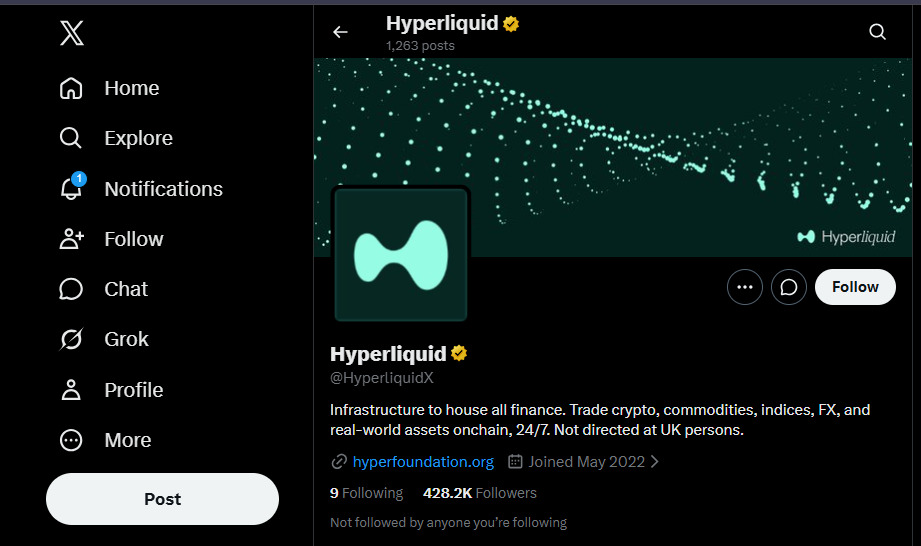
Before trusting any of the Hyperliquid AI trading tools, read the API docs and test on testnet. Check every permission. For updates, follow theofficial X account for announcements.
Disclaimer:
This article is for information only and is not financial advice. Crypto trading and automated bots carry high risk, including total loss. Do your own research before you act.