Hyperliquid's HYPE token has climbed into the Roundtable 100's top ten, moving from No. 20 to No. 9 in the Oct. 30 ranking with a displayed Power score of 80 out of 100. The move puts a propo
Hyperliquid's HYPE token has climbed into the Roundtable 100's top ten, moving from No. 20 to No. 9 in the Oct. 30 ranking with a displayed Power score of 80 out of 100.
The move puts a proposed U.S. expansion of Hyperliquid-based trading in focus. Intercontinental Exchange (NYSE: ICE), the owner of the New York Stock Exchange (NYSE), announced a definitive agreement with Trade[XYZ] on Oct. 29 to bring its perpetual markets onshore.
That is an agreement, not regulatory approval of Hyperliquid or its token. ICE and Trade[XYZ] still intend to seek the approvals needed for a dedicated U.S. retail market and clearing structure, including leveraged trading.
View the original article to see embedded media.
What ICE agreed to build
The companies have distinct roles. Hyperliquid supplies the underlying infrastructure. Trade[XYZ] designs and implements the markets. ICE would be the exclusive operator of Trade[XYZ]'s regulated markets and is making a minority investment in Trade[XYZ].
The planned business targets retail traders seeking around-the-clock exposure to crypto, equities, commodities, foreign exchange and other assets. Perpetual contracts do not expire, unlike traditional futures contracts with a set expiry date.
ICE says more than 99% of participation in its existing markets is institutional. The proposed retail business would operate through a separate market and clearing structure, rather than replacing its institutional futures franchise.
Customers who pass identity and anti-money-laundering (AML) checks are expected to gain access through futures commission merchants. Distribution through the ICE-OKX joint venture also depends on that venture's pending broker-dealer and futures commission merchant approvals.
Popular on TheStreet Roundtable:
The HYPE opportunity still has conditions
Our analysts view the agreement as a prospective distribution route for Hyperliquid-based markets. That is a catalyst to assess, not completed U.S. trading activity or a guaranteed stream of earnings for HYPE holders.
Hyperliquid's existing HIP-3 framework lets builders deploy perpetual markets after staking 500,000 HYPE. Its fee documentation says the assistance fund automatically converts trading fees into HYPE and burns the tokens it holds.
ICE's release does not specify how the proposed U.S. venue would share fees with the protocol or what incremental revenue would reach that mechanism. Its investment is in Trade[XYZ], not a purchase of HYPE. The agreement alone does not establish a return for token holders.
That uncertainty sits alongside the ranking's risk assessment. HYPE's Safety grade is 39 out of 100, well below its Innovation grade of 94. The 11-place rise is a change in analyst ranking, not an 11% token-price return.
ICE also moved higher on the latest board, rising from No. 46 to No. 32 with a displayed Power score of 73.
Find out Hyperliquid's score on the Roundtable 100
TSMC and Applied Materials make larger jumps
Elsewhere on the board, Taiwan Semiconductor Manufacturing (NYSE: TSM) and Applied Materials (NASDAQ: AMAT) each rose 48 places, to No. 23 and No. 34 respectively.
The RTB 100 member John Slazas argued that the earlier assessment of TSMC put too much weight on supply constraints without giving enough weight to demand.
"The supply constraint is real. It reflects demand running ahead of capacity, not a slowdown."
TSMC's Oct. 15 earnings release reported $46.72 billion in third-quarter revenue, up 41.2% from a year earlier in U.S. dollars. Its newest 2-nanometer process accounted for 8% of wafer revenue. Management forecast fourth-quarter revenue of $52.3 billion to $54.3 billion.
The RTB 100 analyst also warned: "Customers are concentrated. Revenue leans on AI and high-end smartphone customers."
The final review gave greater weight to TSMC's innovation and potential value capture, rather than adopting Slazas's proposed Growth target literally. TSMC's displayed Power is 75.
Follow Taiwan Semiconductor Manufacturing on the Roundtable 100
Applied Materials, meanwhile, announced an agreement on Oct. 26 to lift its stake in BE Semiconductor Industries to approximately 20%. The partnership targets advanced packaging and interconnect technologies used in increasingly complex chips. Delivery of the additional shares is subject to the applicable antitrust waiting period.
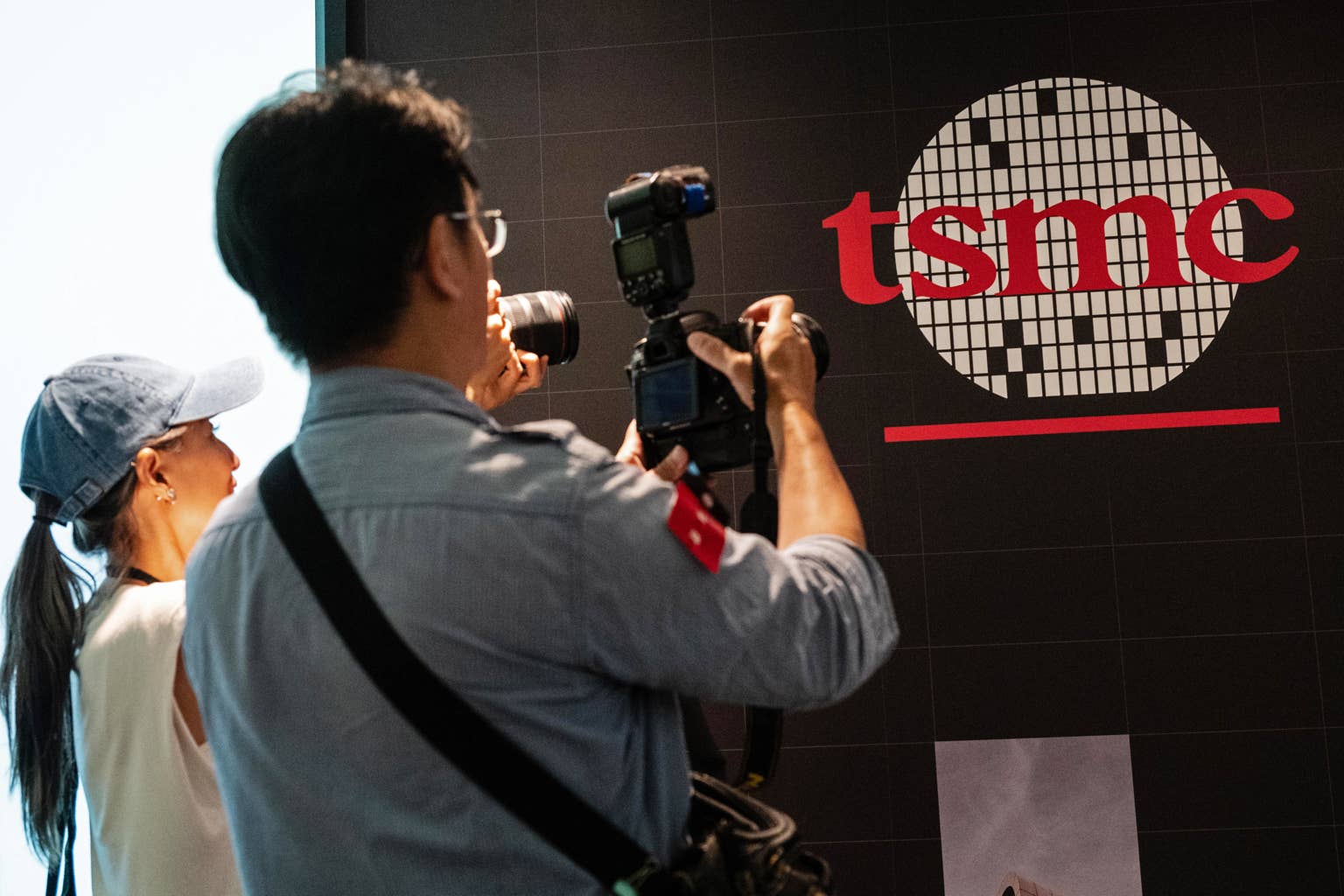
The Taiwan Semiconductor Manufacturing Co. (TSMC) logo displayed during a news conference in Taipei, Taiwan, on Thursday, July 16, 2026.
Getty Images
What the ranking measures
The Roundtable 100 is an analyst-driven ranking of 100 U.S.-accessible assets. The latest slate averages five equally weighted grades: Leadership, Safety, Innovation, Growth and Market Dominance. Its review considers future catalysts and potential value relative to valuation, along with downside risk.
Growth generally reflects six-month price performance relative to the other assets, not a company's revenue growth. The price cutoff for the Oct. 30 slate is Oct. 29. Whole-number Power scores on the public board are rounded from the underlying five-grade averages.
For readers who follow our market coverage, the Roundtable 100 brings together the weekly ranking of technology growth assets, including digital assets. See the full list and each asset's scores at roundtable100.com.
Disclaimer: This article is for informational purposes only and does not constitute financial advice. Investments are subject to market risk. Always conduct your own research before making any investment decisions.
Disclosure: RTB Digital, Inc. (Nasdaq: RTB), publisher of the Roundtable 100, is itself a ranked constituent of the index. The Roundtable 100 is published for informational purposes only and is not investment advice, an offer, or a recommendation to buy or sell any security, commodity or digital asset. Rankings reflect the views of Roundtable analysts as of the ranking date. Investing involves risk, including loss of principal.
Related: Binance's hack has me fearing phone chargers