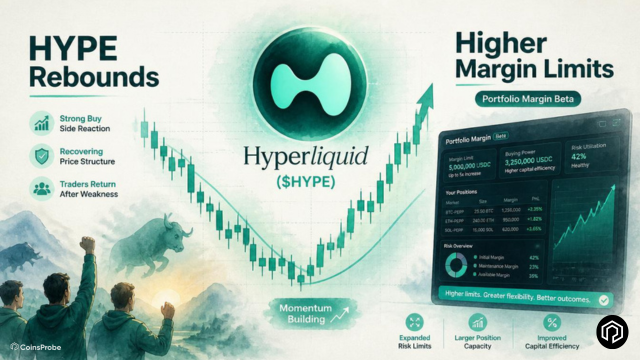
Key Highlights HYPE is trading at $64.03 — up +3.17% in 24 hours — staging a quick recovery after yesterday's broad crypto market decline triggered over $1 billion in liquidations across the
Key Highlights
- HYPE is trading at $64.03 — up +3.17% in 24 hours — staging a quick recovery after yesterday's broad crypto market decline triggered over $1 billion in liquidations across the ecosystem.
- The token remains one of the top-performing large-cap crypto assets of 2026 — up +7.20% over 30 days and +151.81% year-to-date — with a market cap of $16.2 billion.
- Hyperliquid's Portfolio Margin system — live for six months — has entered beta with significantly higher limits, now allowing accounts under $25 million to use BTC and HYPE as collateral.
- The unified margin system spans perpetuals, spot, and outcome markets from a single account — dramatically improving capital efficiency while also enabling idle borrowable assets to earn yield.
Hyperliquid is demonstrating exactly the kind of resilience that has defined its 2026 narrative. A day after a broad crypto market decline wiped out over $1 billion in leveraged positions across the ecosystem, HYPE has already recovered to $64.03 — and the timing coincides with a significant infrastructure upgrade that strengthens the platform’s case as one of crypto’s most capital-efficient trading venues.
 Total Crypto Liquidation on 25 June 2026/Source: coinglass
HYPE at a Glance — June 25, 2026
 Hyperliquid (HYPE) Price on 25 June 2026/Source: Coinmarketcap
The quick recovery from yesterday’s liquidation-induced low of $59.16 reinforces a clear pattern observed throughout 2026: $HYPE consistently absorbs broad market shocks and bounces back faster than the rest of the crypto market.
This resilience is backed by strong structural demand drivers — including token buybacks, robust ETF inflows, and growing institutional positioning — cementing Hyperliquid’s position as one of the top-performing assets of the year.
Portfolio Margin Beta — What’s New
In a significant product update, Hyperliquid announced that its Portfolio Margin system — which has already been live for six months — is now moving into beta with substantially increased limits.
The key changes:
Higher account value threshold — Users with account values under $25 million can now access the expanded beta — a meaningful increase that brings far more active traders and mid-sized institutions within the eligible range.
BTC and HYPE as collateral — The expanded beta now allows both Bitcoin and native HYPE to be used as collateral within the portfolio margin system — broadening the range of assets traders can deploy as margin beyond the prior collateral set.
Unified account across markets — The system supports trading across perpetuals (perps), spot, and outcome markets — all from a single account. This unification is a meaningful structural upgrade, eliminating the need to manage separate collateral pools for different market types.
Yield on idle collateral — Portfolio margin accounts now earn yield on idle borrowable assets — meaning capital sitting as collateral but not actively deployed in a position continues generating return rather than sitting completely dormant.
This builds directly on Hyperliquid’s existing cross-margin system, extending the same underlying philosophy — capital efficiency through unified risk management — to a broader set of assets and a higher account value ceiling.
 Hyperliquid Portfolio Margin/Source: @HyperliquidX (X)
Why Portfolio Margin Matters — The Capital Efficiency Case
Portfolio margin is a fundamentally different approach to collateral management compared to the isolated, position-by-position margining that many trading platforms still rely on — and the benefits compound specifically for active and sophisticated traders.
Reduces over-collateralisation requirements — Under a traditional margining approach, every individual position typically requires its own dedicated collateral, often calculated conservatively to account for that position’s risk in isolation. Portfolio margin instead evaluates risk across an entire account holistically — meaning offsetting positions can reduce the total collateral required, freeing up capital that would otherwise sit locked and unproductive.
Enables more sophisticated strategies — Strategies like delta-neutral positioning or spot-perp basis trades — which involve holding offsetting positions across different instruments specifically to isolate a particular risk or return profile — become significantly more capital-efficient under a portfolio margin framework, since the system recognises that the offsetting positions reduce net risk rather than treating each leg as independently risky.
Lowers liquidation risk through portfolio-level calculations — Because risk is assessed across the whole account rather than position-by-position, a portfolio margin system can more accurately reflect a trader’s actual net exposure — potentially reducing the likelihood of an unnecessary liquidation that might occur under cruder, position-isolated risk models.
Supports multi-asset collateral — The expansion to include BTC and native HYPE as eligible collateral — alongside whatever assets were already supported — gives traders meaningfully more flexibility in how they structure their capital across the platform, rather than being forced to convert into a single specific collateral asset.
What This Signals for Hyperliquid’s Infrastructure Maturity
The decision to expand Portfolio Margin into beta with higher limits — six months after its initial launch — reflects a platform that is iterating deliberately on its core trading infrastructure rather than purely chasing new product categories.
This kind of infrastructure investment is particularly significant for attracting professional traders and institutional capital specifically — the category of market participant most likely to value capital efficiency, sophisticated risk management tools, and the ability to run complex multi-leg strategies from a single unified account.
As we have covered extensively throughout 2026 — including Hyperliquid’s AQAv2 vote approval bringing USDC yield directly into the HYPE buyback engine, and HIP-3’s open interest reaching new all-time highs — Hyperliquid’s product roadmap has consistently focused on deepening the platform’s institutional-grade credibility rather than relying purely on speculative token narratives. The Portfolio Margin beta expansion fits squarely within that same pattern.
The Bigger Picture — Resilience Plus Infrastructure Growth
The combination of today’s news is genuinely notable: a token recovering quickly from a market-wide liquidation event, paired simultaneously with a meaningful capital-efficiency upgrade to the platform’s core trading infrastructure.
These two developments reinforce each other. A platform that survives volatile market conditions with minimal lasting damage to its token price — while simultaneously shipping infrastructure upgrades that make it more attractive to sophisticated capital — is building the kind of compounding credibility that has underpinned HYPE’s +151.81% year-to-date performance through a year that has otherwise been difficult for much of the broader crypto market.
Bottom Line
HYPE’s quick recovery to $64.03 — bouncing back from yesterday’s $1 billion liquidation cascade across the broader crypto market — demonstrates the same resilience that has defined its standout 2026 performance. The simultaneous expansion of Portfolio Margin into beta, with higher account limits and the addition of BTC and HYPE as eligible collateral, adds genuine fundamental strength to the platform’s institutional appeal.
With a market cap above $16 billion and a continuing cadence of meaningful product upgrades, Hyperliquid continues solidifying its position as one of the most capital-efficient and institutionally credible decentralised trading venues in crypto.
Disclaimer: The views and analysis presented in this article are for informational purposes only and reflect the author’s perspective, not financial advice. Technical patterns and indicators discussed are subject to market volatility and may or may not yield the anticipated results. Investors are advised to exercise caution, conduct independent research, and make decisions aligned with their individual risk tolerance.