Hyperliquid Upgrades Token Redenomination as Revenue Surges Two updates just dropped in Hyperliquid News, and one of them exposes something the ecosystem has been dancing around for a while:
Hyperliquid Upgrades Token Redenomination as Revenue Surges
Two updates just dropped in Hyperliquid News, and one of them exposes something the ecosystem has been dancing around for a while: almost everyone building on top of Hyperliquid news is earning pocket change compared to the platform itself.
The other is a quiet but meaningful upgrade to how tokens get restructured on-chain. Here's the full picture.
Hyperliquid's Just Gave Deployers a Safer Way to Rescale Tokens
Buried in a technical update, Hyperliquid extended HIP-1, its native fungible token standard, with a new function called scaleWei.
If you're not knee-deep in token engineering, here's why this actually matters: redenomination, essentially restructuring a token's supply, used to be a manual, risky process.
Miss a step, and you could end up with mismatched balances or stranded open orders sitting on the book.
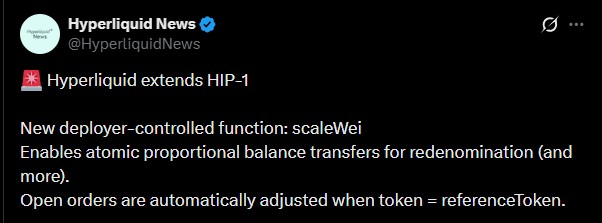
Source: @HyperliquidNews X
scaleWei fixes that in one move. It gives deployers:
Atomic proportional balance transfers—every holder's balance rescales together, in a single indivisible transaction, no partial states or gaps
Native redenomination support — no more cobbling together manual migrations to restructure supply
Automatic open-order adjustment — when the token being redenominated matches the reference token, open orders update themselves instead of needing to be cancelled and resubmitted by hand
What Changed
Before scaling
After scaling
Balance rescaling
Manual, multi-step
Atomic, single transaction
Open orders
Had to be cancelled/resubmitted
Adjust automatically
Risk profile
Higher chance of errors
Built-in consistency
It's not a flashy feature. But if you've ever watched a token migration go sideways, you know why this quietly matters more than it sounds.
This is where today's Hyperliquid news gets genuinely eye-opening. A fresh 30-day holder revenue ranking just came out, and the gap at the top isn't just big, it's almost absurd.
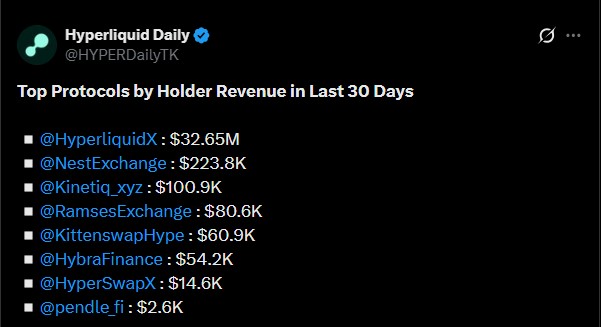
Source: HYPERDailyTK X
Rank
Protocol
Holder Revenue (30 Days)
1
Hyper
$32.65M
2
Nest Exchange
$223.8K
3
Kinetiq
$100.9K
4
Ramses Exchange
$80.6K
5
Kittenswap Hype
$60.9K
6
Hybra Finance
$54.2K
7
HyperSwap
$14.6K
8
Pendle
$2.6K
Source: Data verify from defillama
Read that again. Hyperliquid exchange didn't just win, it lapped the field by 145x.
What That Gap Is Actually Telling Us
Break it down, and the story writes itself:
Hyperliquid's own platform pulled in $32.65 million in 30 days, more than every other protocol on this list combined, several times over.
Nest Exchange, the runner-up, made $223.8K, less than 1% of what $Hyper generated.
Kinetiq, Ramses Exchange, and Kittenswap Hype are the closest thing to a "middle tier" here, each landing somewhere between $60K and $101K.
Hybra Finance and HyperSwap trail further behind, at $54.2K and $14.6K.
Pendle closes out the list at just $2.6K, a rounding error next to the platform it's built on.
The takeaway isn't that these smaller protocols are failing. It's that Hyperliquid's core platform has become such a dominant revenue engine that everything built on top of it, so far, is still operating in its shadow.
Conclusion
Two very different updates, one clear theme: Hyperliquid isn't just scaling its infrastructure, it's scaling its dominance.
The scaleWei function makes token redenomination genuinely safer for builders on HIP-1, while the revenue rankings make it obvious just how much of the ecosystem's economic activity still runs through Hyperliquid news itself. Worth watching whether that gap starts closing or keeps widening in next month's numbers.
YMYL Disclaimer
This content covers Your-Money-Your-Life (YMYL) topics, including cryptocurrency prices and flows. It is for informational purposes only and not financial, investment, tax, or legal advice. Crypto markets are highly volatile, and past performance does not guarantee future results. Always do your own research and consult a licensed financial advisor before making investment decisions.