Key Takeaways Leaders beat their depositors in 465 Hyperliquid vaults Leaders as a group still lost money One strategy can produce four different returns Measure your own cash flows, not the
Key Takeaways
- Leaders beat their depositors in 465 Hyperliquid vaults
- Leaders as a group still lost money
- One strategy can produce four different returns
- Measure your own cash flows, not the chart
Bitquery’s analysis of Hyperliquid vaults, based on a snapshot taken on November 20, 2026, found 465 vaults where the leader finished ahead while the depositors finished behind. Leaders in those vaults gained about $9.5 million including their profit share, and their depositors lost $6.3 million.
Those vaults are a small minority of the 9,478 in the snapshot, and leaders as a whole did badly. They lost $55.9 million on their own stakes, and the $6.1 million they collected in profit share only brought the net loss down to $49.8 million. Most leaders lost money alongside their depositors, so the 465 exceptions say more about how a vault divides results between people than about leaders profiting at their followers’ expense.
What Bitquery’s Snapshot Shows
On the depositor side, the snapshot counts 45,275 wallets in user-run vaults. Of those, 64% were in the red, and together they were down $32.3 million all-time. The total hides a wide spread: wallets in profit were up $25.8 million combined, while wallets in loss were down $58.1 million. These depositor figures exclude leaders’ own shares.
The protocol’s own vault tells a different story. HLP, the Hyperliquidity Provider vault run by Hyperliquid for market making and liquidations, had 94,626 depositors who were up $140.7 million combined. Bitquery keeps HLP, its sub-vaults and the Liquidator vault out of its user-vault figures.
Several limits apply to all of these numbers:
- The snapshot was taken at 10:25 UTC and covers vaults on Hyperliquid’s HyperCore exchange. Vault products on HyperEVM are not included, and Bitquery doesn’t give a separate count of user vaults, so the 465 can’t be expressed as a precise share of them.
- A wallet is not necessarily one person, and some wallets are bots.
- Open positions are valued at snapshot prices, so part of each result is unrealised.
- The leader’s 10% cut is taken when a depositor withdraws, so the gains of depositors who are still invested may read up to 10% higher than they will be on exit.
- Hyperliquid records net deposits only, so the data can’t say what share of the money deposited was lost.
- Bitquery’s snapshot series began on October 27. Some wallets that withdrew in full before then may be missing.
The data shows outcomes, not motives. It can’t explain why any individual leader came out ahead, and a single snapshot can’t rank vaults as they stand today.
How a Leader Finishes Ahead of the Depositors
A user vault pools depositors’ USDC so that one leader can trade it. Each depositor owns a slice of the pool from the moment they enter and shares in its gains or losses from that point on. Under Hyperliquid’s documentation for vault leaders, the leader receives a 10% share of profits and must hold at least 5% of the vault at all times. The leader’s own stake rises and falls with everyone else’s, but the profit share is separate income.
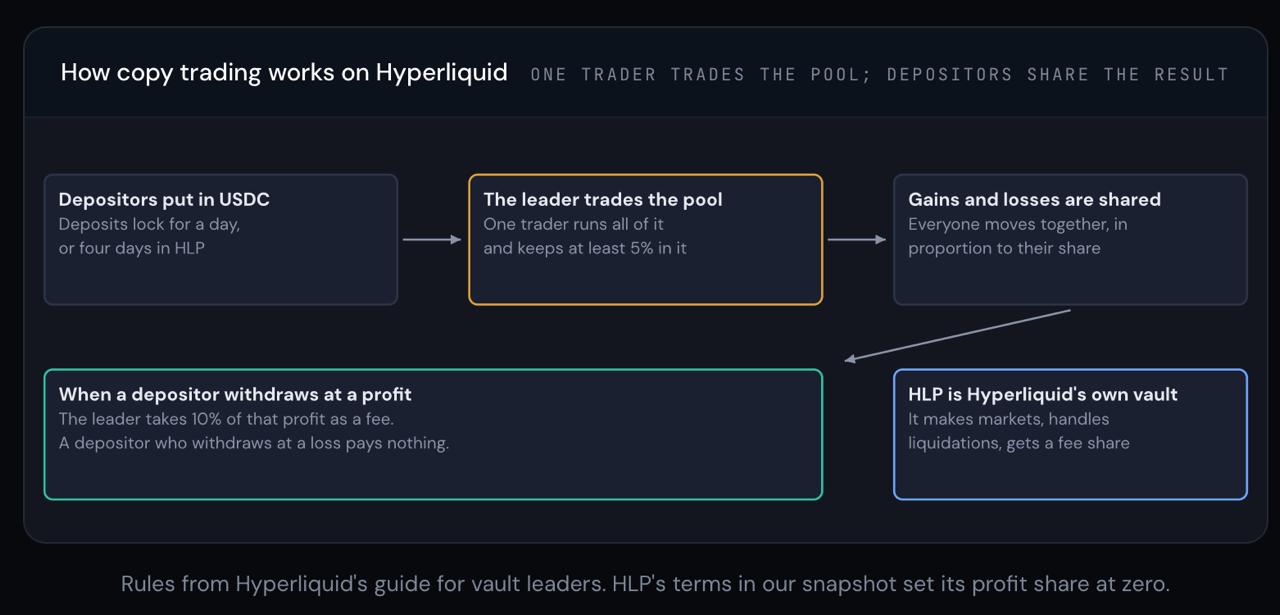
How a Hyperliquid user vault splits results between depositors and the leader. Source: Bitquery
Take a hypothetical vault. The leader puts in 1,000 USDC and an early depositor, Investor A, adds 10,000. The pool gains 10%, taking the leader’s stake to 1,100 and A’s to 11,000. A then withdraws. The leader takes 10% of A’s 1,000 profit, so A receives 10,900.
Investor B then deposits 20,000, bringing the vault to 21,100. The leader’s 1,100 is now about 5.2% of the pool, just above the minimum, so B’s deposit is close to the largest the 5% rule allows at that point. The vault then loses 10%, taking B’s stake to 18,000 and the leader’s to 990. The 100 USDC taken from A earlier sits outside the vault and is untouched by the loss.
Investor A
In: 10,000 Out: 10,900Net: +900
Investor B
In: 20,000 Value at end: 18,000Net: −2,000
Leader
Stake: 1,000 → 990 (−10) Profit share: +100Net: +90
All figures in USDC. Coindoo’s hypothetical illustration, not an observed vault. Assumes proportional returns, elapsed deposit locks and profit share held outside the vault. Excludes trading costs, funding, withdrawal slippage and taxes. B’s and the leader’s stakes are valued at the end point.
The depositors together finish 1,100 USDC behind and the leader finishes 90 ahead, yet the leader never takes anything from B. All of the profit share came from A’s gain before B arrived.
The example leaves out one large cost. Hyperliquid charges 10,000 USDC to create a vault, which would wipe out this leader’s 90 many times over. The example tracks trading results only. It shows how the gap between leader and depositors can open, not what leaders in Bitquery’s data earned overall or why they came out ahead.
One Strategy, Four Different Numbers
Now consider a single unit held from the first day through both moves. It gains 10% and then loses 10%, ending 1% below where it started before any profit share. That per-unit figure is the closest thing to what a strategy chart describes, and it matches nobody in the vault.
Strategy, per unit
−1%
Investor A, after profit share
+9%
Investor B
−10%
Leader, stake plus profit share
+9%
Pooled together, the two depositors put in 30,000 USDC and are 1,100 down, a loss of about 3.7%. A −1%
Disclaimer
This article is for information only and is not financial, investment or tax advice. The worked example is a simplified illustration, not a record of any real vault or trader. Figures attributed to Bitquery come from its own on-chain analysis at a single point in time and may differ from current data. Coindoo does not endorse any vault, leader or trading strategy. Trading leveraged crypto products carries a high risk of loss, including the loss of all capital deposited. Readers should do their own research and consider independent professional advice before investing.
The post Hyperliquid Vaults: Why the Leader Can Win While You Lose appeared first on Coindoo.