The gold price is floating around $4,149 an ounce after another shaky week. A lot of people are starting to wonder if we’ve already seen the top. The week started off strong. Weaker jobs data
The gold price is floating around $4,149 an ounce after another shaky week. A lot of people are starting to wonder if we’ve already seen the top.
The week started off strong. Weaker jobs data came out, and that got people hoping the Fed might cut rates sooner. That sent gold up. But then better employment numbers rolled in, Treasury yields climbed, and the dollar got stronger. So traders took their profits and ran.
Higher bond yields also make gold less attractive, because why hold something that pays nothing when you can get a decent return from bonds? With all the economic uncertainty out there and technical signals losing steam, analysts are getting more careful about calling where the gold price goes next.
Gold Price Downtrend Raises Fresh Warning
Market analyst Michaël van de Poppe thinks gold has turned a corner, and not in a good way. He says the big run-up earlier this year is over. If you look at his weekly chart, gold shot up fast, hit a peak above $5,500, and then tumbled back down toward $4,100. That puts it about 25% off its high.
His reasoning comes down to one thing: how fast it climbed. When something goes up that quickly, it often comes back down just as hard.
Markets that rise aggressively often produce equally volatile declines once buying momentum fades. For that reason, he said he has no interest in buying at today’s levels despite gold already giving back a large portion of its gains.
Instead, van de Poppe is watching the $3,200-$3,500 region as a possible buying zone. Even then, he wants confirmation from lower timeframes before entering new positions, indicating that price alone is not enough to convince him that the correction has ended.
Gold Price Technical Indicators Show Buyers Are Losing Momentum
We had a look at the chart, and the recovery remains limited despite several bounce attempts over the past few weeks. After dropping below $4,000, the gold price recovered toward $4,150, but every rally has struggled to reclaim the series of lower highs that has developed since the February peak.
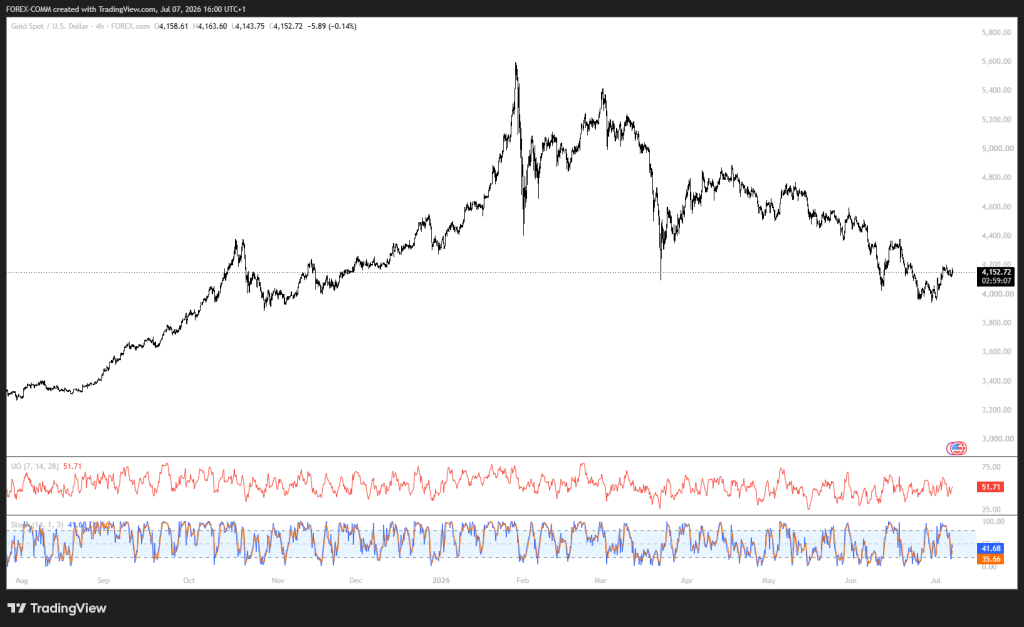 Source: Tradingview.com
The momentum gauges aren’t pointing one way or the other. The Ultimate Oscillator is at 51.71, barely above the halfway mark. That tells us buying has picked up a little, but it’s nowhere near taking over.
The Stochastic is also climbing back from oversold levels, %K at 41.68 and %D at 35.66. That indicates things are steadying out for now, but it’s not a green light for a real turnaround.
The overall trend still favors caution. Buyers need to reclaim resistance around $4,300 before the chart begins to improve. Until then, the sequence of lower highs and failed rallies leaves sellers with the technical advantage.
Related Gold News: Gold Price Prediction: Analyst Warns XAU Could Crash Below $3,900 This Week
News Driving the Gold Price This Week
Economic data has been pulling the gold price in opposite directions. Slower U.S. payroll growth earlier in the week reduced expectations for another near-term Federal Reserve rate increase, and CME FedWatch data showed the probability of a September hike easing to around 55%. That gave gold a bit of a lift, but it didn’t last.
Fed officials keep saying inflation is still a problem, and they haven’t ruled out another rate hike. So now everyone’s waiting for the latest FOMC meeting minutes to get a better read on where the central bank is headed.
The dollar and Treasury yields are still running the show. The 10-year yield hit a two-week high, which pushed the dollar up and made gold more expensive for buyers outside the U.S. Safe-haven buying also cooled off a bit after U.S.-Iran tensions eased. But central banks, especially China’s, keep buying, and that’s helped stop gold from falling even further.
However, the Gold price is stuck. Short-term signs look a little better, but the bigger picture still points down. Analysts like Michaël van de Poppe think this drop isn’t over yet, and that a better buying chance might come later, not now.
For the time being, traders are keeping an eye on fresh economic data, whatever the Fed says next, and whether gold can push back above key resistance levels or break down through support. The next couple of weeks should tell us if this is just a breather or the start of a much bigger fall.
Frequently Asked Questions
What is affecting the price of gold today
The gold price is being influenced by a stronger U.S. dollar, higher Treasury yields, and expectations that the Federal Reserve will keep interest rates elevated. At the same time, easing geopolitical tensions have reduced safe-haven demand, though continued central bank buying has helped limit deeper losses.
Will gold rate decrease in the coming days in 2026Gold could face additional downside if the U.S. dollar and bond yields continue rising or if the Federal Reserve maintains a hawkish stance on interest rates. However, support from central bank purchases and weaker economic data could help slow any further decline.
Can gold reach $10,000A $10,000 gold price is possible over the long term, but it would likely require major global economic changes, persistent inflation, and sustained demand for safe-haven assets. Most analysts view it as a long-term scenario rather than a near-term price target.
Subscribe to our YouTube channel for daily crypto updates, market insights, and expert analysis.
The post “I Don’t Want to Buy Gold Here!” – Analyst Warns Gold Price Has Further to Fall appeared first on CaptainAltcoin.