Before locking tokens for two years, I wanted to understand exactly what happens at every single step, what I actually walk away with, and where the real risk sits versus where there's no ris
Before locking tokens for two years, I wanted to understand exactly what happens at every single step, what I actually walk away with, and where the real risk sits versus where there's no risk at all. So I went through the whole process myself, screenshotting every stage, and this guide breaks all of it down — partly for my own future reference, partly for anyone weighing the same decision.
Short version up front: staking STON isn't "earn a percentage on top," the way classic farming works. It's about governance — a real voice inside the DAO — plus a GEMSTON reward, and, when a campaign is active, a bonus to farming APR. Let me walk through why I chose this path at all, and why I picked the longest lock available.
🔵 Why I Chose STON Staking Specifically
I had two options on the table: just hold STON in my wallet, or stake it. Holding gives you nothing beyond whatever price appreciation happens. Staking gives you three concrete things at once:
A real voice in the DAO. STON.fi runs a fully on-chain DAO, and voting rights there only go to people who staked and received ARKENSTON. Without staking, you're a spectator — you can read proposals, but you can't move them.
A GEMSTON reward. A separate token issued for participating, one you can hold, sell, or transfer — unlike ARKENSTON, which stays glued to your wallet permanently once minted.
A potential boost to farming APR. If a Boost Farm APR campaign happens to be live, an active STON stake can lift your yield in the STON/USDT V2 farming pool. This is a nice bonus on top, not the main reason to stake — campaigns come and go, the governance piece doesn't.
For me, this wasn't a question of "what gives the highest number right now." It was "what gives real, long-term influence over a protocol I'm already financially exposed to." That framing is what made staking the obvious move for me, rather than just another farm pool on a list of APR percentages.
🟢 Staking vs. Farming: Why I Didn't Just Farm Instead
It's worth being explicit about this distinction, because the two get lumped together constantly and they're genuinely different mechanisms.
Farming is about maximizing yield on liquidity you've already provided. You deposit a pair of tokens into a pool, receive LP tokens, and stake those LP tokens to earn additional rewards. Your upside is tied to swap fee volume and reward emissions, and your downside includes impermanent loss if the pair's prices diverge — something I've written about elsewhere when comparing pools.
Staking STON is a completely different mechanism. You're locking a single token — STON itself — directly into a smart contract, with no second asset and no impermanent loss exposure at all, because there's no pair. There's no AMM curve working against you here. The trade-off is liquidity: your STON is locked for the duration you choose, full stop, regardless of what the market does in the meantime.
I went with staking because I wanted governance exposure and didn't need the STON sitting in that position to also be working as liquidity. If your goal is purely yield optimization and you're comfortable with IL risk, farming might suit you better. If your goal is long-term alignment with the protocol's direction, staking is the more direct route.
🟡 The Step-by-Step Process: What I Actually Did
Step 1 — Opening the Stake Section

I navigated to app.ston.fi/stake. The landing dashboard shows everything at a glance: my staked STON (zero, at this point), the amount available to stake, current GEMSTON rewards, and my DAO voting power. I clicked the "Stake STON" button to begin.
Step 2 — Entering the Amount and Choosing a Duration

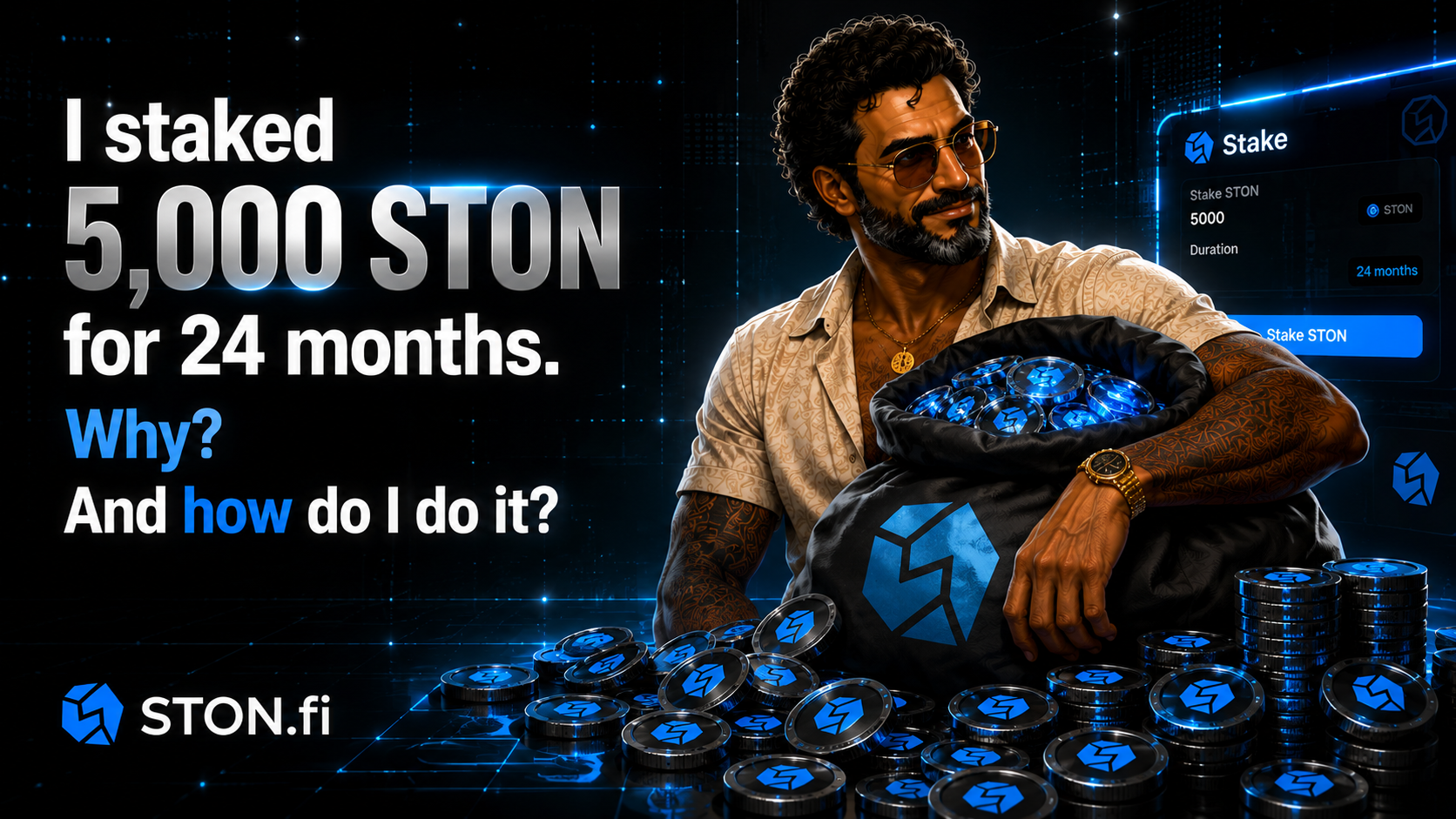
A modal opens asking for an amount. I had 5,000 STON available and put the full balance in. Below the amount field sits a duration slider — 3, 6, 12, or 24 months. I dragged it to the maximum, 24 months, and the calculator underneath immediately started recalculating DAO voting power (in ARKENSTON) and the staking reward (in GEMSTON).
Step 3 — Reviewing the Calculation Before Committing

Once 24 months was locked in, the calculator displayed its projection. I deliberately paused here and re-read the numbers twice, because this is the exact moment you're committing to terms that will hold for the next two years — not a step to rush through.
Step 4 — Clicking "Stake STON" and Confirming in My Wallet

After clicking through, a toast notification appeared: "Staking STON..." with a "See details" link — meaning the transaction had been submitted and was processing on-chain. At this stage, I just waited for wallet confirmation.
Step 5 — Getting Confirmation

The final screen read: "Stake of 5,000 STON was successful," along with an Explorer link to view the transaction directly on-chain. From that moment, my 5,000 STON were locked for 24 months, and an ARKENSTON token showed up in my wallet.
📊 The Numbers I Actually Captured
Here's what the calculator showed for a 5,000 STON / 24-month stake:

One honest detail worth flagging: during steps 2–3, the modal's calculator briefly displayed a much smaller intermediate figure — 5.25 GEMSTON and 0 ARKENSTON — for the exact same 5,000 STON / 24-month input. After the stake completed, reopening the calculator with identical parameters showed the far more substantial 5,000 GEMSTON and 1,151 ARKENSTON. My best guess is this comes down to real-time recalculation and a UI cache that hadn't fully loaded pool data yet. Takeaway for anyone following this guide: don't trust the number you see in the first second the modal opens — give the calculator a moment to stabilize, and double-check the figure shown right before you confirm the transaction, not the one shown on first render.
🔴 How to Avoid Losing Money on STON Staking
This isn't a farm with a free exit at any time, and that needs to be understood going in, not discovered later.
1. This is a lock, not a flexible deposit.Once you choose 24 months, you can't simply pull your STON back out a week later because you changed your mind. This is a deliberate commitment, and it should only be made with capital you genuinely won't need over that window.
2. Getting your STON back requires burning ARKENSTON.At the end of the staking term, retrieving your full STON balance requires burning the ARKENSTON you received. It's a straightforward technical step, but if you haven't read about it ahead of time, it can catch you off guard when the term actually ends and you're trying to figure out the unlock flow.
3. ARKENSTON cannot be transferred or sold.It's a soul-bound token, permanently tied to the wallet that staked — until the moment you burn it. If you were hoping to somehow monetize your voting power separately from the underlying stake, that's not how this is designed, and it's not meant to be.
4. GEMSTON's future value depends on DAO decisions.GEMSTON is a community token, and its mechanics, distribution rules, and future utility are determined by the DAO itself — not fixed in advance. Treat it as a token with an evolving, community-governed utility, not as something with a guaranteed, stable value the way a stablecoin reward would behave.
5. Boost APR is a campaign, not a permanent feature.If part of your reason for staking is the farming APR boost, check whether a campaign is actually active right now and when it's scheduled to end. Once the campaign window closes, your underlying stake remains, but the boost itself doesn't carry over automatically.
6. Audit and protocol risk still exists, even with no IL.No impermanent loss doesn't mean zero risk. You're still trusting the staking smart contract itself. STON.fi publishes audit information for its infrastructure, and it's worth checking that before locking a meaningful sum for two years specifically — a shorter audit history is a reasonable factor to weigh against a 24-month commitment.
🟣 Why 24 Months Specifically, and Not Less
The slider offers four tiers — 3, 6, 12, and 24 months — and the underlying logic is straightforward: the longer the lock, the higher the calculated multiplier and the resulting payout on the same principal. I deliberately chose the maximum for two specific reasons.
First, I genuinely wasn't planning to use that 5,000 STON for anything else over the next two years regardless of whether I staked it. If a token is going to sit idle either way, the gap between a 3-month lock and a 24-month lock is the difference between minimal and maximum return on the exact same idle asset.
Second, a DAO voice only really makes sense as a long-term position. If the goal is genuine influence over the direction of a protocol I already believe in, a 3-month stake carries meaningfully less weight than a position built around a two-year horizon — both in raw voting power and in the signal it sends about commitment.
If there's any realistic scenario where you might need that capital sooner, a shorter duration is the more honest choice for your own situation than maxing out the slider purely to chase the bigger number in the calculator.
❓ Questions I Asked Myself Before Committing
What happens if I need liquidity before the 24 months are up?You don't get early access to the locked STON — that's the entire mechanism of a lock period. This is exactly why sizing matters more than duration here: stake what you can genuinely afford to not touch.
Do I need to do anything during the 24 months, or does it just run?Once staked, it runs on its own. The thing to actually track is whether any time-limited campaigns (like a Boost APR window) are active or expiring, since those are the parts that change independently of your stake itself.
Is GEMSTON worth anything right now?Its value and mechanics are explicitly left to the DAO to define going forward, so I'd treat any current pricing as provisional rather than a fixed expectation baked into your decision.
Could I have staked a smaller amount and topped up later?Yes — nothing requires staking your full balance in one transaction. I chose to stake the full 5,000 because that was capital I'd already decided wasn't part of my active trading or liquidity plans.
Bottom Line
Staking STON makes sense if you're already planning to hold the token long-term and want something beyond simple holding: a DAO voice, a GEMSTON reward, and — depending on timing — a boost to farming APR. It's not a quick-yield play, and I wouldn't recommend going in with capital you might realistically need before the lock period ends.
Every number in this guide reflects exactly what I personally saw in the calculator at the time of my own stake. Before staking yourself, check the live figures in the app directly — they may differ from what I observed.
🔗 More detail: ston.fi/staking | app.ston.fi/staking
Not financial advice. DYOR — weigh the lock duration against your own liquidity needs before staking.