Key Highlights IBM achieved a significant quantum computing breakthrough by successfully connecting and cooling two cryogenic modules to temperatures under 15 millikelvin, advancing its 2029
Key Highlights
- IBM achieved a significant quantum computing breakthrough by successfully connecting and cooling two cryogenic modules to temperatures under 15 millikelvin, advancing its 2029 Quantum Starling initiative.
- The tech giant introduced a revolutionary dual-architecture mainframe chip at Hot Chips, leveraging 2nm process technology to execute both IBM and Arm operating systems concurrently.
- Shares of IBM closed at $235.68 on August 21, reflecting a 21% decline year-to-date and trading 30% beneath its 52-week peak of $332.46.
- Second-quarter 2026 revenue increased a modest 1% to $17.2 billion, hampered by a 42% collapse in IBM Z mainframe sales, prompting management to lower full-year projections.
- Wall Street analysts assign IBM a consensus “Moderate Buy” recommendation with an average target price of $251.87, suggesting potential upside of 8.4%.
Trading at $235.68, IBM shares have tumbled more than 21% since the start of the year, despite the company unveiling a series of impressive technological breakthroughs that have captured industry attention.
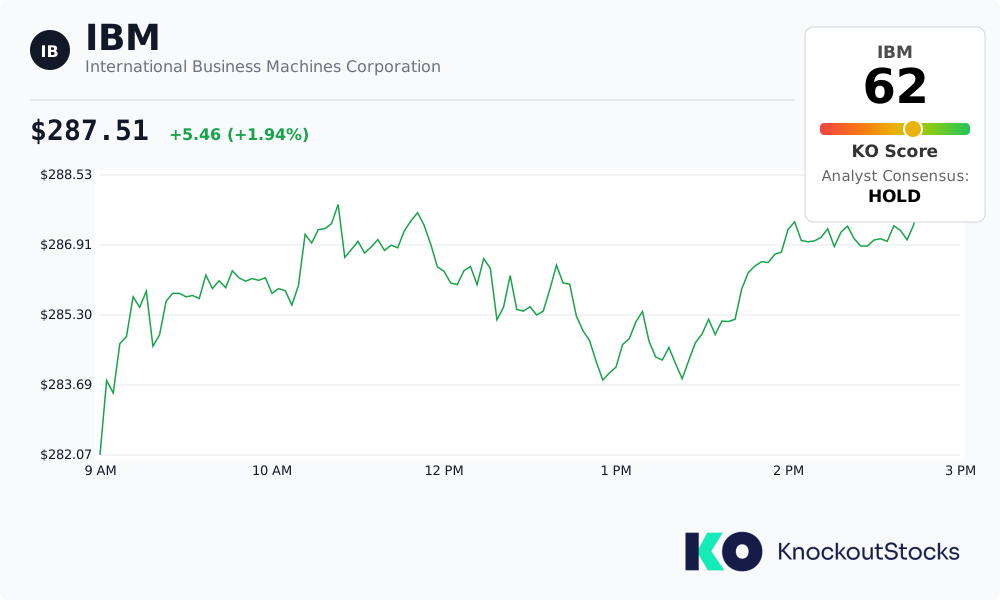 International Business Machines Corporation, IBM
On August 19, the company revealed it had successfully integrated and cooled two separate modular cryogenic systems into one unified ultra-cold environment, achieving temperatures lower than 15 millikelvin. This architecture is engineered to ultimately link hundreds of quantum processing units, addressing a fundamental obstacle in quantum computing scalability.
This achievement directly supports IBM’s Quantum Starling system roadmap, scheduled for deployment in 2029. The company has pledged over $10 billion in investments throughout the next half-decade to push quantum computing forward through research initiatives, manufacturing expansion, and strategic acquisitions.
However, market participants responded tepidly. IBM shares climbed only 1.9% following the quantum announcement before retreating approximately 1.5% in the subsequent trading session. The reaction suggests investors are demanding tangible financial results beyond technological achievements.
Revolutionary Dual-Architecture Processor Unveiled at Hot Chips
Five days later, on August 24, IBM made another significant announcement at the Hot Chips conference: a groundbreaking dual-architecture mainframe processor capable of simultaneously running both IBM and Arm operating systems.
Manufactured using cutting-edge 2 nanometer technology, the processor features 11 high-performance cores operating at frequencies exceeding 5.7 GHz. The chip integrates AI inference acceleration units, an embedded data processing unit, and sophisticated encryption features. Remarkably, each core can natively process both Arm and IBM Z instruction sets concurrently.
This processor emerges from IBM’s strategic partnership with Arm, initially announced in April 2026. According to IBM, this collaboration opens the door to a developer community exceeding 22 million professionals globally.
These technological advances arrive against a challenging financial landscape. IBM’s second-quarter 2026 earnings, reported on July 22, revealed revenue growth of merely 1% year-over-year, reaching $17.2 billion. Net income declined 1% to $2.2 billion. Adjusted EPS registered at $2.93, representing a 5% increase.
IBM Z mainframe revenue emerged as the primary weakness, plummeting 42% during the quarter as enterprise customers redirected capital toward AI infrastructure investments. Software division revenue provided some relief, advancing 5% to $7.8 billion. Consulting revenue remained stagnant at $5.3 billion.
Management also revised downward its full-year outlook. The company now anticipates constant-currency revenue growth between 4% and 5%, a reduction from the previous forecast exceeding 5%.
Shares touched a 52-week bottom of $199.19 on July 23, immediately following the earnings release. Since that trough, the stock has rebounded approximately 12.4%.
IBM currently trades at 19.13 times forward earnings, representing a valuation discount compared to industry peers. The analyst consensus remains at “Moderate Buy,” with a mean price target of $251.87. CITIC Securities maintains a “Buy” rating with a $297 price objective. Susquehanna holds a “Neutral” stance with a $225 target.
Among 24 analysts tracking IBM, 11 assign a “Strong Buy” rating, 10 recommend “Hold,” and one rates it “Strong Sell.”
The post IBM (IBM) Stock Down 21% YTD: Should You Buy After Recent Quantum Breakthrough? appeared first on Blockonomi.