Key Highlights IBM shares surge 1.93% following major quantum infrastructure achievement. Company successfully connects dual cryogenic modules for scalable quantum operations. Innovative cool
Key Highlights
- IBM shares surge 1.93% following major quantum infrastructure achievement.
- Company successfully connects dual cryogenic modules for scalable quantum operations.
- Innovative cooling architecture achieves sub-15 millikelvin temperatures.
- Company aims to deliver 1,000+ programmable qubits by 2027.
- Fault-tolerant Quantum Starling project continues development for 2029 deployment.
Shares of IBM (IBM) gained 1.93%, closing at $237.16, following the company’s announcement of significant progress in large-scale quantum computing infrastructure. The stock rebounded from session lows around $231.00 after revealing a successful integration of dual cryogenic modules operating within a unified ultra-cold environment.
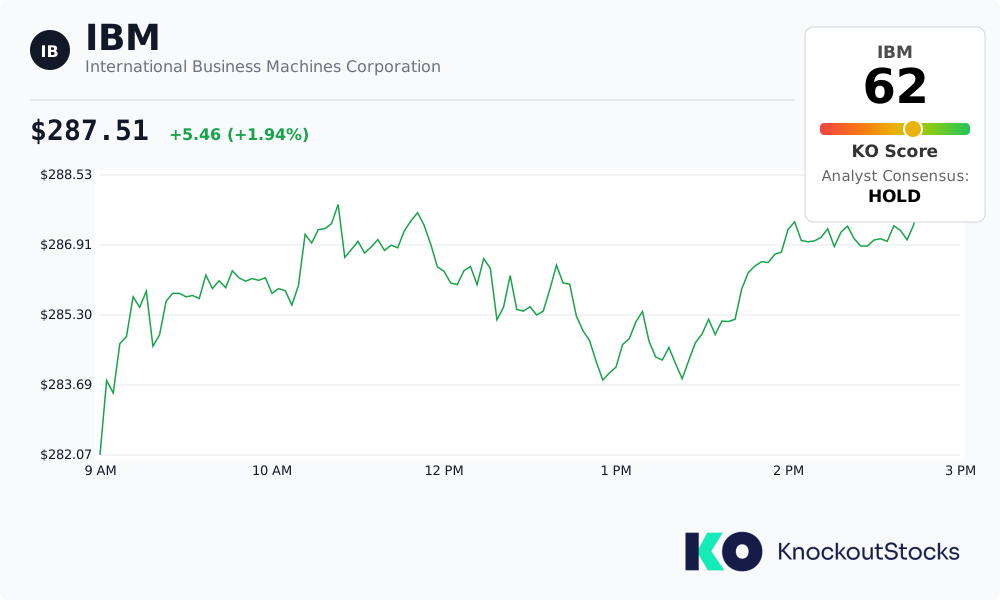
International Business Machines Corporation, IBM
Cryogenic Infrastructure Achievement Boosts IBM Stock
The technology giant engineered this advanced cryogenic framework to accommodate hundreds of interconnected quantum processors in a unified scalable platform. The initial pair of functioning modules measure over eight feet in both height and width. During preliminary testing, both units achieved four Kelvin temperatures in less than five days.
Following the primary cooling phase, the infrastructure dropped to temperatures under 15 millikelvin. Additionally, each vacuum chamber delivers substantially enhanced wiring infrastructure compared to IBM‘s current quantum computing deployments. The company reports these updated modules offer up to 12-fold greater wiring capacity for chip interconnections.
This cubic modular design enables multiple units to function in closely aligned configurations while facilitating direct chip-to-chip communication. The company intends to utilize its L-coupler innovation to bridge separate quantum processors throughout the modular infrastructure. Consequently, individual processors can share data and function collectively as components of an expanded quantum computing network.
Roadmap Points to 1,000-Qubit System by 2027
IBM intends to deploy L-coupler technology to unite multiple processors into an integrated quantum platform by 2027. This anticipated infrastructure will feature no fewer than 1,000 programmable qubits designated for computational operations. The modular cooling framework therefore represents critical foundational infrastructure supporting the company’s quantum processor development timeline.
Later this year, IBM will integrate Quantum Nighthawk processors within these cryogenic units for additional validation testing. These deployments enable the company to evaluate system capabilities as processor concentration and interconnection capacity grow. Simultaneously, engineering teams can separately evaluate and refine multiple elements integrated into this innovative modular design.
The architecture incorporates three critical environmental systems currently deployed in IBM Quantum System Two. The company has reconfigured these systems to permit independent evaluation and enhancement of individual components. This methodology may expedite hardware innovation while minimizing limitations tied to testing complete integrated cooling infrastructures.
Quantum Starling Project Progresses Toward 2029 Launch
This recent achievement bolsters IBM’s comprehensive strategy to launch Quantum Starling in 2029. The company anticipates Starling will become a large-scale fault-tolerant quantum platform constructed on modular foundations. Individual cryogenic units may ultimately house thousands of qubits as the infrastructure scales.
IBM unveiled Starling alongside an error-mitigation strategy engineered to minimize physical resources necessary for fault-tolerant operations. Subsequently, the organization has validated crucial hardware elements and refined techniques for efficient error-correction processing. These advancements satisfy technical specifications related to processor architecture, decoding methodologies, systems engineering, and dependable quantum functionality.
Fault-tolerant quantum computing seeks to manage computational errors that presently constrain the scale and dependability of quantum calculations. For years, IBM has refined processors, software platforms, cooling systems, and error-mitigation protocols for expanded quantum infrastructures. The integrated cryogenic modules now contribute an additional infrastructure element supporting the company’s anticipated evolution toward scalable fault-tolerant quantum computing.
The post IBM (IBM) Stock Surges on Major Quantum Computing Cooling Innovation appeared first on Blockonomi.