Policy6 min read
XRPL Wallets Move Inside Apps With Privy
Key Takeaways Privy lists XRP Ledger among the networks supported by its wallet infrastructure. Apps can connect XRPL wallet creation to their existing login and user-account flow. XRPL suppo
The International Monetary Fund (IMF) has published its first dedicated chapter on tokenized markets as part of its October 2026 Global Financial Stability Report, and Ondo Finance appears am
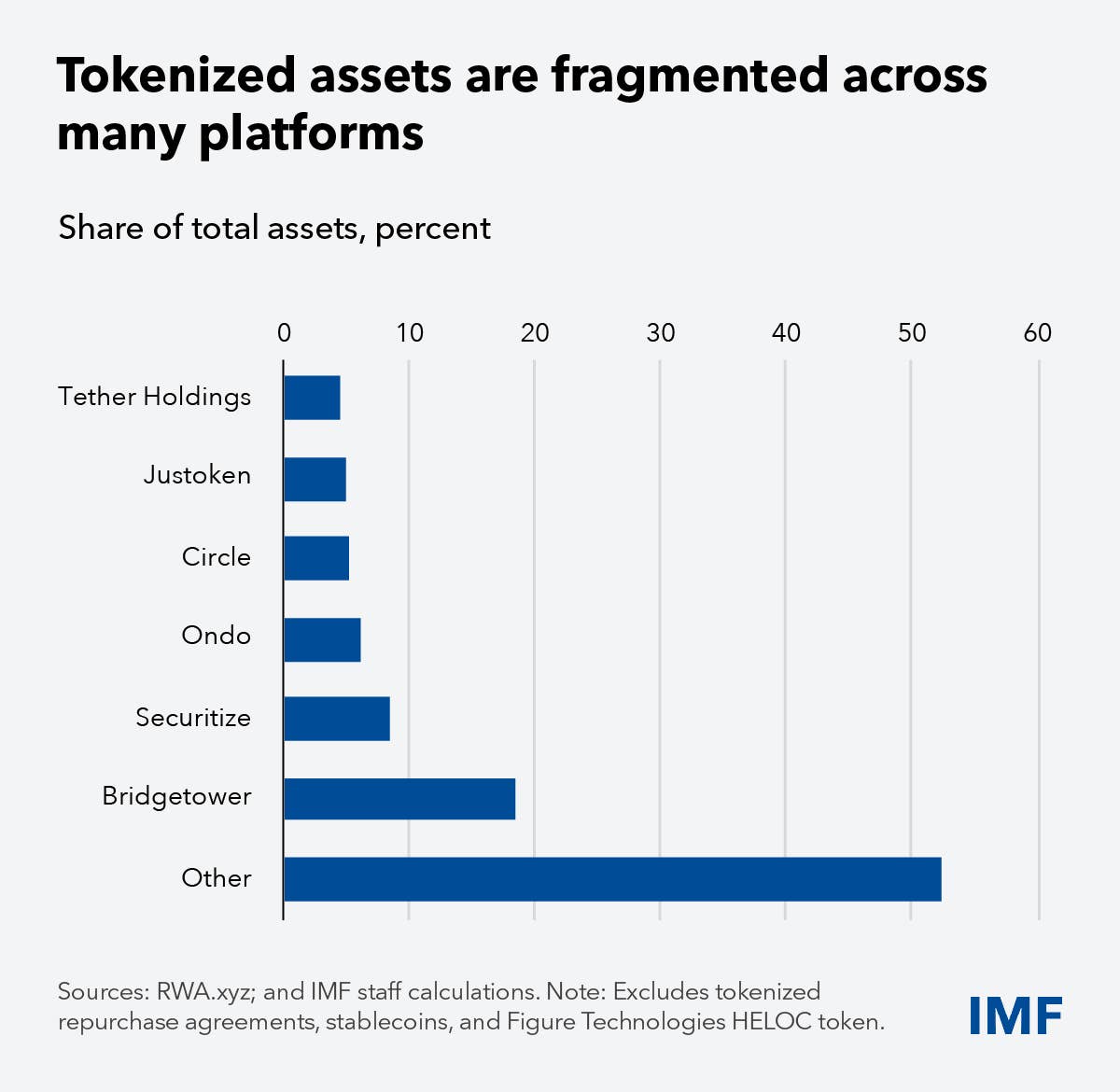
The International Monetary Fund (IMF) has published its first dedicated chapter on tokenized markets as part of its October 2026 Global Financial Stability Report, and Ondo Finance appears among the named platforms shaping the space.
Ondo is a platform that brings institutional-grade financial products onchain, including yield-bearing tokens backed by U.S. Treasuries (USDY) and tokenized versions of publicly traded stocks (Ondo Stocks).
The IMF’s chart, sourced from RWA.xyz data and the fund’s own calculations, shows Ondo alongside Securitize, Circle, Tether Holdings and Bridgetower as one of the individually identified platforms in the tokenized asset market.
The remaining share, over 50%, is grouped under "Other", underscoring how fragmented the market remains.
Source: IMFThe report shows that the market is growing fast but remains small compared with traditional finance.
Tokenized repos average $300 billion to $350 billion in daily transaction volume, while other tokenized assets, credit, money market funds, equities, add roughly $65 billion daily.
For context, the U.S. repo market alone handles about $13 trillion a day, and global capital markets represent $300 trillion in assets.
More than half of tokenized equity trading takes place outside traditional market hours, the IMF found, a sign that demand for round-the-clock access is real.
Around 80% of tokenized equity trades analyzed were smaller than a single share, indicating that fractional ownership is already a core feature of these markets.
Related: Ripple takes on Wall Street banks with a $35 billion client
The report identifies four constraints holding tokenized markets back.
The first is legal certainty, whether tokenized assets represent enforceable rights or not. The second is regulatory clarity on how existing rules apply to new infrastructure.
The third is interoperability between platforms that currently operate as isolated liquidity pools. And the fourth is settlement using safe, widely accepted forms of money.
On risk, the IMF warned that scaling tokenized markets could amplify traditional financial vulnerabilities like fire sales, liquidity runs and contagion.
The sequential processes that add friction and cost to today’s markets, messaging, delayed settlement, reconciliation, also provide buffers that could disappear in a fully tokenized environment.
Ondo currently leads all providers in tokenized U.S. Treasuries with approximately $2.9 billion on rwa.xyz and holds $3.9 billion in total value locked across its platform.
Its institutional partners include BlackRock, Franklin Templeton, JPMorgan’s Kinexys and DTCC’s Fund/SERV.
The IMF’s recognition of the platform in its flagship financial stability publication signals that tokenization has moved firmly from the experimental fringe into the institutional mainstream.
Related: 3 decisions fueled Trump's rise, Anthony Scaramucci says