The International Monetary Fund has warned that the tokenized asset market has reached $65.1 billion, cautioning that the automated liquidation mechanisms embedded in many tokenized positions
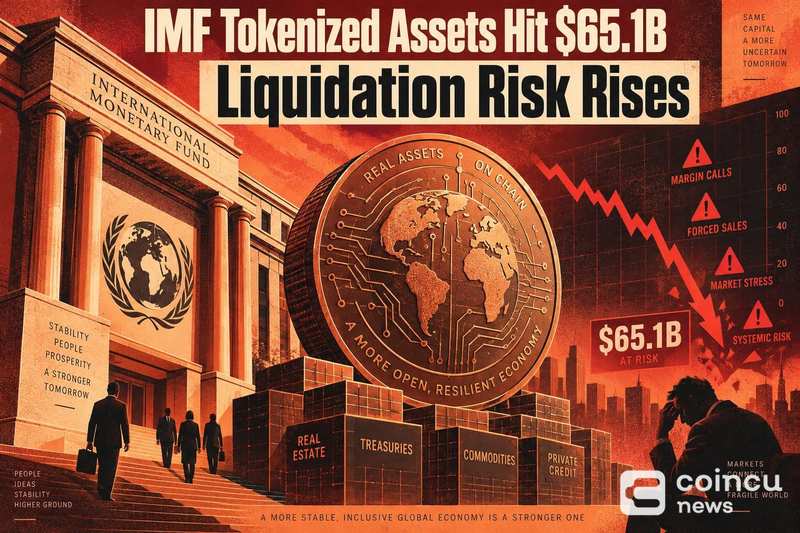
The International Monetary Fund has warned that the tokenized asset market has reached $65.1 billion, cautioning that the automated liquidation mechanisms embedded in many tokenized positions could amplify financial stress if markets turn sharply, raising questions about systemic risk at the intersection of traditional finance and blockchain infrastructure.
IMF flags $65.1 billion tokenized asset threshold
The IMF's warning centers on the scale now reached by tokenized real-world assets, a category that includes tokenized Treasuries, money market funds, bonds, and other instruments settled or issued on public or permissioned blockchains. The $65.1 billion figure cited by the IMF represents the aggregate market size the Fund has flagged as reaching a threshold significant enough to carry contagion potential. For related coverage, see Brent rises on IRGC threat to Mideast economic centers.
The growth reflects a structural shift in how institutions interact with blockchain rails. Projects such as Consensys and ClearToken's push for 24/7 settlement of tokenized securities illustrate how settlement infrastructure is being rebuilt to accommodate round-the-clock, programmable asset transfer, compressing the operational gaps that traditionally allowed human intervention during stress events. For related coverage, see Why Is Beldex (BDX) Price Surging Today? Bridge Risks Explained.
How automatic liquidation could amplify financial stress
The IMF's concern about automatic liquidation points to a structural feature of tokenized and on-chain collateral arrangements: smart contracts can be programmed to liquidate positions without human authorization once a collateral ratio or price threshold is breached. Unlike a margin desk that can exercise discretion during a volatile session, an automated liquidation contract executes the moment its conditions are met, regardless of market depth or correlated selling pressure elsewhere. For related coverage, see Why Is Starknet (STRK) Price Down Today? | CoinCu.
The risk is one of synchronization. If a large cohort of tokenized positions share similar liquidation thresholds, a correlated price move across underlying assets could trigger simultaneous forced sales across multiple protocols, compressing liquidity precisely when it is most needed. The IMF frames this as a potential amplifier rather than a confirmed event, meaning the warning is conditional on market conditions that have not yet materialized.
Efforts to expand the tokenized asset universe, including plans by Harneys and dropRWA to issue tokenized catastrophe bonds in 2027, indicate that the pipeline of new asset classes entering on-chain formats continues to grow, widening the perimeter the IMF's warning covers.
Why the warning matters beyond crypto-native markets
The IMF's focus is not on crypto-native tokens but on instruments that have traditional-finance counterparts: government securities, credit instruments, and fund shares that have been migrated onto blockchain rails. If automatic liquidation of these instruments were to force simultaneous asset sales, the impact would be felt in underlying bond and money markets, not only in crypto order books, creating a transmission channel from on-chain mechanics to broader financial stability.
The Fund's warning implicitly calls on regulators and market participants to assess whether existing liquidity risk frameworks account for the speed and simultaneity of smart-contract-driven liquidations, which operate on a different timescale than the T+1 or T+2 settlement cycles that current stress-testing models are calibrated against.
What remains conditional and what to watch
The IMF has described a risk scenario, not a confirmed stress event. Whether automatic liquidation would materially amplify a downturn depends on variables that are not yet quantified in the Fund's public warning: the proportion of the $65.1 billion carrying automated liquidation triggers, the degree to which those triggers are correlated across protocols, and the depth of liquidity available to absorb forced selling at the time of any stress event.
Regulators and institutional participants should monitor the share of tokenized assets held in leveraged or collateralized structures, the concentration of liquidation price levels across major platforms, and whether cross-protocol margin calls could synchronize during a sharp drawdown in underlying fixed-income or equity markets. The IMF's warning is an early-stage flag; the next concrete milestone is whether the Fund or national regulators move toward prescriptive guidance on liquidation design for tokenized instruments.
FAQ: IMF warning on tokenized assets
What are tokenized assets?
Tokenized assets are traditional financial instruments, such as government bonds, money market fund shares, or real estate, represented as digital tokens on a blockchain. The token confers the same economic rights as the underlying asset but can be transferred and settled on-chain, often with programmable conditions attached.
The IMF cited $65.1 billion as the size of the tokenized asset market, using that figure to frame why the sector has grown large enough to carry potential systemic relevance if liquidation dynamics misfired during a stress episode.
Why can automatic liquidation increase market stress?
Smart-contract liquidations execute at machine speed without human override. If multiple large positions breach their thresholds simultaneously, the resulting forced sales can occur faster than market makers can reprice or provide liquidity, accelerating price declines and triggering further liquidations in a feedback loop.
Does the warning confirm that a liquidation event has occurred?
No. The IMF's language frames automatic liquidation as something that "may amplify" financial impact, a conditional risk assessment rather than a report of an event that has taken place. The warning is prospective.
Additional source references: source document 1.
Disclaimer: This article is for informational purposes only and does not constitute financial or investment advice. Cryptocurrency and digital asset markets carry significant risk. Always do your own research before making decisions.
The post IMF: Tokenized Assets Hit $65.1B, Liquidation Risk Rises was initially published on Coincu.