India Crypto News: Parliament Reopens Debate on Virtual Digital Assets India's long-running conversation about how to regulate virtual digital assets returned to Parliament on September 16, 2
India Crypto News: Parliament Reopens Debate on Virtual Digital Assets
India's long-running conversation about how to regulate virtual digital assets returned to Parliament on September 16, 2026. The Standing Committee on Finance heard oral testimony from the Department of Economic Affairs, part of a multi-agency review that has already brought in the Reserve Bank of India, tax authorities, exchanges, and industry bodies over the past year.
The hearing itself changes nothing about India's existing India crypto rules today, but it adds another data point to a process that could eventually shape how the country classifies, taxes, and supervises digital assets.
At a Glance
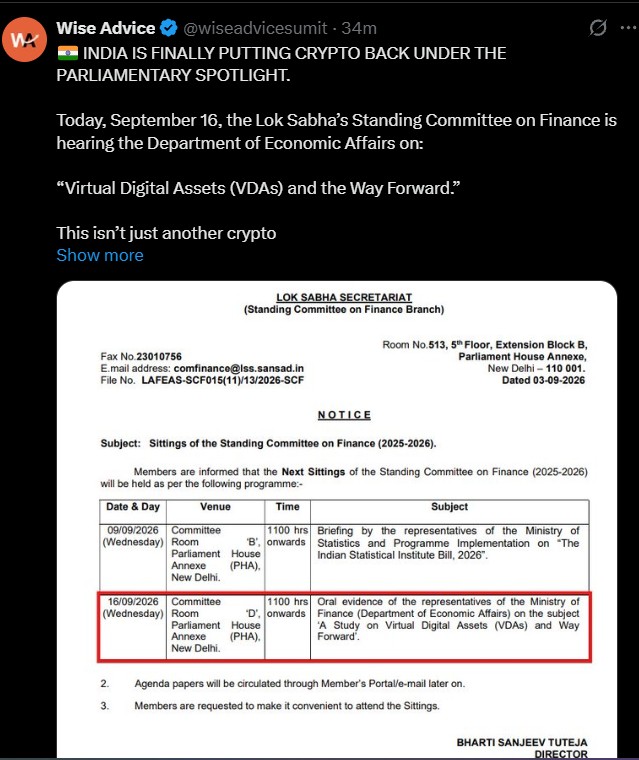
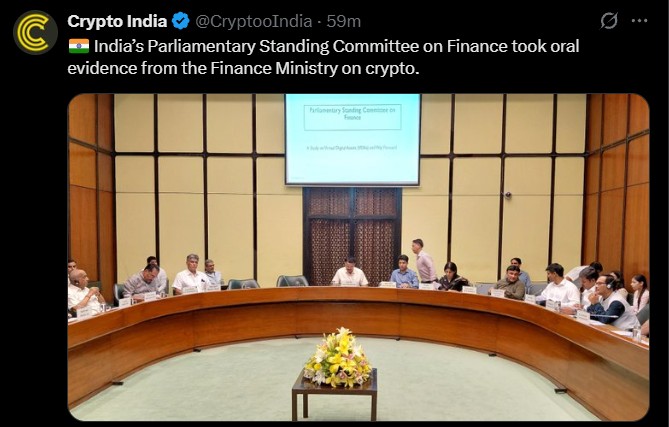
The Lok Sabha Standing Committee on Finance took oral evidence from the Department of Economic Affairs (DEA) on September 16, 2026, as part of its ongoing study, "A Study on Virtual Digital Assets (VDAs) and Way Forward."
The session does not create any new law; it is part of an evidence-gathering process that has run through much of 2025 and 2026.
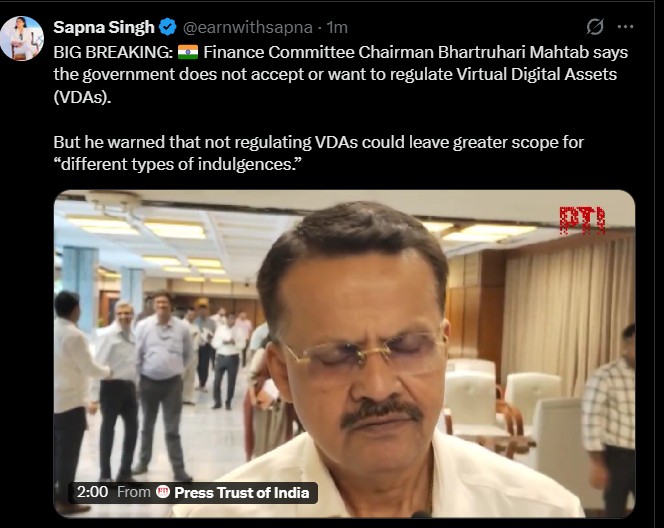
Committee Chairman Bhartruhari Mahtab reportedly said the government does not want to regulate VDAs at this stage, while warning that leaving the space unregulated could open the door to "different types of indulgences."
Unresolved issues include legal classification, investor protection, stablecoin oversight, and the reported flow of over 90% of Indian crypto trading volume to offshore platforms.
This article is for informational purposes only and does not constitute financial, investment, tax, or legal advice. India's cryptocurrency markets and regulatory positions can change quickly; readers should verify current rules and consult a qualified professional before making decisions.
Why India's Crypto Regulation Is Back Under Parliamentary Review
The committee's study was set up to examine whether India needs a dedicated regulatory architecture for VDAs, beyond the tax and anti-money-laundering rules already in place.
Through 2025 and 2026, the panel has met with the RBI, the Institute of Chartered Accountants of India, crypto exchanges, and central crypto tax bodies.
The September 16 sitting with the DEA had originally been scheduled for August 27 before being postponed. Because the DEA effectively sets the government's direction on financial policy, its testimony is seen as a central piece of the committee's overall assessment.
Source: Wise Advice
How Could India Classify Crypto Assets Under a Future Framework?
One of the most basic questions still unresolved is where digital assets legally belong: as securities, as commodities, or in a category of their own. The answer matters because it determines which regulator would have authority, what disclosure standards would apply, and how exchanges and custodians would be supervised. No classification has been formally adopted, and nothing said at this hearing should be read as a government decision on the matter.
Indian Crypto Investor Protection and Exchange Oversight Remain Key Gaps
India already applies tax and anti-money-laundering obligations to registered VDA service providers, but a broader market-structure framework covering custody, exchange conduct, and investor grievance redress remains limited.
The committee has previously floated the idea of an interim arrangement built around self-regulatory organizations operating under a designated regulator, though no such structure has been finalized.
Source: Crypto India
Stablecoins and Offshore Crypto Trading Put More Pressure on India's Framework
Stablecoins such as USDT and USDC could draw closer scrutiny given their links to cross-border payments and remittances, areas that intersect with foreign exchange rules. A more pressing concern for lawmakers is the scale of offshore trading: industry estimates cited around the hearing put the share of Indian crypto volume flowing to overseas platforms above 90%, which complicates both tax collection and oversight.
Area
Current Position
Key Question Under Review
Taxation
30% flat tax on VDA gains applies
How effective is compliance, especially offshore?
AML
VDA service providers covered under PMLA
How can enforcement and monitoring improve?
Classification
No unified framework
Securities, commodities, or separate category?
Exchanges
AML duties apply to registered providers
Who oversees broader exchange conduct?
Investor protection
No dedicated market-structure rules
What custody, disclosure, redress rules are needed?
Stablecoins
Part of the broader VDA debate
How to address payment and FX-related risk?
Regulatory authority
Split across existing institutions
Should one designated regulator be named?
Bhartruhari Mahtab's VDA Comments Add Another Layer to the Debate
Committee Chairman Bhartruhari Mahtab was reported to have said that the government neither accepts nor wants to regulate VDAs at this time, while cautioning that the absence of regulation could leave room for what he called "different types of indulgences."
Taken together with his past remarks, including flagging large capital outflows tied to crypto investment as concerning, the comments point to continued caution rather than a settled policy stance. They should be read as one committee member's characterization rather than a final government position.
Source: Sapna Singh
From RBI and Industry Consultations to the September 16 Hearing
December 2025: Industry groups and exchanges gave evidence.
January 2026: FIU-IND and CBDT testified.
May 2026: IFSCA, the Department of Revenue, and the Ministry of Corporate Affairs took part.
July 2026: The RBI reiterated its opposition to legalizing VDAs; ICAI pushed for a comprehensive accounting and legal framework.
August 2026: A planned DEA sitting was cancelled without an official explanation.
September 16, 2026: The rescheduled DEA hearing took place.
What Happens After the Hearing?
The September 16 session was evidence-gathering, not lawmaking. The committee will weigh the DEA's testimony alongside a year of prior consultations before drafting findings and recommendations, which would still need government and, potentially, legislative follow-through before becoming binding rules. For now, existing tax and compliance obligations continue unchanged.
Conclusion
India crypto policy remains a work in progress. The September 16 hearing adds detail to an already lengthy record of consultations but leaves the biggest questions, classification, regulatory authority, and how to handle offshore trading, still open. Investors and businesses operating in the space should watch for the committee's eventual report rather than expecting immediate regulatory change.
Disclaimer: This article is intended for general informational purposes only and should not be interpreted as financial, legal, or investment advice. Cryptocurrency investments carry significant risk, including the risk of total loss, and regulatory positions in India remain under active review. Readers should conduct independent research and consult licensed professionals before making any financial decisions.