India Crypto News: BTCFUND Bitcoin Scam Took Rs200 Crore in Total The Enforcement Directorate (ED) has attached assets worth Rs8.54 crore belonging to Hemant Ishwar Sharma, the man accused of
India Crypto News: BTCFUND Bitcoin Scam Took Rs200 Crore in Total
The Enforcement Directorate (ED) has attached assets worth Rs8.54 crore belonging to Hemant Ishwar Sharma, the man accused of running a Bitcoin investment scam through the website BTCFUND.IS between 2014 and 2018. This development pushes total attachments in the case to roughly Rs13.10 crore.
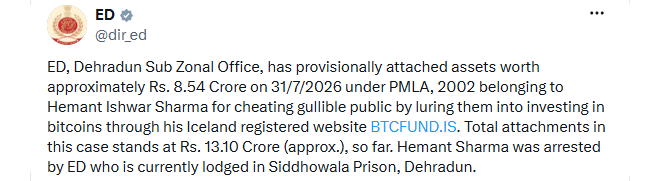
The India crypto news today comes straight from a Prevention of Money Laundering Act order issued by the Dehradun Sub-Zonal Office on 31 July 2026.
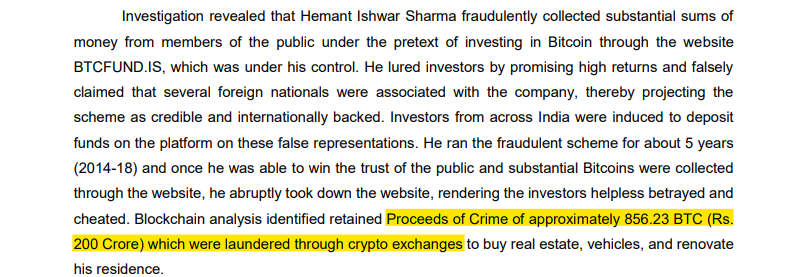
Source: Official Press Release
Sharma allegedly pulled investors in with promises of outsized Bitcoin returns and false claims of foreign backing. Blockchain analysis later traced about 856.23 BTC, valued near Rs200 crore (~$23 million), back to his operation as proceeds of crime.
That Rs200 crore is the estimated total crypto scam proceeds; the Rs13.10 crore is only the portion the ED has traced and attached so far.
Inside The BTCFUND Bitcoin Scam: How Rs200 Crore Vanished Into Assets
BTCFUND.IS ran out of Iceland on paper, but its investor base sat across India. Sharma claimed international credibility and foreign national involvement to convince people the scheme was legitimate as per ED reports.
Once the Bitcoin came in, the money moved fast through cryptocurrency exchanges and into tangible assets:
Two BMW cars registered in Sharma's name
A bungalow in a prime Dehradun location
Additional properties and renovations, with no other meaningful income source on record to explain them
He was arrested earlier in 2026 during related searches and now sits in Siddhowala Prison in Dehradun. A special PMLA court took cognizance of the prosecution complaint in July, after it was filed in May 2026.
India Crypto News Today: Update Reveals About The ED's PMLA Push
Local police in Uttarakhand had already registered cheating cases under Section 420 of the IPC. The ED stepped in separately to handle the money laundering angle under PMLA, using searches, digital evidence, and blockchain tracing to connect the website's proceeds to Sharma's assets.
Provisional attachment orders exist to freeze property while a case moves through the system, preventing a suspect from selling off assets during investigation.
Crypto fraud now sits alongside terror financing, cyber crime, and narcotics as a stated priority area for ED leadership, according to the agency's own statements. That shift matters because it signals older, dormant cases can resurface years later once blockchain forensics catches up.
Why India Crypto Scam Cases Keep Resurfacing Right Now
The country carries one of the largest retail cryptocurrency bases anywhere, with an estimated 39 million KYC-verified users. High-return pitches tend to land hardest with newer investors outside major cities, and offshore websites from the mid-2010s were often hard to shut down at the time they operated.
A few structural gaps keep feeding this pattern:
Crypto's borderless movement makes layering funds into real assets or hawala-style networks easier
Taxation and anti-money laundering rules exist, but no single India crypto law present to oversees the sector directly
Investor recovery stays limited even after seizures, since converting crypto back into cash for victims is harder than freezing physical property
India Crypto Tax And CBDC Rules Shaping The Digital Asset Landscape
Crypto in India sits in a gray zone: not banned, not treated as legal tender either. Trading through FIU-registered Virtual Digital Asset platforms is allowed, but the core tax rules stay strict:
A flat 30% tax on cryptocurrency gains, with no loss set-off in most cases
1% TDS on specified transactions, unchanged under Budget 2026
New penalties for missed or inaccurate reporting: Rs200 per day of delay, and Rs50,000 for inaccurate statements, per the Central Board of Direct Taxes
Tax authorities also issued guidance in late July 2026 aligning India with the OECD's Crypto-Asset Reporting Framework, extending FATCA and Common Reporting Standard coverage to crypto holdings abroad.
The Reserve Bank of India continues to raise concerns about private cryptocurrencies while supporting the digital rupee development. In early August, Union Minister Piyush Goyal said that heavy taxation reflects the government's stance on unbacked digital assets.
Cases like the BTCFUND matter show where enforcement is headed next: older, offshore-run schemes are no longer safe from scrutiny just because time has passed, and blockchain tracing is turning cold cases into live ones again.
Disclaimer: This article is for informational purposes only and does not constitute financial or investment advice. Cryptocurrency markets carry significant risk. Always do your own research before making any investment decisions.