Canary Capital filed another amended registration statement for its Staked INJ ETF with the SEC. The fund is still unapproved and cannot sell shares until the registration becomes effective.
- Canary Capital filed another amended registration statement for its Staked INJ ETF with the SEC.
- The fund is still unapproved and cannot sell shares until the registration becomes effective.
- The Injective Foundation opened a Trench Treasury to back small projects built around INJ.
- INJ has held its June high as support for three weeks after doubling from its August low.
Canary Capital now describes its Canary Staked INJ ETF as “coming soon”, and the wording follows a concrete step: on September 24, 2026 the issuer submitted another amended S-1/A registration statement to the U.S. Securities and Exchange Commission. In the same stretch, the Injective Foundation opened a Trench Treasury aimed at small teams building around the token. INJ trades at $7.74, about 11% below the $8.673 peak it reached in late September after a 119% run from its mid-August low.
Canary names BitGo and U.S. Bank, but the SEC has not cleared a single share
Canary first filed for the product in July 2025, one of the earliest attempts to put Injective exposure and staking income inside a U.S.-listed fund. The September amendment runs across dozens of exhibits covering custody, administration and authorized participants, the trading firms that create and redeem ETF shares. BitGo Bank & Trust is named as crypto custodian, U.S. Bank holds the cash side and U.S. Bancorp Fund Services acts as administrator and transfer agent. According to the prospectus, the fund would hold INJ directly, calculate its net asset value from a third-party benchmark rate and stake part of its holdings to earn additional tokens. Canary lists the ticker as INJC.
Canary Staked INJ ETF: the road so far
July 2025
First S-1 filed
March 9, 2026
Cboe listing proposal withdrawn
September 24, 2026
Amended S-1/A submitted
Pending
SEC effectiveness
“Coming soon” is the issuer’s phrase. The SEC document is still a preliminary prospectus and states that the securities cannot be sold until the registration statement becomes effective.
Slashing costs Injective validators nothing today, and governance can change that
An investor who wants staking income today has to buy INJ, move it to an Injective wallet, choose validators and delegate the tokens. The fund would do all of that through service providers, so a shareholder’s return would equal the INJ price move plus staking rewards, less fund and staking expenses.
The filing lists the risks that come with this. Validators can be jailed, meaning temporarily removed from the active set, and staked tokens can be slashed, the term for a penalty that destroys part of a stake. Canary notes that as of September 15 Injective’s parameters imposed zero forfeiture of INJ for the infractions it describes. A governance vote can rewrite that setting.
A second application sits alongside it. The 21Shares Injective ETF also received an amended S-1 in September, and Injective chief executive Eric Chen told the audience at Korea Blockchain Week that he expects U.S. INJ funds before 2027, calling that year “a little bit too far”.
Trench Treasury counts heavy team allocations against applicants
The Injective Foundation announced the program on October 5 through its X account. It funds small projects and communities and sets up rewards for long-standing community members, known as ninjas. The foundation has not disclosed the size of the fund or how teams apply, so the published selection criteria are the only detail available. INJ has to be central to the product. The holder base should have grown organically, the markets need real liquidity with sustained activity, and launches with outsized team allocations count against an applicant.
Those filters connect to how the token captures revenue. Through the Community BuyBack, participants commit INJ, receive a proportional share of ecosystem revenue, and the committed tokens are burned permanently. A recent extension called Stockdrop adds tokenized stocks, distributed on Robinhood Chain, to what participants can receive. Projects that generate fee revenue in INJ feed that mechanism directly, which explains why the foundation is screening for economic activity over project count.
Three weeks of daily closes above $7.327 keep the breakout alive

INJ/USDT daily chart. Source: Alexander Stefanov on TradingView
Since the $3.952 low in mid-August, each pullback has ended higher than the one before it, first near $4.70 and then near $5.15. The 50-day average crossed above the 200-day average in early September, a signal known as a golden cross, and the steepest part of the advance followed. Those averages now stand at $6.54 and $5.55.
The level carrying the chart is $7.327, the early June high. Price cleared it in one session in mid-September and has sat on top of it ever since. Several daily lows reached roughly $7.15 to $7.20, yet buyers closed every one of those sessions back above the line. Volume has thinned throughout, which after a fast rally usually reflects few sellers.
RSI reads 61.7, down from above 70 in late September. In practice the market shed its overheated reading while giving back very little price, so a new push would not start from stretched conditions. Sellers last appeared between $8.40 and $8.67.
INJ price map
$8.673
September high
$8.00
Daily close above reopens the high
$7.74
Current price
$7.327
June high, now support
$7.15
Daily close below means support failed
$5.15
Last higher low, uptrend breaks below
Between $7.15 and $5.15 the chart offers several places where a decline could stall: the first retracement level of the rally at $6.870, then the 50-day average at $6.54 close to the rally’s halfway point at $6.313, and lower down the 200-day average at $5.55.
With 59% of INJ staked, fund inflows would meet a thin float
$772M
Market cap
59%
Supply staked
7.2M
INJ burned
INJ’s market capitalization is about $772 million with roughly 100 million tokens in circulation, and the price remains some 85% below the $52.62 record. Recent estimates place more than 58 million INJ in staking, while burns have reportedly removed more than 7.2 million tokens. With a majority of the supply locked, the amount available on exchanges is small relative to large-cap assets, so fund inflows that would barely register in Bitcoin or Ether could represent a meaningful share of INJ’s tradable supply. Whether those inflows arrive is unknown.
The institutional groundwork extends past the ETF. Injective Institutional Services registered with the SEC as a transfer agent in August, the network completed its Meridian upgrade on September 24 with features for tokenization, settlement and collateral, and the project has finalized an INJ white paper under the EU’s MiCA rules.
Cboe’s earlier proposed rule change to list the Canary product went through SEC proceedings and was withdrawn on March 9, 2026. The September prospectus still names Cboe BZX as the exchange where the shares would trade, and it gives no launch date.
The post Injective ETF Filing Advances as INJ Holds Above Its June High appeared first on ETHNews.

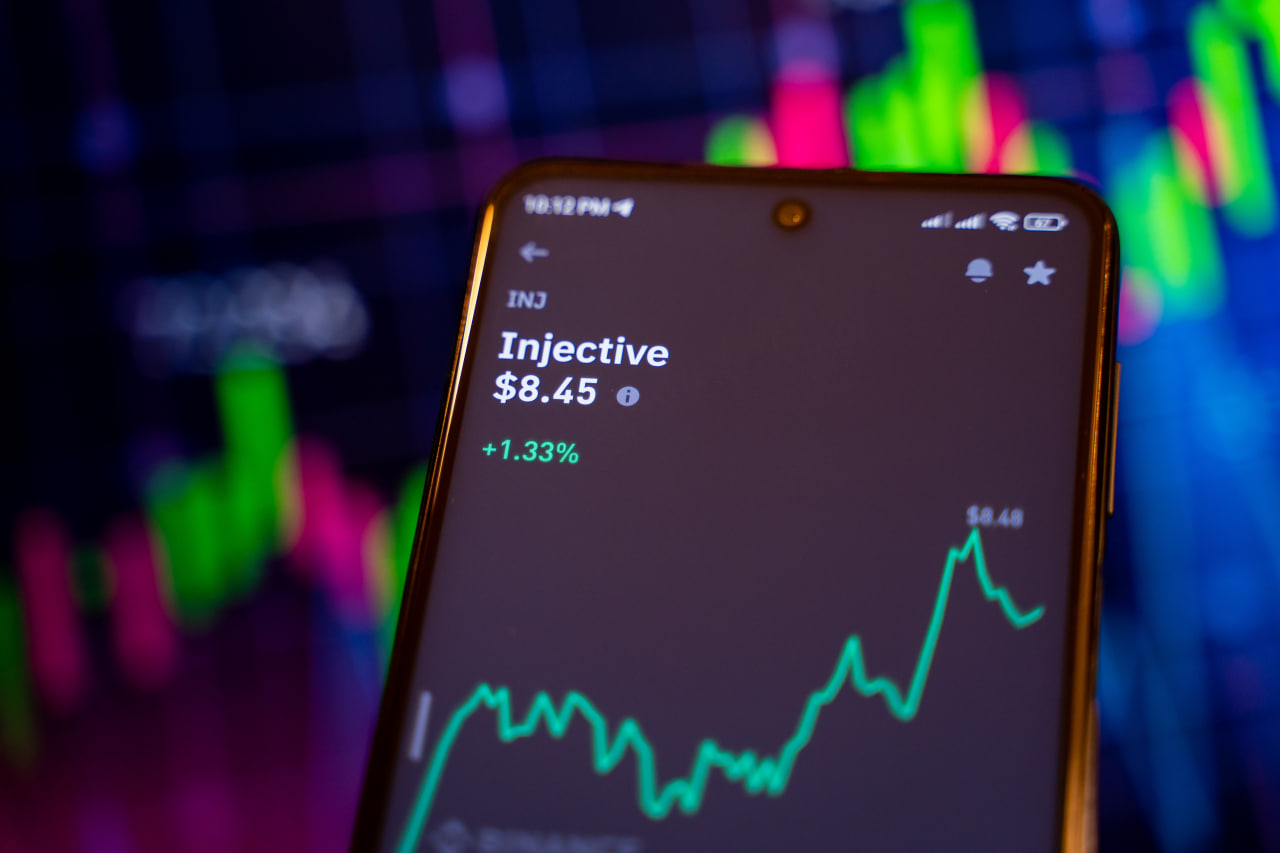
 The Canary Staked INJ ETF (Ticker: INJC) is coming soon.
 (@injective)