Policy11 min read
Is Sky a Good Buy at Current Prices?
Sky changes hands at $0.0683 on Monday evening. That leaves the token 30.0 per cent below its twelve-month high of $0.0976, set on 5 October 2026, and 63.4 per cent above its twelve-month low
Injective has launched a new perpetual futures market that lets traders speculate on changes in the rental cost of high-end Nvidia GPUs—packaging five chip price feeds into a single index. Th
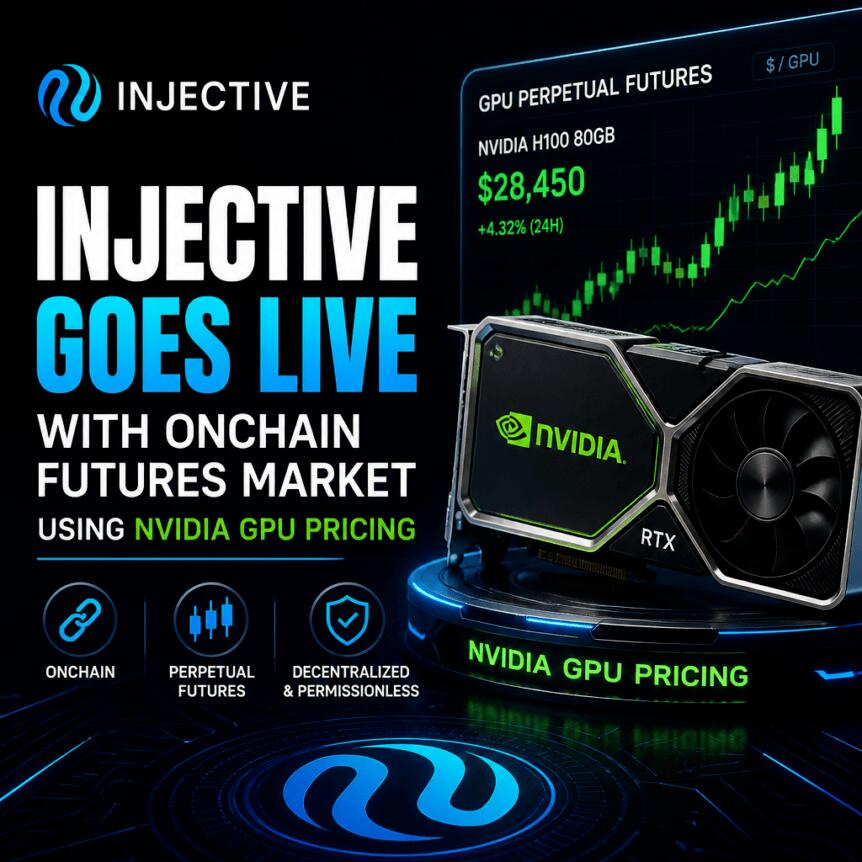
Injective has launched a new perpetual futures market that lets traders speculate on changes in the rental cost of high-end Nvidia GPUs—packaging five chip price feeds into a single index. The Super Intelligence Compute Index (SICI) is designed to turn volatility in AI compute expenses into a tradable financial benchmark on Injective’s Layer-1 network.
According to Injective’s announcement on the SICI launch, the index tracks rental prices for Nvidia H100, B200, H200, A100, and RTX 4090 units. Traders can open positions using USDC margin, placing directional bets on whether the index level will rise or fall, with leverage up to 10x.
The SICI is centered on real-time pricing signals for rented hardware—an approach that reflects how many AI teams source compute today. Instead of buying GPUs outright, developers frequently rent capacity from compute marketplaces and cloud providers, meaning costs can swing with demand for training and inference workloads.
Injective says the index “assigns the largest weight” to the Nvidia H100 (40%), followed by the B200 (25%). The index is updated hourly and is calculated using a trailing seven-day average of rental prices, a smoothing mechanism intended to reduce the impact of day-to-day noise in rental quotes.
On the trading side, the perpetual futures market structure allows participants to take leveraged positions without needing to wait for a contract’s expiration. Injective’s product description also notes that traders can use USDC as margin, a practical detail for market access given how widely stablecoins are used across crypto markets.
This launch builds on earlier momentum: Injective previously introduced a market tied specifically to Nvidia H100 rental prices in August 2025. By expanding from one GPU model to a broader five-chip index, Injective is effectively broadening the exposure available to traders and hedgers.
That matters because AI workloads do not always rely on a single generation of hardware. Even when the H100 remains central for many training-heavy pipelines, other accelerators—including newer or differently optimized models—can play roles depending on availability, performance characteristics, and pricing across providers. A multi-asset index may better reflect the shifting mix of hardware used in the market than a single-chip benchmark.
While the mechanism is new for crypto derivatives, the economic problem is not. AI infrastructure operators and GPU providers face difficult questions about whether they can consistently recover the capital and operating costs of data centers and specialized hardware as demand cycles and competition evolve.
Research firm Gartner warned in October that more than 80% of “neocloud” providers—specialist AI-focused cloud businesses—could stop operating independently by 2030 if they fail to generate sufficient returns. The concern is that the AI cloud model may be capital intensive enough that lenders become more cautious, especially when revenue depends heavily on continued monetization of GPU capacity.
That theme was echoed in recent comments from Elon Musk, who said more than 200 neocloud providers could face failure or consolidation as financing becomes harder for companies dependent on AI data center revenue. Musk’s remarks also referenced his sector involvement through SpaceX’s “Super Intelligence” business, which recently reported $7.6 billion in third-quarter revenue—up 830% year over year—partly attributed to new cloud services agreements, as reported in the source coverage.
The launch also lands amid wider scrutiny of AI spending. Major companies have been trying to contain expenses while maintaining momentum on infrastructure buildouts.
On Monday, Bloomberg reported that Microsoft is offering voluntary buyouts to about 60,000 eligible employees as part of cost reduction efforts, while also noting Microsoft’s forecast of roughly $175 billion in capital expenditures for 2026. Separately, Cointelegraph coverage referenced Meta cutting 8,000 jobs in May as part of restructuring connected to its AI investment plans.
Taken together, these reports reinforce the broader backdrop in which AI compute costs—and the ability to manage them—are becoming a more central operational and financial variable. Injective’s approach translates that reality into a market where participants can hedge higher rental costs or profit from expected changes in GPU availability and pricing.
The key open question for SICI traders and potential hedgers will be how quickly and consistently rental prices across the five tracked GPU models respond to real changes in AI demand—and whether the index’s weighted construction provides a stable benchmark under stress. Investors should also watch liquidity and adoption: a compute-cost index is only as useful as its ability to support tight spreads and sufficient trading depth as market participants decide whether GPU rental volatility deserves dedicated derivatives exposure.
This article was originally published as Injective Goes Live With Onchain Futures Market Using Nvidia GPU Pricing on Crypto Breaking News – your trusted source for crypto news, Bitcoin news, and blockchain updates.