Key Takeaways Intel’s shares have climbed more than 33% in the last 30 days and approximately 236% year-to-date in 2026, marking its strongest calendar year performance in over 40 years. Arti
Key Takeaways
- Intel’s shares have climbed more than 33% in the last 30 days and approximately 236% year-to-date in 2026, marking its strongest calendar year performance in over 40 years.
- Artificial intelligence infrastructure expansion is fueling Intel’s CPU sales, with data center and AI revenue jumping 59% year-over-year to reach $6.3 billion.
- CEO Lip-Bu Tan reports Intel can satisfy approximately 50% of customer demand, indicating significant supply constraints.
- Institutional investors increased their positions, with 138 hedge funds holding stakes last quarter compared to 112 previously, while short interest climbed to approximately 158.81 million shares.
- Historical patterns suggest caution: four out of Intel’s five strongest years since 1981 were followed by negative returns, creating uncertainty around 2027 performance.
Intel (INTC) shares are currently hovering around $123, representing a surge of over 33% during the past 30 days. The impressive climb stems from renewed appetite for the chipmaker’s central processing units as spending on AI infrastructure accelerates.
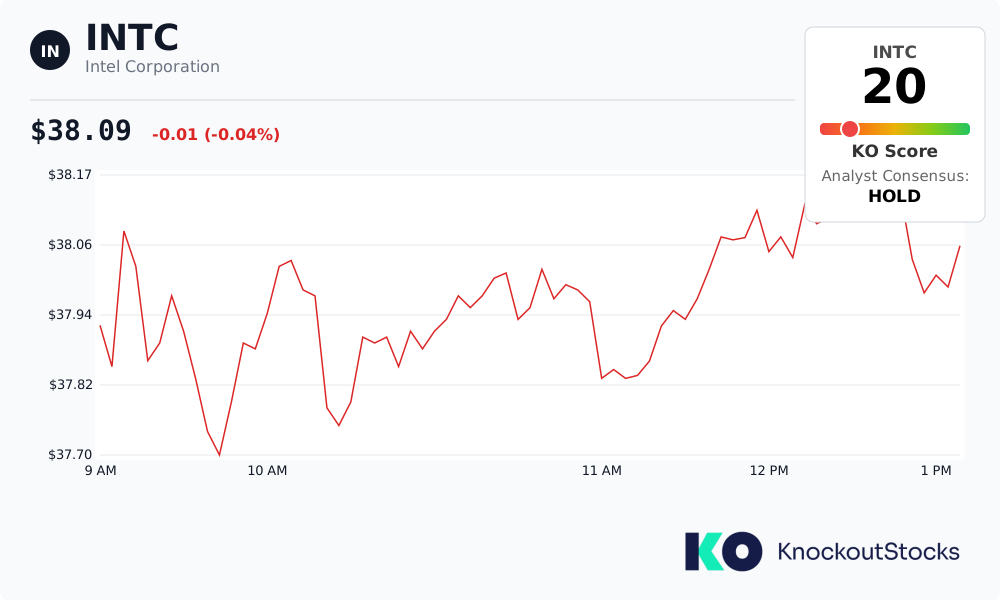 Intel Corp., INTC
Looking at 2026 as a whole, Intel’s stock has jumped approximately 236% from its 2025 closing price. This performance positions the semiconductor giant for its strongest calendar year since data tracking began in 1981.
The momentum reflects a broader reassessment of CPUs in the AI computing landscape. While graphics processing units dominate headlines, central processors remain essential for coordination and general computing functions.
Intel’s Xeon server chips are capitalizing on this dynamic. Enterprise customers are deploying additional CPUs alongside each accelerator as artificial intelligence data centers expand their operations.
Supply Struggles to Keep Pace with Orders
During its second-quarter earnings report, Intel disclosed data center and AI revenue reaching $6.3 billion. This represented year-over-year expansion of 59%.
CEO Lip-Bu Tan revealed the company can currently fulfill approximately 50% of incoming processor orders. This indicates a supply bottleneck rather than weakening customer interest.
Such supply-demand imbalances carry historical baggage. Intel experienced a painful lesson in 1984 when comparable shortages triggered excessive ordering by customers, followed by a sharp demand collapse once production normalized.
Intel is simultaneously pursuing expansion beyond traditional CPU sales. The semiconductor manufacturer is building out its foundry capabilities to produce chips for external clients.
Google has selected Intel to manufacture its Tensor Processing Units. Additionally, SK Hynix has engaged in discussions with Intel regarding memory chip fabrication at its Ohio facility.
Should foundry operations achieve meaningful scale, this could open an additional revenue stream for Intel. However, no major external customer has committed to its upcoming 14A process technology.
Competitive Pressures and Cost Challenges Persist
AMD is steadily capturing server CPU market share from Intel. This competitive dynamic restricts the proportion of industry growth Intel can realistically secure.
Escalating expenses for memory components, wafers, and substrates represent another challenge. Should Intel transfer these costs to customers through price increases, some buyers might postpone purchases or explore alternatives.
Institutional investment in Intel has expanded alongside the stock’s appreciation. Insider Monkey’s tracking shows 138 hedge funds maintained Intel holdings at the conclusion of the second quarter, up from 112 in the preceding period.
SoftBank Group maintained a position valued at approximately $12.14 billion. Coatue Management initiated a fresh stake worth nearly $1.68 billion.
Short interest has also risen, hitting approximately 158.81 million shares as of September 15. This compares to 135.1 million shares a month prior, though it represents only 3.01% of outstanding shares.
Intel’s valuation multiples have stretched rapidly. Shares currently trade at approximately 60 times projected 2027 adjusted earnings, substantially higher than the roughly 38 times earnings multiple at the start of 2004, a year when profits increased 36% yet the stock declined 27%.
For the third quarter, Intel’s management projects revenue between $15.8 billion and $16.8 billion. This would represent approximately 19% year-over-year growth at the midpoint, with adjusted earnings per share forecast at $0.38 compared to $0.23 in the prior year period.
The post Intel (INTC) Stock Soars 236% in 2026 as AI CPU Demand Creates Supply Shortage appeared first on Blockonomi.
