Key Highlights IonQ (IONQ) shares climbed 4.4% to reach $42.54 during Wednesday’s session, while the Nasdaq declined 1.1%. Nvidia selected IonQ’s Superion 256 as the inaugural quantum system
Key Highlights
- IonQ (IONQ) shares climbed 4.4% to reach $42.54 during Wednesday’s session, while the Nasdaq declined 1.1%.
- Nvidia selected IonQ’s Superion 256 as the inaugural quantum system for its newly established quantum research facility.
- The quantum processor will integrate with Nvidia’s GB200 NVL72 platform via NVQLink connectivity technology.
- Competing quantum firms Rigetti, D-Wave, and Quantinuum experienced declining share prices on the same trading day.
- IonQ shares had previously surged over 8% in after-hours trading Tuesday following publication of an error correction research paper.
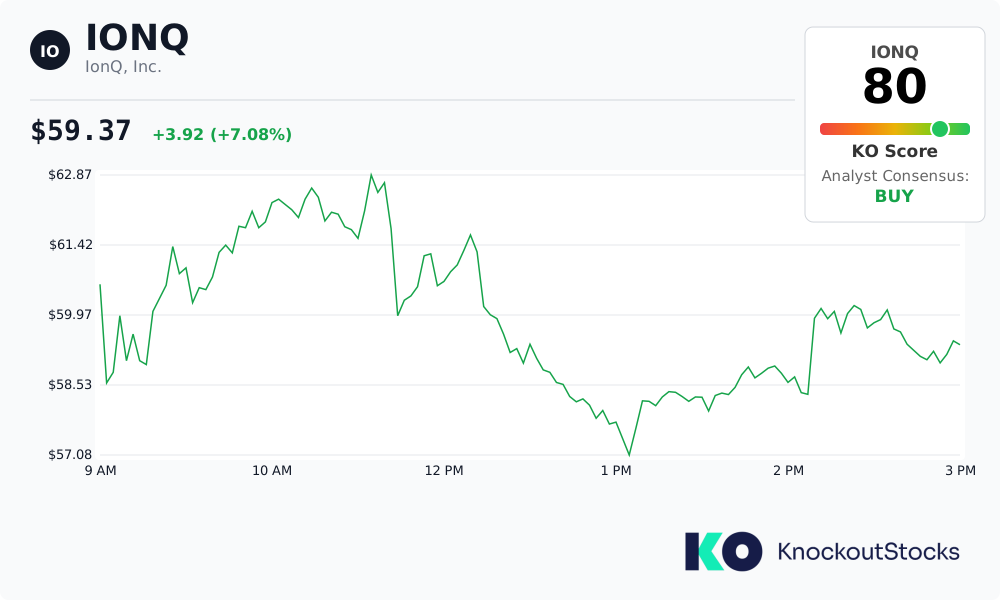
Shares of [[LINK_START_1]]IonQ (IONQ)[[LINK_END_1]] advanced 4.4% to $42.54 during Wednesday’s trading session, defying broader weakness across technology equities. The tech-heavy Nasdaq Composite index fell 1.1% during the same period.
 IonQ, Inc., IONQ
The stock’s upward momentum followed IonQ’s disclosure that Nvidia selected its Superion 256 quantum processor as the inaugural installation for Nvidia’s Accelerated Quantum Research Center. This represents a significant achievement for the quantum computing firm, which has consistently marketed itself as a quantum industry leader comparable to Nvidia’s position in GPU computing.
Meanwhile, quantum sector competitors including Rigetti Computing, D-Wave Quantum, and Quantinuum failed to capture similar investor enthusiasm. All three companies finished Wednesday’s session with losses as IonQ outperformed its peers.
Understanding the Technical Integration
IonQ’s Superion 256 processor will establish a direct connection with Nvidia’s GB200 NVL72 infrastructure using Nvidia’s proprietary NVQLink interface technology. Rather than operating as an isolated research instrument, the quantum system will serve as an integrated co-processor alongside Nvidia’s graphics processing units.
The architecture routes quantum-optimized computations to the Superion 256 processor, while Nvidia’s GPU infrastructure manages conventional computational tasks and artificial intelligence operations concurrently. Both platforms operate within Nvidia’s open-source CUDA-Q software framework.
IonQ CEO Niccolo de Masi characterized the development as “an exciting moment for compute and the history of compute.” He emphasized that Superion processors incorporate engineering solutions to address vibrations and electromagnetic interference challenges that typically compromise quantum system stability, making them well-suited for deployment in production data center settings.
Nvidia’s Timothy Costa, serving as Vice President, noted that the quantum computing sector has been progressing toward this hybrid computational model. He drew parallels to earlier challenges integrating GPUs into AI infrastructure, acknowledging the complexity of establishing efficient workload distribution and data transfer protocols between the two architectures.
Economic viability remains a critical consideration. Enterprise adoption of quantum technology depends on demonstrating measurable performance advantages that justify the investment, and Nvidia’s research facility aims to provide empirical evidence addressing this fundamental question.
Multiple Catalysts Drive Investor Interest
The Nvidia partnership isn’t the sole development attracting market attention to IonQ. The company’s stock experienced an 8% surge in extended trading Tuesday after researchers published findings on quantum error correction methodology.
The research outlined an approach for implementing quantum error correction using conventional central processing units, potentially reducing latency typically associated with error correction procedures. However, the methodology’s validation relied exclusively on simulated noise environments rather than actual quantum hardware, leaving questions about real-world performance characteristics unanswered.
Microsoft also contributed to quantum sector news flow this week. The software giant inaugurated its own quantum research facility adjacent to the University of Maryland campus, incorporating workforce development programs and strengthened collaboration with government agencies.
IonQ, Nvidia, Oak Ridge National Laboratory, and the University of Tennessee jointly presented research findings at IEEE Quantum Week earlier this month. Their collaborative work explored combining generative artificial intelligence with distributed quantum algorithms, leveraging the CUDA-Q platform for applications spanning portfolio optimization and pharmaceutical discovery.
The Superion 256 system is scheduled to commence commercial shipments during the coming year. Its architecture supports progressive expansion, enabling additional qubit integration as the technology evolves.
This announcement arrives shortly after IonQ finalized its acquisition of semiconductor manufacturing facility SkyWater Technology last month, a transaction carrying an approximate valuation of $1.8 billion.
The post IonQ (IONQ) Stock Surges 4% After Securing Nvidia Quantum Partnership appeared first on Blockonomi.
