Key Takeaways Shares of IonQ climbed approximately 6% on Wednesday, reaching around $43 per share. Nvidia has chosen Superion 256 as the inaugural quantum processing unit for its quantum rese
Key Takeaways
- Shares of IonQ climbed approximately 6% on Wednesday, reaching around $43 per share.
- Nvidia has chosen Superion 256 as the inaugural quantum processing unit for its quantum research facility.
- The quantum system will integrate directly with Nvidia’s GB200 NVL72 infrastructure via NVQLink technology.
- Nvidia’s CUDA-Q platform will manage hybrid computing tasks between quantum and traditional processors.
- While strategically significant, quantum computing commercialization faces ongoing technical and execution challenges.
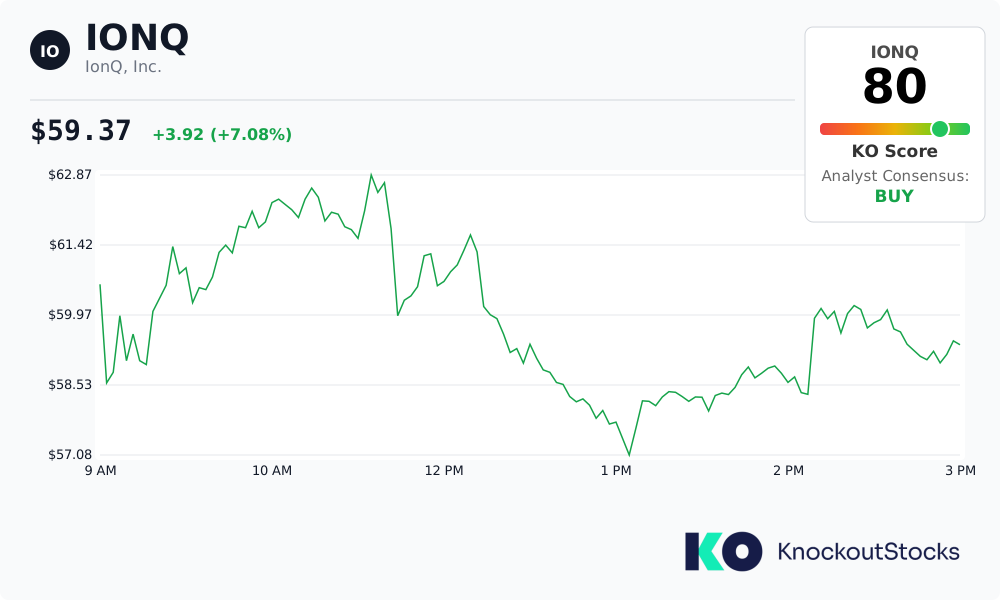
Shares of IonQ (IONQ) surged approximately 6% on Wednesday, trading near $43 following news of a major collaboration with Nvidia. Earlier in the trading session, the stock peaked at $45.93, up from Tuesday’s closing price of $40.74.
 IonQ, Inc., IONQ
The market enthusiasm stems from an agreement that positions IonQ’s Superion 256 quantum processor at the Nvidia Accelerated Quantum Research Center. According to IonQ, this represents the inaugural on-site quantum computing deployment at Nvidia’s research facility.
This designation carries weight because the collaboration extends beyond simple software compatibility. IonQ’s quantum processing technology will be physically co-located with Nvidia’s artificial intelligence infrastructure, enabling direct participation in hybrid quantum-classical computing research initiatives.
Direct Integration With Nvidia’s Computing Infrastructure
The Superion 256 system will establish a connection with Nvidia’s GB200 NVL72 platform using NVQLink technology. Nvidia’s open-source CUDA-Q framework will manage workflow coordination, enabling computational tasks to transition seamlessly between quantum and conventional processing units.
Research efforts will concentrate on developing hybrid software applications and prototyping large-scale integrated systems. Both companies intend to publish open research findings and architectural guidelines for designing next-generation AI and quantum-GPU computing systems.
IonQ unveiled its Superion 256 platform earlier this month, positioning it as the company’s sixth-generation quantum technology. The system is currently available for order, with initial customer installations projected for 2027.
The Nvidia research center deployment is similarly scheduled for next year. This timeline indicates Wednesday’s announcement represents a forward-looking strategic partnership rather than an immediate revenue-generating commercial contract.
IonQ and Nvidia have previously collaborated on research initiatives. Earlier this month, the two companies joined Oak Ridge National Laboratory and the University of Tennessee in publishing research that merged generative artificial intelligence with distributed quantum computing algorithms.
The current deployment represents a significant expansion of that existing relationship by establishing IonQ’s physical hardware presence within Nvidia’s research ecosystem.
Strategic Partnership Bolsters IonQ’s Market Position
IonQ CEO Niccolo de Masi has articulated the company’s vision to establish itself as a leading platform provider within the quantum computing sector. This Nvidia collaboration offers investors tangible evidence of how IonQ technology might integrate into future data center architectures.
The underlying concept centers on hybrid computational models. Quantum processors would address specific specialized calculations while Nvidia’s GPU technology continues handling artificial intelligence and conventional computing workloads.
This architectural approach may prove essential because practical quantum systems are unlikely to function in complete isolation. Error correction protocols, task scheduling, and substantial portions of supporting computational processes continue to rely heavily on traditional processor technology.
IonQ has recently pursued international expansion for its Superion platform. On September 21, the company revealed an agreement with South Korea’s SDT involving a Superion 256 system alongside a quantum memory module.
The primary concern remains the nascent stage of commercial quantum computing. Technical advancement doesn’t automatically translate to short-term revenue generation, and companies must still demonstrate that hybrid quantum architectures can deliver meaningful performance benefits at economically viable costs.
IONQ stock also exhibits significant volatility. Wednesday’s gains follow considerable daily price fluctuations throughout September, indicating investors are pricing in substantial future growth that depends on ongoing technology development and market acceptance.
Currently, the Nvidia deployment serves as the most significant near-term catalyst. By securing the first quantum processor installation at Nvidia’s NVAQC, IonQ has positioned itself prominently in research programs designed to integrate GPUs and quantum processing units into future quantum supercomputing architectures.
The post IonQ (IONQ) Stock Surges 6% on Nvidia Quantum Computing Partnership appeared first on Blockonomi.
