Artificial Superintelligence Alliance trades at around 0.111 US dollars per FET on Thursday, 26 November. That leaves the AI token roughly 62 percent below its 12-month high of 0.2956 US doll
Artificial Superintelligence Alliance trades at around 0.111 US dollars per FET on Thursday, 26 November. That leaves the AI token roughly 62 percent below its 12-month high of 0.2956 US dollars, the daily close of 7 January 2026, and only about 4 percent above its 12-month low of 0.1065 US dollars, set as recently as Wednesday, 25 November. Over 30 days FET has lost 36 percent, over 90 days 33 percent and over a full year 60 percent. Is FET a good buy at current prices, or is this a falling knife that is better left alone?
cryptoticker.io analysed the price data for this article itself on 26 November 2026, using the daily closing prices published by CoinMarketCap. The moving averages, the RSI and the distances to the high and the low are our own calculations from that series.
FET price analysis: where the Artificial Superintelligence Alliance price stands
The picture is clearly weak. In the past seven days alone FET fell by 14 percent, and with a market value of about 275 million US dollars the token now ranks only 99th among the largest crypto-assets. A small bounce of almost 4 percent over the last 24 hours has done little to change that.
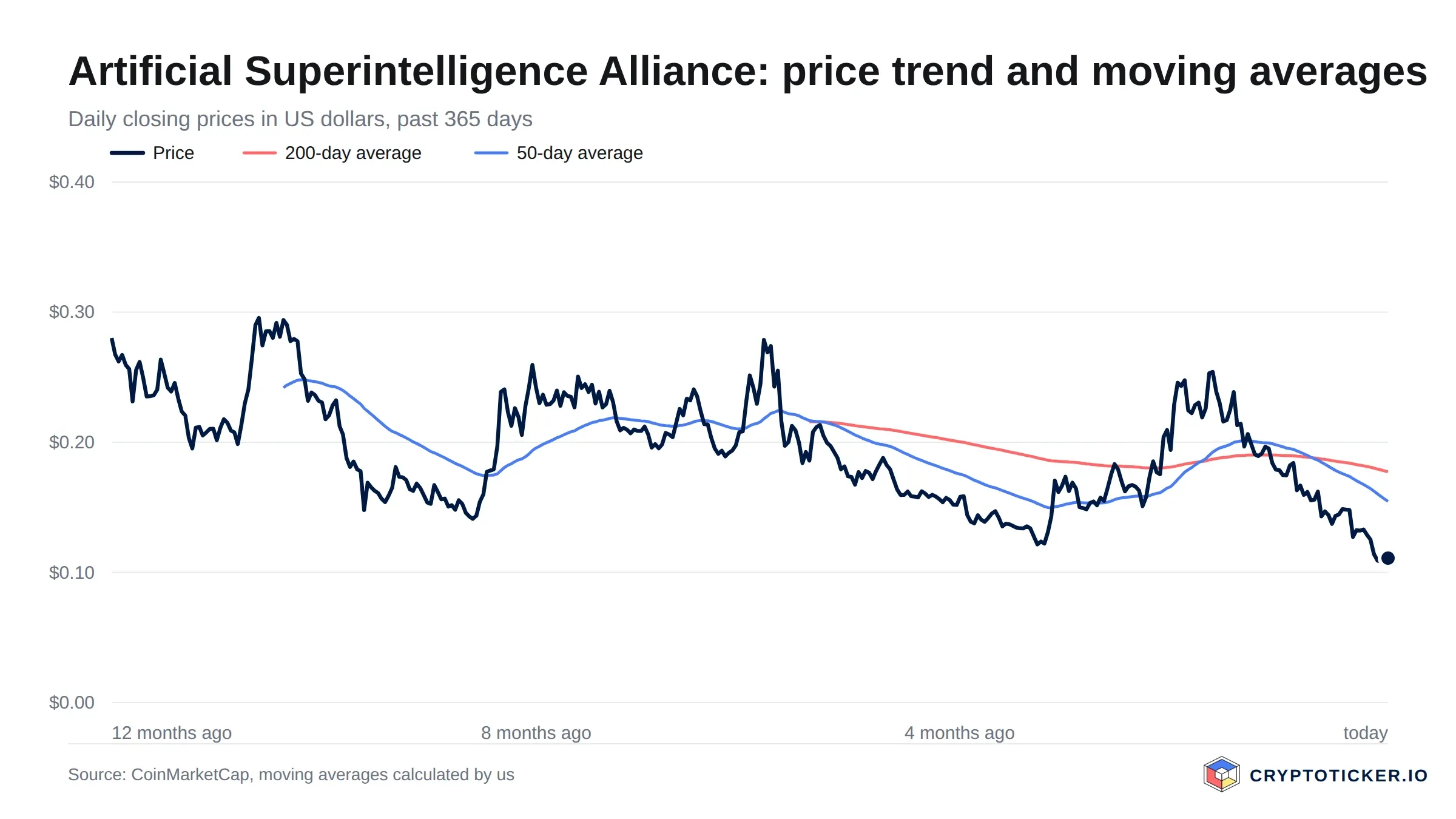
Artificial Superintelligence Alliance price and moving averages, calculated by us from CoinMarketCap daily closing prices
Three levels define the chart. The first is the zone between 0.121 and 0.127 US dollars. On 17 August FET closed at 0.121 US dollars, its low of the year at that point, and from there the price more than doubled to 0.248 US dollars by 28 September. This support gave way last week and now acts as resistance. The second level is the band around 0.14 to 0.15 US dollars, where FET spent the first half of November. The third is the 200-day moving average at 0.178 US dollars. The current price sits about 38 percent below it.
Below the current price there are hardly any tested levels. FET last traded lower more than a year ago. In chart terms the token is therefore moving through territory where buyers still have to show at what price they are willing to step in again.
Has the FET downtrend been broken or merely interrupted?
There is no sign of a broken downtrend. Since the late-September high at 0.248 US dollars and the interim peak of 0.254 US dollars on 6 October, FET has been forming lower highs and lower lows. In October the price still held above 0.16 US dollars; in November it slipped through every intermediate step.
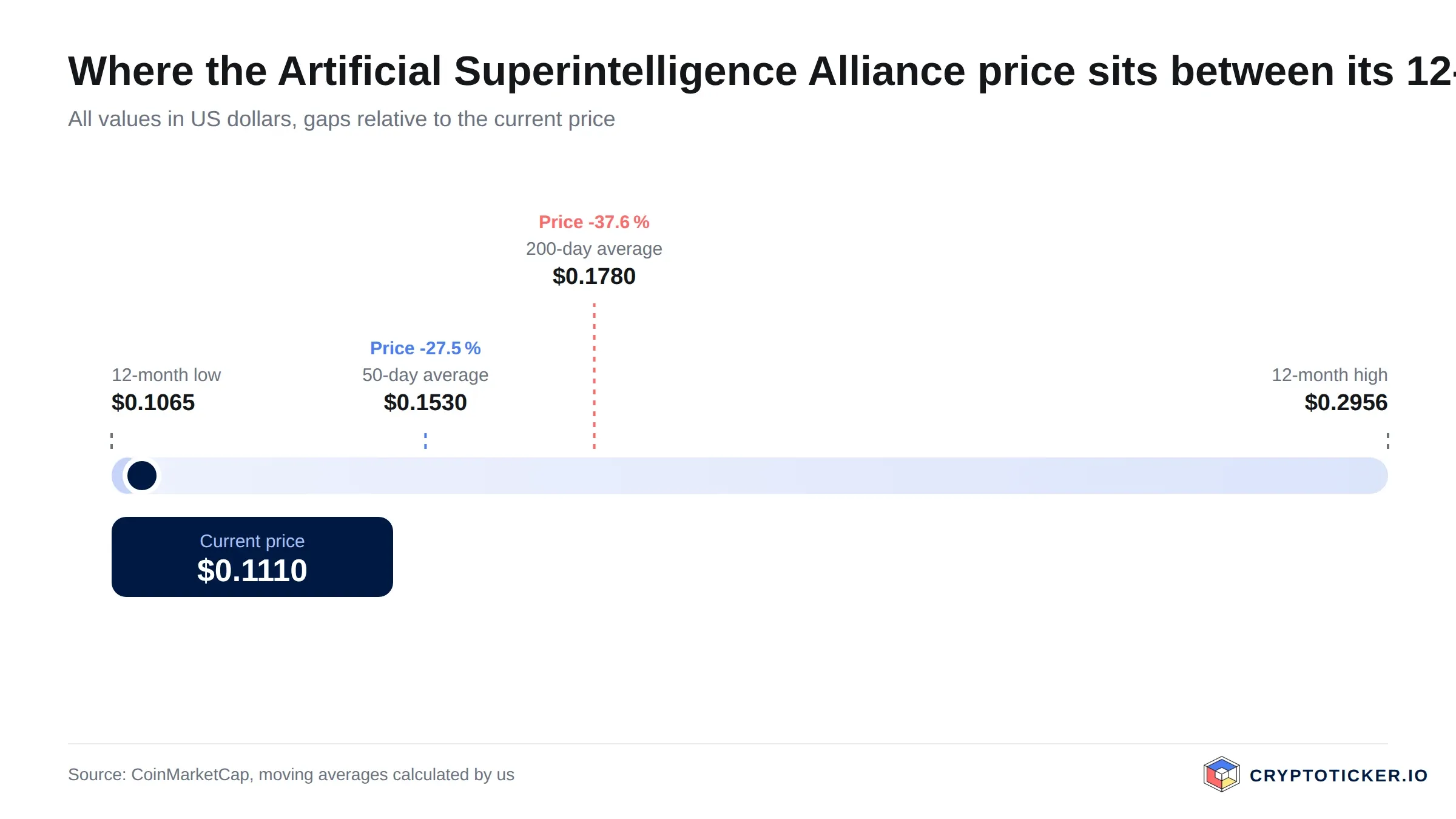
The Artificial Superintelligence Alliance price relative to its 12-month low, high and both moving averages
The most damaging day was 15 November. The daily close fell from 0.148 to 0.127 US dollars, a loss of about 14 percent in a single session. No recovery followed, only a series of smaller declines down to the current level. The new low of 0.1065 US dollars on 25 November was the latest step in that sequence.
A first sign of a trend reversal would be a daily close back above 0.127 US dollars, which would mean reclaiming the broken August zone. The picture would only become robust with a weekly close above 0.15 US dollars. Until then, any rebound is a countermove within the prevailing downtrend.
The wider market offers no support. The CoinMarketCap Fear and Greed Index stands at 10 out of 100, deep in extreme fear. In such phases investors tend to pull money out of smaller, speculative assets first, and thematic tokens such as FET belong to that group.
What the RSI and moving averages mean for a FET entry
The 14-day Relative Strength Index stands at 29.5 after the latest bounce; on Wednesday's close it was 24.5. Readings below 30 are considered oversold. For an entry this is a double-edged signal. On the one hand, the low RSI shows that selling pressure has been unusually strong and that a technical rebound is becoming more likely. On the other, tokens in an intact downtrend can remain oversold for weeks.
The moving averages paint a clear picture. The 50-day moving average is at 0.153 US dollars, the 200-day moving average at 0.178 US dollars. The price is therefore trading roughly 27 percent below the shorter line and 38 percent below the longer one, and the shorter line runs below the longer one. That is the typical order of a downtrend.
Such a wide gap to the 200-day average is rare. It points to an overstretched move from which rebounds can be sharp. Anyone buying now is betting on exactly that and therefore needs a clear exit rule, such as a weekly close below 0.10 US dollars.
What FET trading volume reveals about demand
Trading volume over 24 hours comes to about 128 million US dollars. That equals almost half of the entire market value of 275 million US dollars, which is a very high turnover. Over the past 30 days an average of around 146 million US dollars changed hands each day, over 90 days around 162 million US dollars.
Volume has therefore not collapsed; it is merely easing. The token remains actively traded and there is ample liquidity for a purchase. At the same time a buying surge is missing. Even on the day of the slump on 15 November, volume of 159 million US dollars was barely above average. The sell-off has been steady rather than panicked.
The heaviest volume of the past 90 days came on 6 October, when FET set its interim high at 0.254 US dollars. Around 300 million US dollars traded on that single day. A similar spike, this time on a rising price, would be the clearest sign that demand is returning.
Structural factors in favour of the Artificial Superintelligence Alliance
FET is the token of an alliance of several AI projects. In 2024 Fetch.ai, SingularityNET and Ocean Protocol merged their tokens into the Artificial Superintelligence Alliance, with FET becoming the shared token. Ocean Protocol left the alliance again in October 2025. The goal of the group is an open infrastructure for AI agents and AI services that is not controlled by individual corporations. The alliance publishes details on its projects and roadmap on its official website.
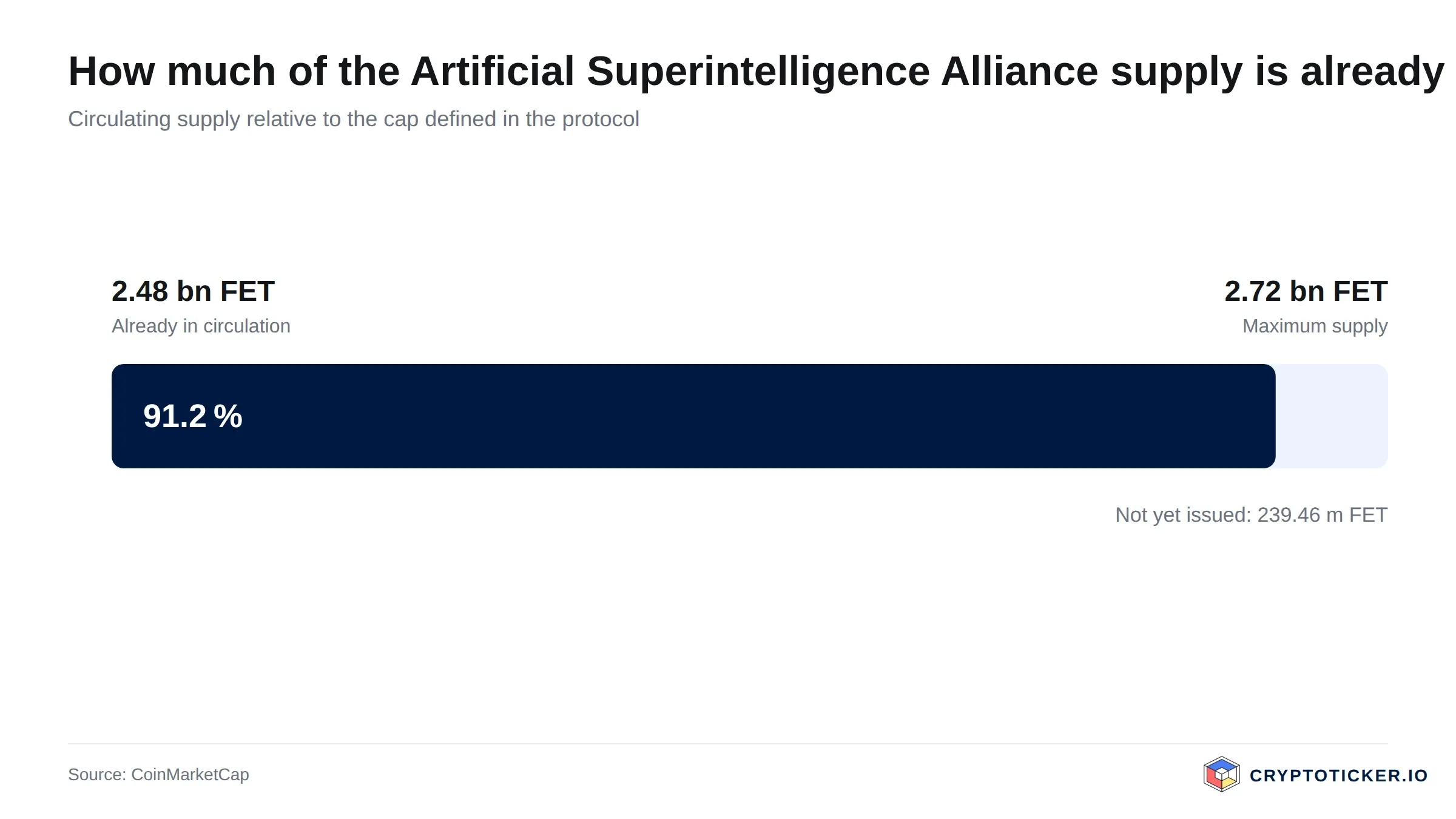
Artificial Superintelligence Alliance supply structure according to CoinMarketCap data
In terms of supply mechanics, FET is largely mature. Of a maximum of 2.72 billion tokens, around 2.48 billion are in circulation, or just over 91 percent. Only a limited number of new tokens will be added. Selling pressure from unlocks, which often weighs heavily on the price of younger projects, plays a smaller role here.
From a regulatory perspective, FET falls under the EU Markets in Crypto-Assets Regulation, MiCA, for buyers in Europe. It requires providers that sell crypto-assets to customers in the EU to hold a licence. The European Securities and Markets Authority ESMA publishes which firms are authorised in its register.
What speaks for buying FET at the current price
- Oversold conditions: An RSI just below 30 and a discount of 38 percent to the 200-day average point to an overstretched move. Late summer showed how strong FET rebounds can be: from the August low at 0.121 US dollars the price climbed to 0.248 US dollars within six weeks.
- A major theme: Artificial intelligence remains one of the defining technology themes. FET is one of the best-known tokens through which investors can bet on decentralised AI infrastructure.
- Little dilution left: With 91 percent of the maximum supply already in circulation, there are no large waves of unlocks that could cap a later rise.
What speaks against buying FET at the current price
- Intact downtrend: Lower highs, lower lows and falling averages. The August zone around 0.121 US dollars has broken, and below it there are no tested support levels.
- Weak environment: With extreme fear across the market, smaller thematic tokens come under pressure first. As long as sentiment does not turn, there is no tailwind.
- Competition and restructuring: The exit of Ocean Protocol shows that the alliance is not set in stone. Many other AI projects are competing for the same attention and the same capital.
How to buy FET at the current price
FET is listed on many large crypto exchanges. For buyers in Europe three points matter most: a MiCA licence, low fees and secure custody. Which providers offer FET and what they charge is shown in our crypto exchange comparison.
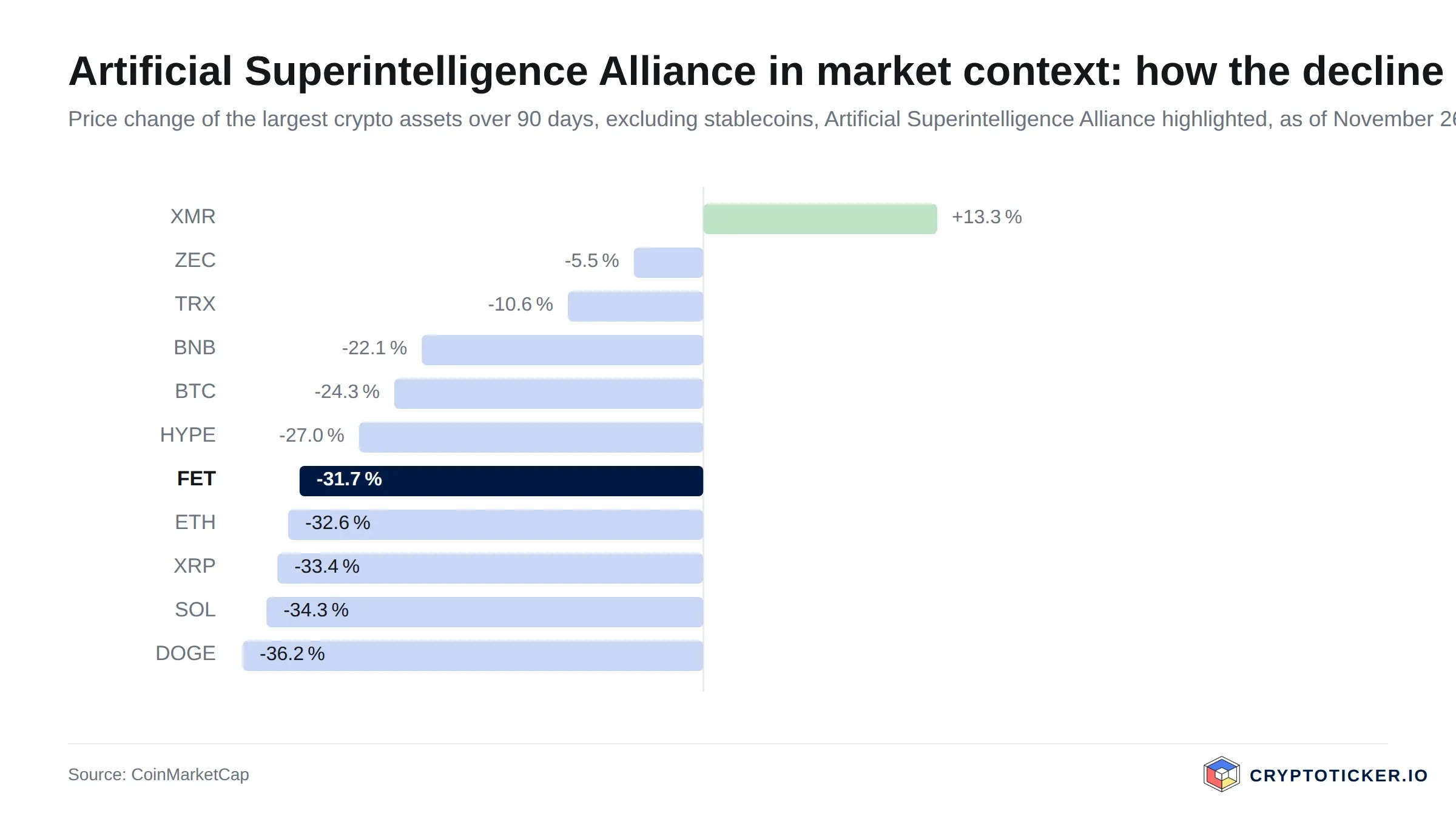
Artificial Superintelligence Alliance compared with the other large crypto assets over 90 days
Costs deserve a close look. Many broker apps add a spread to the price that can easily exceed one percent. On an exchange with an order book you usually pay considerably less. How Bitpanda performs on fees, range and security is covered in our Bitpanda reviews, and the Kraken reviews offer a comparison with an established order-book exchange.
On custody: if you plan to hold FET for longer, you can transfer the tokens to a wallet of your own. It is important to choose the correct network, because FET exists on several blockchains. Picking the wrong network can render a transfer unusable. Sending a small test amount before the actual transfer reduces that risk.
So is FET a good buy at current prices?
In the short term the chart argues against buying a full position. The price has just set a new 12-month low, all key averages are far above it, and sentiment across the market is at a low point. The oversold RSI makes a rebound more likely, but it would initially be no more than a recovery within the downtrend. A daily close above 0.127 US dollars would be the scenario for stabilisation. A weekly close below 0.10 US dollars, by contrast, would point to a further leg lower.
In the long term the answer depends on whether the alliance can turn its AI infrastructure into real usage. The supply side is largely exhausted and the discount to the 12-month high is large. Investors who believe in the theme may consider building a position gradually over several weeks rather than buying everything at once. That assumption would be refuted if FET fails to climb back above the 200-day average at 0.178 US dollars even after the wider market recovers. Possible price targets and scenarios are set out in our FET price prediction.
Buying FET: Your next three steps
- Set a loss limit before you buy, for example a weekly close below 0.10 US dollars, and weigh the scenarios in our Artificial Superintelligence Alliance price prediction.
- Buy through a provider with an EU licence; our comparison of regulated exchanges shows which platforms qualify.
- Compare FET with another token from the field of AI and computing power: our analysis Is Render a good buy at current prices? looks at where Render stands.
Disclosure: Some of the providers mentioned in this article work with us through affiliate programmes. This has no influence on the price analysis or the assessment of the chart picture; the price data comes from a public market data source and can be verified there.
(As of: 26 November 2026. This article is not investment advice. Prices, fees and conditions change; check them with the provider before every purchase. Crypto-assets are subject to high price volatility, and a total loss is possible.)