What Is ContraCop Protocol? Everything You Should Know in 2026 ContraCop Protocol is a new crypto project built around that exact question. The platform checks wallets, tokens, and smart cont
What Is ContraCop Protocol? Everything You Should Know in 2026
ContraCop Protocol is a new crypto project built around that exact question. The platform checks wallets, tokens, and smart contracts, then turns confusing blockchain data into simple risk scores.
Its CCP token is in a crypto presale right now. That is why the name keeps showing up in crypto news feeds and search results. This review covers the product, the token, the published numbers, and the biggest gaps as of October 2026.
What Is ContraCop Protocol and Why Does It Matter?
ContraCop is a Web3 security platform that runs on AI. Its July 2026 whitepaper says the goal is to help developers, investors, and teams spot risk faster.
A user adds a token address, code repository, or wallet. The system then returns findings, severity levels, and next steps. Its main target is the rug pull, a scam where developers take the money from a project and disappear.
The pitch is practical, not flashy. The project even admits in its own papers that the tool cannot remove risk or replace a proper human review.
Which Features Does ContraCop Protocol Offer?
The project lists eight planned tools:
An AI code scanner that checks Solidity, Vyper, and possibly Solana program code for risky logic.
A bug finder that flags weak access controls and unsafe outside calls.
A rug pull checker that studies minting rights, blacklist functions, contract ownership, and how the deployer has behaved in the past.
A dashboard that tracks large holders and liquidity moves.
Wallet scoring.
Live monitoring.
Paid audit reports.
An API for businesses.
Every one of these is a plan. Public sale crypto listings show similar tools, but no document says which ones are live today.
How Does ContraCop Protocol Work Behind the Scenes?
The technical annex describes a group of small AI agents, each with one job:
Wallet Guard watches money moving in and out.
Liquidity Sentinel tracks pool size and sudden withdrawals.
Token risk checks mint and blacklist powers.
Deployer Watch follows the people who created the contract.
A central system then combines these signals into one score from 0 to 100. The score falls into one of four levels: low, guarded, high, or critical.
One design choice stands out. Each finding is meant to show its data source, timing, and confidence level. If the agents disagree, the case goes to a human reviewer instead of getting a forced answer. The annex calls this a proposed design, so it remains unproven.
CCP is called a utility token. It is meant for using the product, not for owning company shares or earning income. The project lists these uses:
Paying for premium audits
Buying live monitoring time
Using advanced scanners
Getting business API access
It also mentions rewards for security researchers, possible staking tiers, and voting rights, all only where the law allows. A burn plan may destroy part of the CCP spent on audits and API access once it is announced.
This means demand depends on real customers who need the product. Value tied to real use is easier to understand than value tied to hype. Still, one question remains: who will pay for scans when free tools already exist?
What Does the ContraCop Protocol Tokenomics Model Show?
Total supply is 1,000,000,000 CCP. The official paper gives a price range of USD 0.0071 to USD 0.0128 and names USDT and USDC as payment options. Sale listings mention SOL and ETH payments and a $2,000,000 hard cap.
Allocation
Share
Tokens
Purpose
Public Presale
40%
400,000,000
Community sale
Liquidity Pool
25%
250,000,000
Market liquidity after launch
Ecosystem and Staking
15%
150,000,000
Incentives and researcher programs
Team and Advisors
10%
100,000,000
Long-term contributors
Marketing and Development
10%
100,000,000
Growth, tools, operations
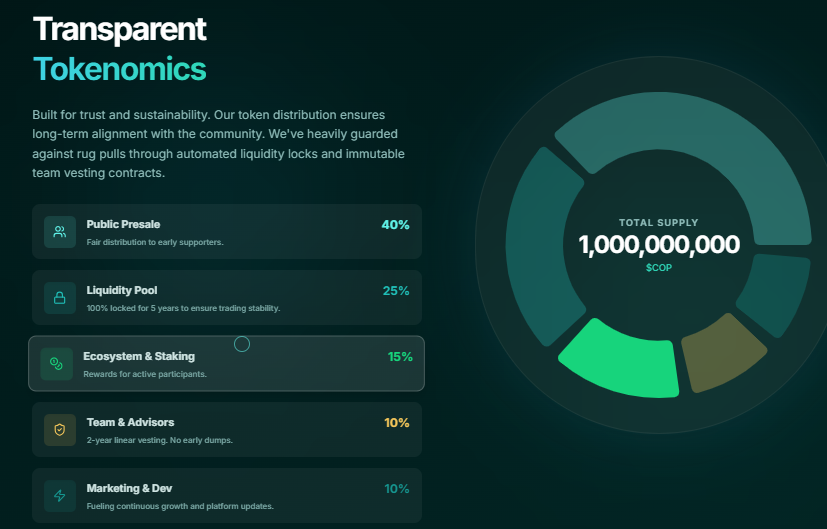
At the starting price, the fully diluted valuation (FDV, the value if every token were already in circulation) comes to about $7.1 million.
FDV is not market cap, and neither one is a live crypto price on an exchange. The presale price is only what the project charges during the sale.
Two points need checking. The official paper lists 800,000,000 tokens for sale, but the presale share shows 400,000,000. Vesting for team and advisor tokens is also marked “recommended,” which is not the same as locked.
What Is the ContraCop Protocol Roadmap?
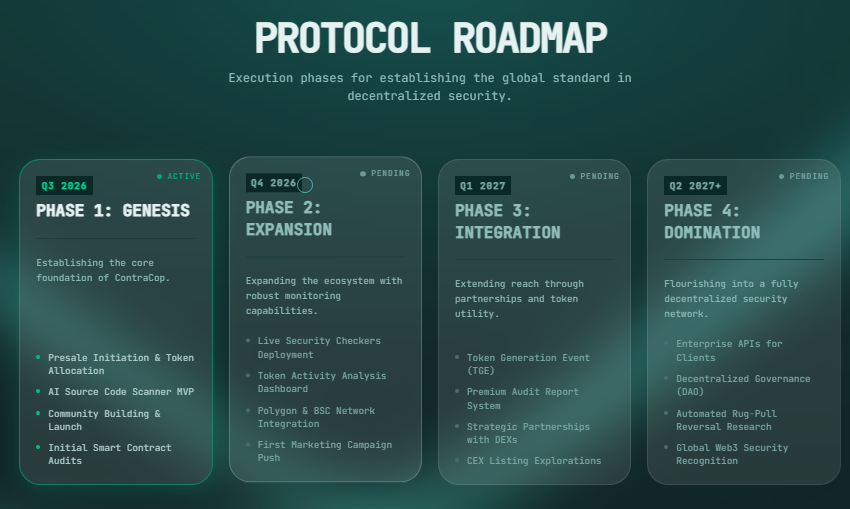
The roadmap has four phases, and the dates are not guaranteed.
Q3 2026, Genesis: presale start, token allocation, a first AI scanner, community building, and early contract audits.
Q4 2026, Expansion: live security checks, a token activity dashboard, Polygon and BSC support, and a first marketing push.
Q1 2027, Integration: the token launch if final reviews pass, paid audit reports, DEX partnerships, and early crypto listing talks that are not guaranteed.
Q2 2027 and later, Ecosystem Expansion: business APIs, DAO planning, and research into rug-pull reversal.
Sale listings also show a Telegram security bot in Q4 2026.
What Are the Main Risks and Challenges?
The first concern is missing detail. The official paper still has blanks for the blockchain, token standard, audit provider, and supported chains. It also does not name any team members. A security platform that asks for trust should show its own track record.
AI accuracy comes next. False alarms could scare people away from safe tokens, and missed threats could cost real money. Adoption is another risk, since developers already have audit firms and free tools. Liquidity also matters, because exchange listings are only described as exploratory.
No crypto airdrop has been announced in the published documents. Anyone who sees an airdrop claim linked to the name should check it on official channels first.
What Does the Data Say About ContraCop Protocol?
The strongest signals are the clear problem statement and the honest risk table. The main worry is delivery. Nothing in the published papers confirms a working product, a finished audit, or locked liquidity.
The biggest unknown is whether paying customers will show up. On current evidence, this is a watch-list name, not a proven product. Readers should check the contract address, vesting terms, and product status on their own.
Final Thoughts: Is ContraCop Protocol Worth Watching?
ContraCop Protocol goes after a real problem with a sensible idea. Its papers are also more careful than most presale material.
However, missing technical details, an unconfirmed audit, and an early product stage keep the picture uncertain. It deserves attention as an early crypto project. Launch progress, audits, and vesting terms are the next things to check.
Disclaimer
This article is for information only and is not financial, legal, or tax advice. Crypto presales and tokens carry high risk, and the full amount invested can be lost. Readers should do their own research and consult a qualified advisor before making any decision.