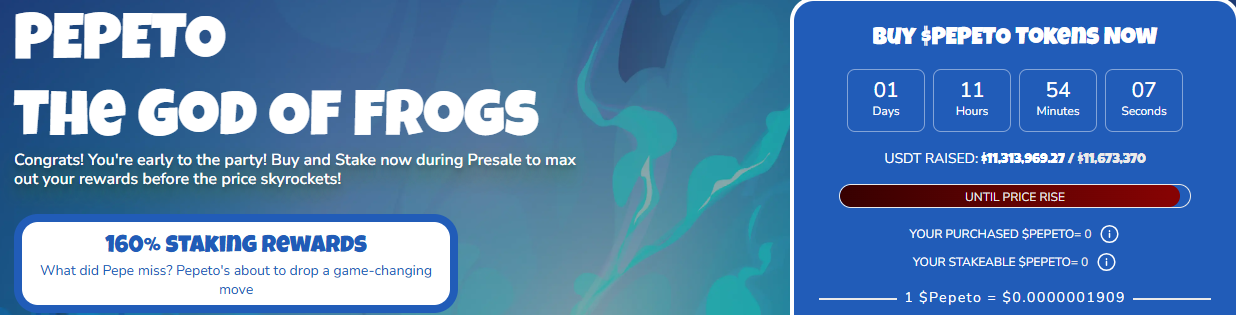
Dashboard Reading Shows the Sale Figure Nearly Filled The latest dashboard reading, as of 9:48 PM IST on 26 November 2026, shows $11,313,969.27 raised against $11,673,370, about 96.9%, with a
The latest dashboard reading, as of 9:48 PM IST on 26 November 2026, shows $11,313,969.27 raised against $11,673,370, about 96.9%, with a counter at 01d 11h 54m 07s and a rate of $0.0000001909.
About $359,401 remains before that figure. The reading is a snapshot, so later figures will differ.
Source: Official Dashboard
This Pepeto price prediction starts from what the dashboard states. Two points frame it:
Gap: the Pepeto presale end date is not stated, and the counter marks a step, not a close.
Method: each possible last-stage level becomes the anchor for the first trading band.
Pepeto presale end date: what the dashboard states and omits
The dashboard gives the raised amount, a counter and a rate, but no closing day. The table pairs those figures with the whitepaper allocation.
Item
Figure
Source
USDT raised
$11,313,969.27
Dashboard
Figure beside the counter
$11,673,370
Dashboard
Presale allocation
126T tokens (30% of 420T)
Whitepaper
Allocation at today's rate
about $24.05M
Calculated
Closing day
Not shown
Dashboard
At today's rate, the full allocation would carry more than twice the USDT raised. Earlier rates are unknown, so the table cannot show how much of the allocation remains, and the Pepeto presale end date stays open.
Stage Matrix: How Later Increases Move the Anchor
Each further round lifts the cost for the final buyers. Increases per stage are not published, so the matrix tests 1%, 3% and 5% across 2, 5 and 10 stages. A longer Pepeto presale end date implies more stages.
Increase
2 stages
5 stages
10 stages
1%
$0.000000195
$0.000000201
$0.000000211
3%
$0.000000203
$0.000000221
$0.000000257
5%
$0.000000210
$0.000000244
$0.000000311
Price prediction: the opening zone against the last stage
Buyers from the last stage hold the highest cost, so the first trade tends to cluster just under their level. Each zone runs from 15% below the final level up to it, an editorial assumption.
Early close: final level $0.0000001909, zone $0.000000162 to $0.0000001909.
Mid case (3% increases, 5 stages): final price $0.000000221, zone $0.000000188 to $0.000000221.
Long case (5% increases, 10 stages): final rate $0.000000311, zone $0.000000264 to $0.000000311.
The central estimate is $0.000000162 to $0.000000221, because the Pepeto presale end date could bring further rounds, yet no schedule is public.
In the long case the final buyers would sit 62.9% above today's rate, so a first trade near them would need demand beyond the sale total. A Pepeto listing before the next increase would keep the zone at the early-close row.
The central estimate spans about 36% from low to high, a width that reflects the missing schedule rather than precision.
In the long case the final buyers would sit 62.9% above today's rate, so a first trade near them would need demand beyond the sale total. A Pepeto listing before the next increase would keep the zone at the early-close row.
What Would Change the Estimate
Earlier rates: lower earlier rates mean more coins sold per dollar raised.
Schedule: published increases replace the matrix assumptions.
Closing terms: a stated stop shows how unsold coins are treated.
Venue: first trading depth depends on which exchange opens.
Next reading: a later counter reading shows whether the sale figure has moved.
Bottom Line: The Final Level Sets the First Anchor
Until the Pepeto presale end date is stated, the final price is the open variable: each added round lifts the zone, while an early close keeps it near $0.0000001909.
Three signals would narrow it: a published stop day, the increases ahead and a named exchange. Each zone is an editorial estimate, not a promise, and no traded level exists to test it.
Disclaimer:This article is for informational and educational purposes only and should not be taken as financial or investment advice. Crypto markets are volatile, and details such as roles, plans, or figures mentioned here can change over time. Readers should do their own research before making any decisions based on this content.
