Japan 30 Year Bond Yield: Why Is Bitcoin Suddenly in Focus? Here's Japan news today that actually starts in the world of bonds, not blockchain, but the ripple effects reach markets everywhere
Japan 30 Year Bond Yield: Why Is Bitcoin Suddenly in Focus?
Here's Japan news today that actually starts in the world of bonds, not blockchain, but the ripple effects reach markets everywhere, including crypto.
Japan's longest-term government bond, the one that pays back investors 30 years from now, just hit its highest interest rate ever recorded, 4.235%.
If you've never followed bond markets closely, don't worry, this breaks down exactly what happened, why it's happening, and why it could actually matter for the price of Bitcoin and other assets you might care about.
What Actually Happened, In Plain Terms
Think of a government bond like a loan you give to a country. You hand over money today, and the government promises to pay it back later, plus interest. The "yield" is simply that interest rate.
On October 5, the rate on Japan's 30-year bond climbed to 4.235%, the highest it's ever been since Japan first started selling these 30-year bonds back in 1999.
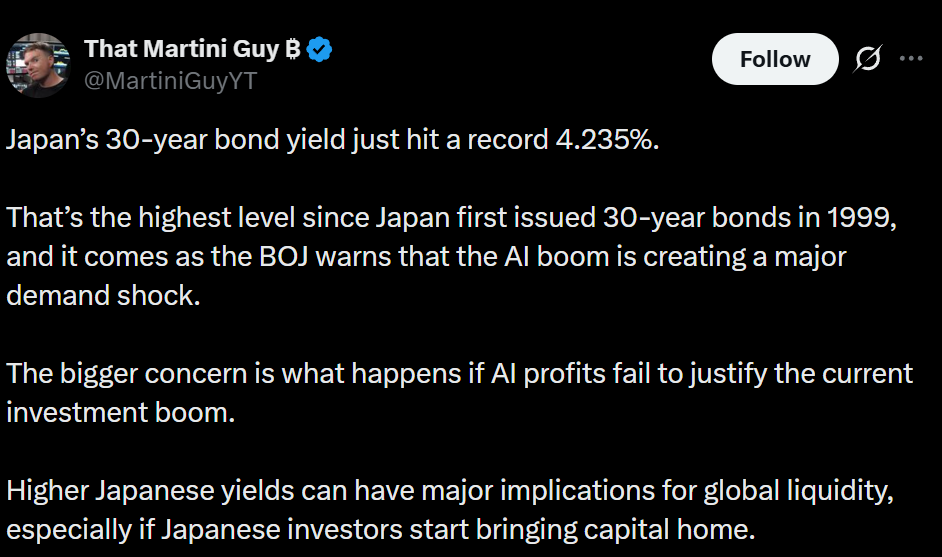
Source: X Post
In other words, Japan now has to pay more than 4% just to borrow money for three decades, something that would have sounded unthinkable a few years ago when Japan was famous for having interest rates near zero.
Why Japan's Central Bank Is Actually Worried
This is where it gets interesting. The Bank of Japan's own Deputy Governor, Shinichi Uchida, directly addressed this situation in an official speech published by the Bank of Japan.
He described the AI boom as "a big positive demand shock," meaning AI investment is genuinely boosting economic activity and pushing prices up.
But he also flagged a real risk sitting right behind that optimism, saying plainly, "There is a risk of correction if profits do not follow."
In simple terms, the Bank of Japan is watching closely to see whether all this AI spending actually pays off or whether it's a bubble waiting to pop.
The AI Connection That's Pushing Yields Higher
Here's the mechanism behind the rising Japan 30 year bond yield that connects directly to the AI industry.
AI companies around the world have been borrowing huge amounts of money, issuing bonds, to fund the enormous cost of building data centers and AI infrastructure.
Uchida's speech explicitly listed this as one of four key ways AI is affecting monetary policy, noting that "large-volume bond issuances by AI-related companies have been putting upward pressure on long-term interest rates."
A few reasons this matters:
More bonds being sold overall means more competition for investor money, which pushes interest rates up across the board
Japan's 30-year bond, being extra long-dated, is especially sensitive to this kind of pressure
Japan's own government spending plans have added to the mix, with ministries requesting a record ¥143.1 trillion budget for next year
Why the "Super-Long" End of the Curve Is Telling a Story
Something notable happened alongside this record: shorter-term Japanese bonds, like the 2-year, actually eased slightly even as the 30-year hit its record. That split matters.
When only the very long-term rates spike while shorter ones stay calm, it usually means investors aren't worried about next month, they're worried about the next few decades.
They're demanding extra compensation to lend money for that long, specifically because things like heavy government borrowing and AI-driven uncertainty make the distant future feel less predictable right now.
Why This Could Actually Matter for Bitcoin and Global Markets
This is the part that connects a Japanese bond auction to your crypto portfolio.
For years, Japan kept interest rates near zero, which made it cheap for Japanese investors to borrow yen and put that money into higher-returning assets elsewhere around the world, including stocks, gold, and crypto.
A few things worth watching now:
A 30-year Japanese bond paying over 4% genuinely changes the math for conservative Japanese investors like insurers and pension funds, who may no longer need to look abroad to hit their return targets
If Japanese capital starts flowing back home to capture these higher domestic yields, that could pull liquidity away from global risk assets
Rising yields worldwide have generally coincided with periods of tighter financial conditions, which can weigh on more speculative assets
Conclusion
Japan's bond market just broke a record that stood for over a quarter century, and the reasons behind it reach well beyond Japan's own borders.
With the Bank of Japan's own deputy governor directly connecting rising rates to AI-driven borrowing and openly questioning whether AI profits will actually justify this investment boom, the Japan 30-year bond yield has become a genuine barometer worth watching, not just for bond traders, but for anyone paying attention to where global liquidity might head next.
Disclaimer
This article is for educational and informational purposes only and should not be considered financial or investment advice. Always conduct your own research before making investment decisions.