Japan’s crypto cybersecurity coordination effort is taking a step toward more structured cross-border incident response. JPCrypto-ISAC, a Japanese industry group focused on sharing and analyz
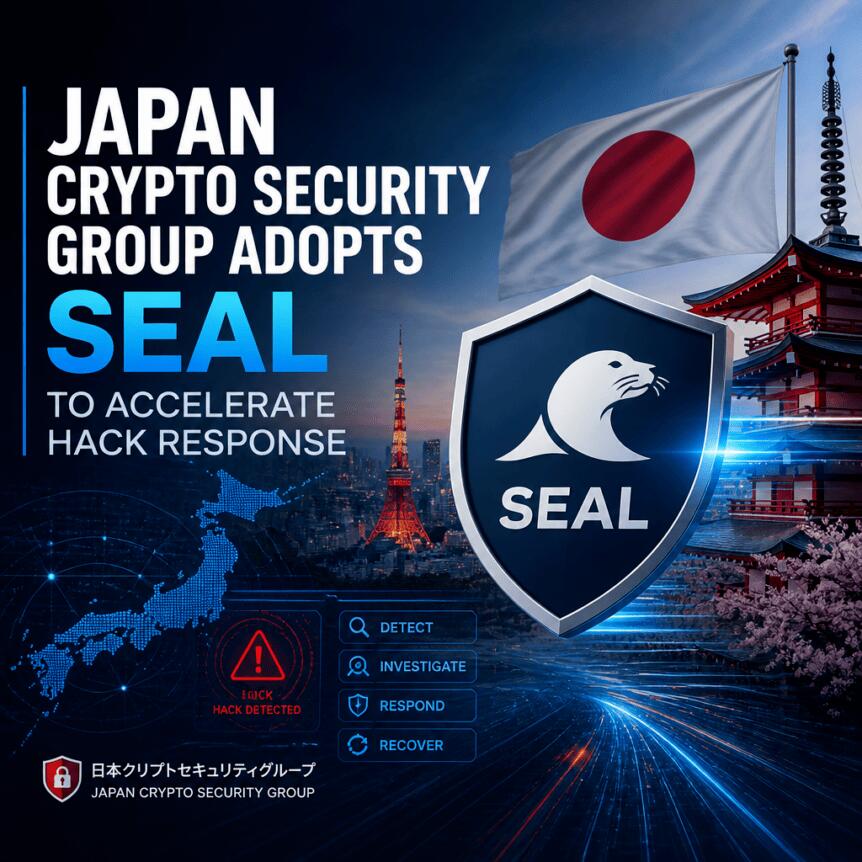
Japan’s crypto cybersecurity coordination effort is taking a step toward more structured cross-border incident response. JPCrypto-ISAC, a Japanese industry group focused on sharing and analyzing cyber threat intelligence, has signed a memorandum of understanding (MOU) with US nonprofit Security Alliance (SEAL) to enhance how member organizations detect attacks and handle security incidents.
In a statement released Friday, the organizations said the partnership will support the development of an incident response framework for JPCrypto-ISAC and provide access to SEAL’s incident response and support capabilities. The MOU also calls for sharing cyber threat intelligence—an element JPCrypto-ISAC emphasizes as especially important for Web3, where attackers and infrastructure often operate across jurisdictions.
Key takeaways
- JPCrypto-ISAC’s new MOU with SEAL aims to strengthen detection and incident response for Japan’s crypto industry.
- The agreement includes access to SEAL’s incident response and support capabilities, alongside shared cyber threat intelligence.
- The move reflects rising urgency after multiple security incidents affecting Japanese crypto firms and their service providers.
- SEAL’s involvement is positioned as a way to build more coordinated response processes rather than relying on ad hoc handling.
Cyber incidents in digital assets can quickly escalate from a localized disruption into a broader operational and reputational problem—especially when attackers target shared infrastructure, third-party vendors, or workflows that are common across multiple organizations. JPCrypto-ISAC’s statement frames the SEAL partnership as an effort to address cyber threats that “transcend national borders,” a reality the Web3 sector has repeatedly confronted.
Under the MOU, SEAL will help JPCrypto-ISAC develop an incident response support framework, intended to improve how participating Japanese firms respond when something goes wrong. The organizations also plan to share cyber threat intelligence, which is meant to support earlier detection and better decision-making during active attacks—where speed and coordinated communication can affect the difference between containment and deeper damage.
JPCrypto-ISAC representative director Naoji Noda said the group is “delighted” to establish the partnership through the MOU, underscoring that the collaboration is meant to translate shared information into practical response capabilities.
Who is in JPCrypto-ISAC and what the group does
JPCrypto-ISAC launched in 2025 with 16 full members, including SBI VC Trade, bitbank, GMO Coin, and Rakuten Wallet. The organization’s role is to help Japanese crypto companies share and analyze cyber threat intelligence—work that can reduce time-to-awareness when threats emerge and help participants recognize patterns across environments.
The new agreement with SEAL suggests that the group is moving beyond information-sharing alone toward building an operational layer: a more repeatable method for incident response support and guidance. For market participants, this can be meaningful because it standardizes how organizations prepare for, react to, and learn from incidents—particularly when threats evolve rapidly and technical details may differ across member companies.
Recent security incidents highlight the stakes
The JPCrypto-ISAC and SEAL announcement lands amid a broader backdrop of cyber incidents impacting Japanese crypto firms and their ecosystems.
Earlier this month, Japanese crypto exchanges Zaif and CoinTrade disclosed that a breach involving their email provider, Arara, exposed hundreds of thousands of customer email addresses. According to the disclosure, Arara estimated the breach may have affected up to 380 companies across its customer base. While email exposure is not the same as theft of digital assets, it can increase downstream risk, including phishing attempts and account-targeting scams that often follow data leaks.
The industry has also seen more severe attacks. In May 2024, hackers stole Bitcoin worth about $305 million at the time from crypto exchange DMM Bitcoin. US and Japanese authorities later attributed the theft to North Korean hackers, according to coverage that reported on the attribution, linking the incident to state-aligned activity.
Together, these events show a pattern that cybersecurity groups increasingly have to plan for: threats can range from third-party data exposure to large-scale crypto asset theft, and the response requirements vary widely depending on what systems were compromised and what information or funds were at risk.
Cross-border cooperation: what to watch next
The JPCrypto-ISAC–SEAL partnership does not instantly change the security posture of every member organization overnight, but it points to how Japan’s crypto industry may tighten its preparedness. A key variable for investors and operators will be how quickly JPCrypto-ISAC can translate the MOU into actionable processes—particularly the incident response support framework it plans to develop with SEAL’s help.
For the market, better incident coordination can also reduce uncertainty during crises. When threat intelligence is shared and response guidance is standardized, member firms may communicate more consistently with partners and regulators, and internal decisions may be made faster when incidents occur. At the same time, readers should keep an eye on whether the partnership leads to measurable improvements—such as clearer guidance to members, more robust intelligence sharing routines, and updated playbooks for handling incidents tied to third parties.
As cyber threats continue to move across borders and through shared service providers, the practical impact of the JPCrypto-ISAC and SEAL MOU will likely depend on execution—what the framework looks like in practice, how intelligence sharing is operationalized, and how quickly member organizations can adopt the response capabilities being developed.
This article was originally published as Japan Crypto Security Group Adopts SEAL to Accelerate Hack Response on Crypto Breaking News – your trusted source for crypto news, Bitcoin news, and blockchain updates.