Japan’s government, the Financial Services Agency and the Bank of Japan are forming a study group to design blockchain infrastructure for near-instant settlement of stocks and government bond
- Japan’s government, the Financial Services Agency and the Bank of Japan are forming a study group to design blockchain infrastructure for near-instant settlement of stocks and government bonds, with a development plan targeted for early 2027.
- Stock trades in Japan currently settle two business days after execution, and government bond trades settle one day after. The goal is settlement in real time.
- MUFG launched a live proof of concept for round-the-clock, blockchain-based settlement of government bond repo trades on August 13, 13 days before this report, under a regulatory sandbox that has been running since February.
Japan’s government, its top financial regulator and the Bank of Japan are moving to build blockchain infrastructure that would let stock and government bond trades settle almost instantly, instead of the one to two business days it currently takes.
The Financial Services Agency, the Ministry of Finance and the central bank are said to be forming a joint study group this summer, tasked with producing a development plan by early 2027 covering the blockchain’s design and how responsibilities split across agencies and banks. Full deployment is not expected until the early 2030s.
The real bottleneck isn’t the study group
That timeline undersells how far along parts of this already are. The Bank of Japan has been technically testing blockchain-based settlement of its own current-account deposits since at least March, when Governor Kazuo Ueda told a fintech conference the central bank was verifying whether central-bank money could be issued as blockchain tokens interoperable with existing systems.
The Financial Services Agency has also run a “Payment Innovation Project” sandbox since February, letting banks pilot tokenized settlement under regulatory supervision.
Banks are already testing this
On August 13, MUFG and its banking, trust and securities units launched a proof of concept with Digital Asset, Progmat and Secured Finance AG to settle government bond repo trades in real time on the Canton Network, a blockchain built for regulated financial institutions.
MUFG’s own release shows how a trade would move through Japan’s bond registry, the participating banks and the blockchain layer at once, rather than waiting a day or more to clear. The bank is targeting pilot completion by the end of this year and a commercial version between fiscal 2027 and 2029, roughly the same window the new study group is aiming to finish its own development plan.
Japan’s banks are already piloting live 24/7 bond settlement years before the government’s own currency layer needed to make it final exists.
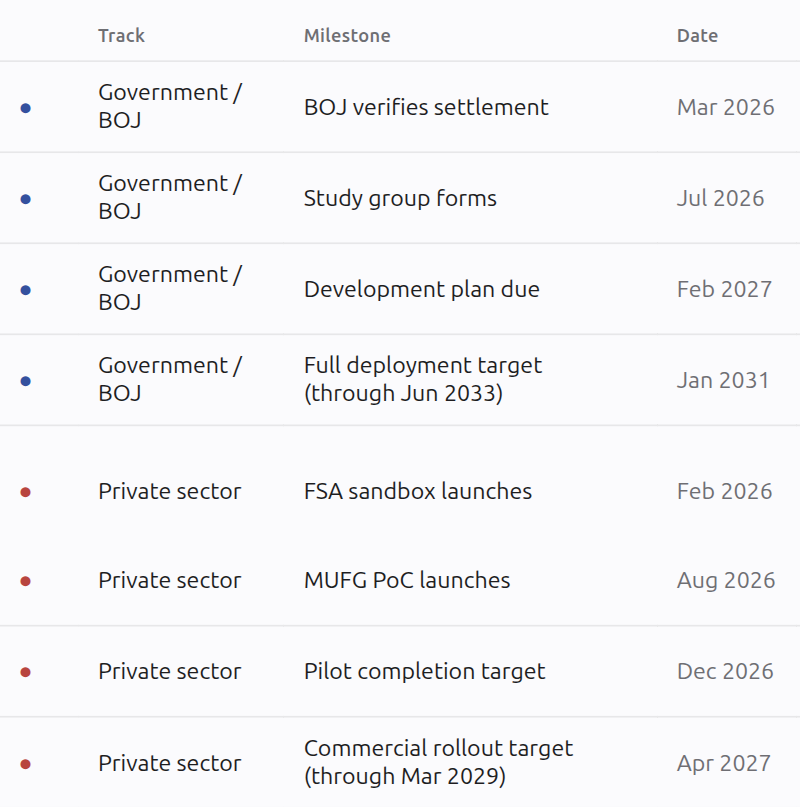 Japan’s blockchain settlement roadmap
What the study group is actually chartered to build sits underneath all of that: a working, tokenized version of real central-bank money that trades like MUFG’s could ultimately settle against with legal finality, instead of just simulating instant settlement on a test network.
That is why the government and BOJ track runs so much slower than the private pilots it is meant to eventually support.
Japan is also part of the Bank for International Settlements’ Project Agorá, one of seven central banks, alongside the Eurosystem, the Bank of England and the Federal Reserve Bank of New York, testing whether tokenized central-bank money can speed up cross-border payments too.
Officials are said to see a working domestic system as leverage for that broader effort, amid concern that the United States and Europe are moving faster on tokenized-securities infrastructure.
Whether that foundational piece arrives on schedule is the thing worth watching. If it slips much past the early 2030s target, banks like MUFG could end up with commercially ready settlement pilots and nowhere yet to plug them in for real, final settlement.