Japan has taken one of its most significant steps toward mainstream crypto adoption in years.
Japan has taken one of its most significant steps toward mainstream crypto adoption in years.
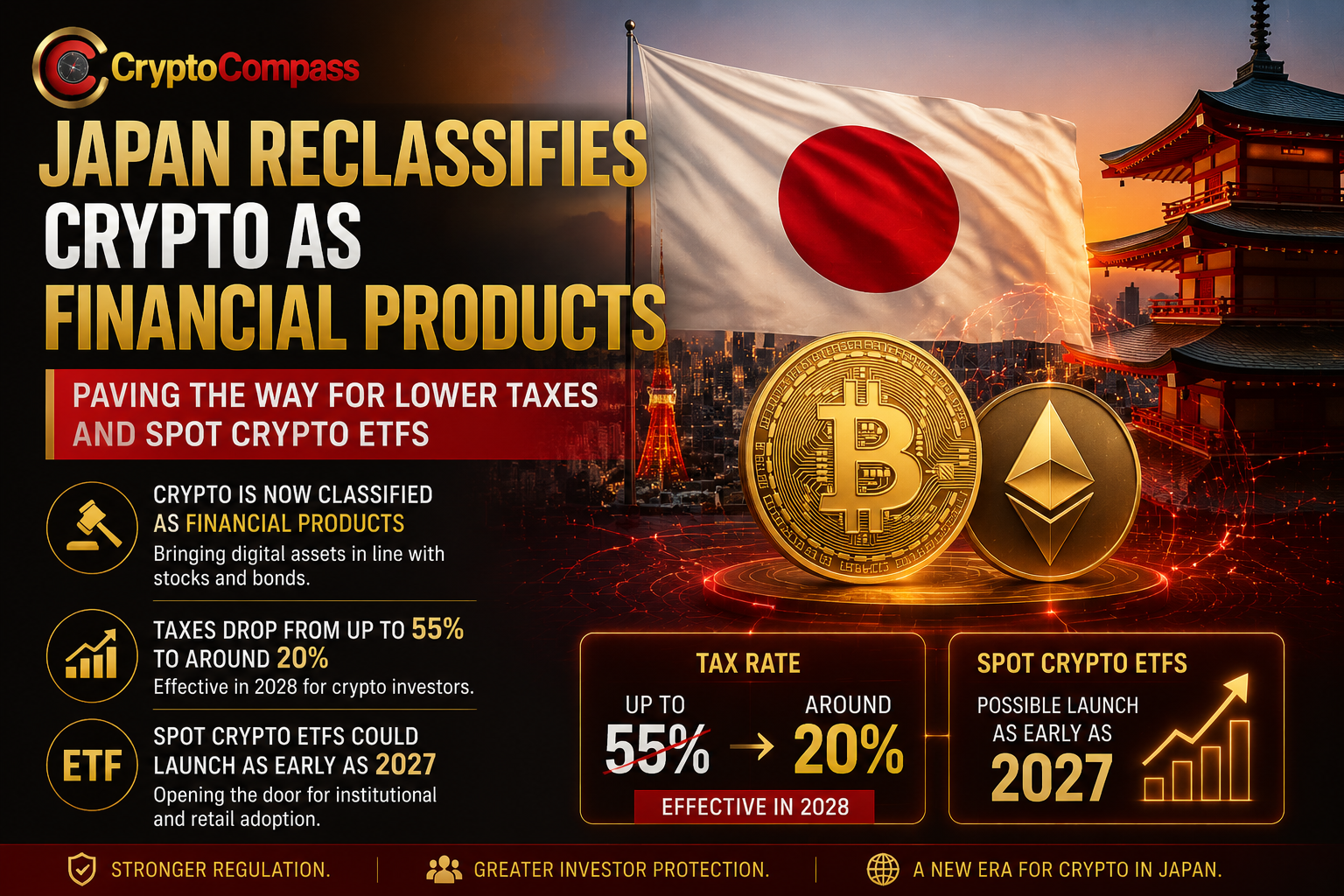
The Japanese parliament has approved landmark legislation that will officially reclassify cryptocurrencies as financial products, placing digital assets under a regulatory framework much closer to stocks, bonds, and other traditional investment instruments.
While the law will take several years to be fully implemented, its long-term implications could reshape Japan's digital asset market, encourage institutional participation, and strengthen the country's position as one of the world's most crypto-friendly economies.
A Fundamental Regulatory Shift
For years, cryptocurrencies in Japan have existed in a unique legal category.
Although Bitcoin has been recognized as a legal means of payment since 2017, crypto assets were largely regulated as payment instruments rather than investment products.
The new legislation fundamentally changes that approach.
Instead of treating cryptocurrencies primarily as payment assets, Japan will regulate them as financial products, bringing them under a framework similar to securities and investment products.
This provides significantly greater legal clarity for:
Institutional investors
Asset managers
Banks
Brokerage firms
Pension funds
ETF issuers
Clearer regulation has long been considered one of the biggest prerequisites for broader institutional adoption.
Crypto Tax Could Drop From 55% to Around 20%
Perhaps the most celebrated part of the reform is taxation.
Currently, crypto profits in Japan are taxed as miscellaneous income.
Depending on an investor's total annual earnings, tax rates can reach 55%, among the highest in the developed world.
Under the new framework, beginning in 2028, crypto gains are expected to receive the same treatment as stock investments.
That would reduce taxation to approximately 20%, aligning crypto with traditional financial assets.
For Japanese investors, this is a dramatic improvement.
Lower taxation increases after-tax returns, encourages long-term investing, and reduces incentives for capital to move offshore.
Spot Crypto ETFs Move Closer
The legislation also creates a regulatory pathway for domestic spot cryptocurrency ETFs.
Japan has historically taken a cautious stance toward crypto investment products despite being an early Bitcoin adopter.
The new financial product classification could allow regulators to approve:
Market observers believe the first domestic spot crypto ETFs could launch as early as 2027, depending on regulatory implementation.
If approved, Japan would join a growing list of major economies embracing regulated crypto investment vehicles.
Why This Matters Globally
Japan remains one of the world's largest financial markets.
Its regulatory decisions often influence policymakers across Asia.
Unlike many jurisdictions that continue debating whether crypto should be treated as a commodity, currency, or security, Japan is moving toward a comprehensive financial asset framework.
This provides businesses with greater certainty when developing products and services.
It also signals that governments are increasingly focusing on integrating digital assets into existing financial systems rather than restricting them.
Institutional Capital Could Follow
Regulatory clarity has consistently proven to be one of the strongest drivers of institutional adoption.
Lower taxes and clearer rules may encourage:
Banks to expand crypto services.
Brokerages to offer additional digital asset products.
Asset managers to launch new investment funds.
Pension funds to evaluate limited crypto exposure.
International firms to increase operations in Japan.
As the world's fourth-largest economy modernizes its crypto regulations, institutional participation could accelerate significantly.
Japan's Long Crypto History
Japan has often been ahead of other countries in crypto regulation.
It was among the first major economies to license crypto exchanges following the Mt. Gox collapse.
Rather than banning the industry, regulators focused on consumer protection, licensing requirements, and operational standards.
The latest legislation represents the next evolution of that strategy.
Instead of simply regulating exchanges, Japan is integrating digital assets into its broader financial system.
Competition for Global Crypto Leadership
The move comes as governments worldwide compete to attract blockchain innovation.
The United States continues developing market structure legislation.
Hong Kong has expanded licensing for digital asset firms.
The European Union has begun implementing MiCA.
South Korea is advancing institutional crypto reforms.
Japan's latest legislation reinforces Asia's role as one of the fastest-moving regions for crypto regulation.
What It Means for the Market
Although implementation will take time, markets often react well before new rules officially take effect.
Investors may increasingly view Japan as:
A favorable jurisdiction for digital asset businesses.
A future source of institutional capital.
An important market for crypto ETFs.
A long-term driver of RWA and tokenization adoption.
Lower taxes alone could significantly increase domestic participation, while ETF approval would provide another regulated channel for capital entering the digital asset market.
Outlook
Japan's decision is more than a tax reform.
It represents a structural shift in how one of the world's largest economies views digital assets.
By recognizing cryptocurrencies as financial products, reducing tax burdens, and opening the door for spot crypto ETFs, Japan is building a regulatory framework designed for long-term adoption rather than short-term speculation.
As governments around the world race to define the future of digital finance, Japan has positioned itself among the global leaders.
Key Takeaways
Japan will officially classify cryptocurrencies as financial products.
Crypto tax rates are expected to fall from as high as 55% to roughly 20% beginning in 2028.
The new framework creates a pathway for spot Bitcoin and Ethereum ETFs in Japan.
Regulatory clarity could unlock greater institutional participation.
Japan strengthens its position as one of the world's leading crypto-friendly financial markets.
Disclaimer: This article is for informational purposes only and does not constitute investment advice.